
This Old Motorcycle Is Quietly Becoming A Collector Icon
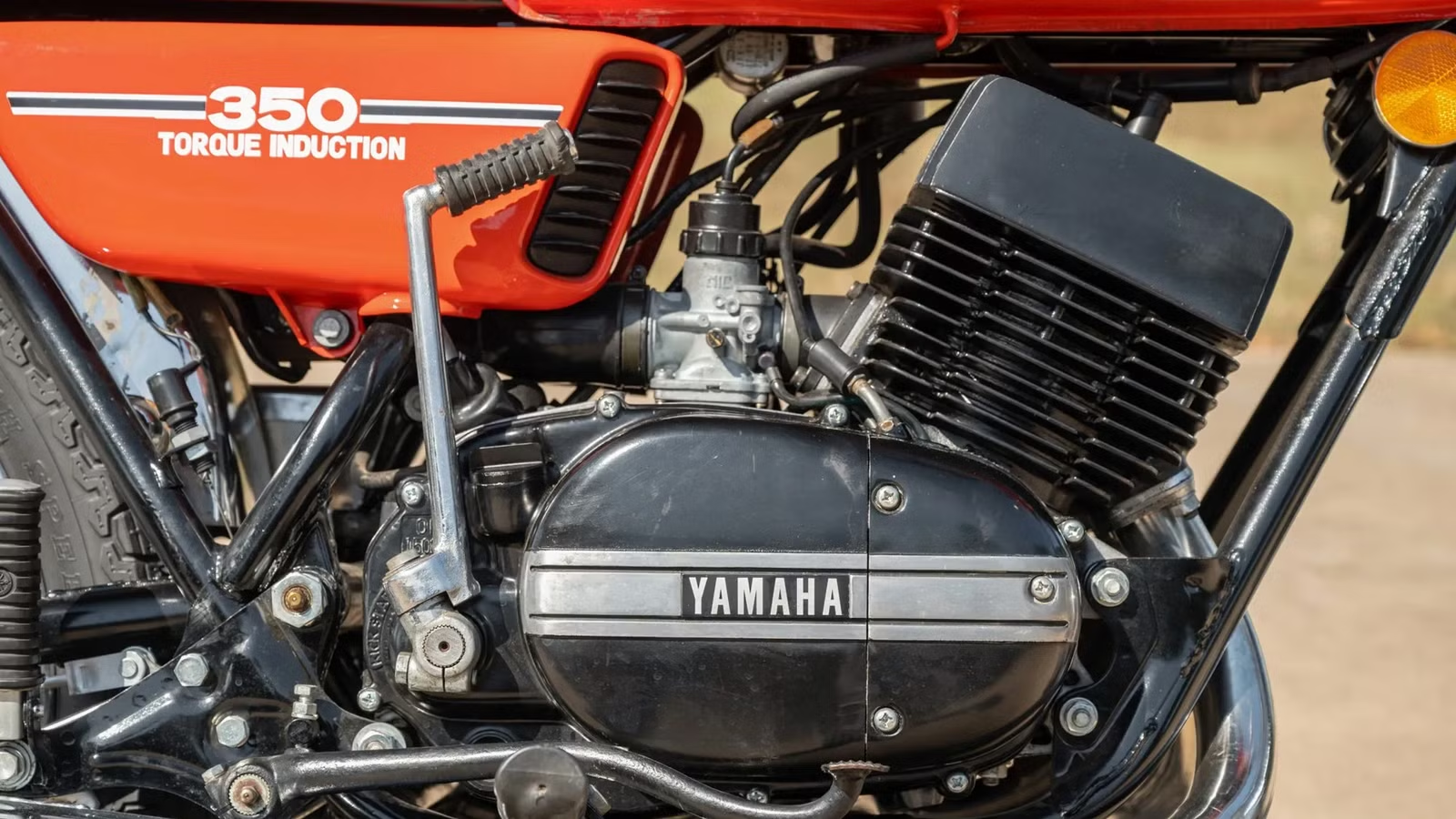
Spend any time around serious motorcycle collectors and one name keeps surfacing — not a current model, not even a modern classic motorcycle, but a two-stroke twin that first rolled out of Yamaha’s factory more than 50 years ago. In an era obsessed with ride-by-wire throttles, traction control, and ever-climbing horsepower figures, the 1973 Yamaha RD350 is quietly pulling in new fans, new money, and a level of reverence that most bikes never achieve in their own lifetime — let alone half a century later.
Vintage Bikes Can Look Modern, Even Today

Just because a bike is old doesn’t mean it can’t look new. The fundamental motorcycle formula — two wheels, a tank, handlebars, and a seat — only allows for so many variations, and when you consider that the 1990s were a golden age of motorcycle design, it’s no surprise that the same visual patterns keep reappearing.
Take the Honda NR750, for example. The bike was light years ahead of the competition at the time and, realistically, it still is today. Its full fairing, carbon fiber bodywork, and single-sided swingarm are all elements you could expect on a modern machine, let alone back in 1992. Honda struck again with the CB400SF. Produced in the same year, the naked bike’s timeless design has remained largely similar throughout its 34-year production run.

And who could forget the Ducati 916? The bike took the world by storm on its 1994 release and remains one of the most beautiful motorcycles ever created. The race-inspired aesthetic, under-seat exhaust, performance, and sophistication made it “the very essence of Ducati DNA,” according to Ducati themselves.

Particularly at a time when everything is increasingly digital, riders are looking back fondly at an era when things were more analog. Vintage and retro bikes deliver that feeling in armfuls.
Why Vintage Bikes Are Gaining Attention

Vintage bike sales have always largely been driven by nostalgia. People want the bikes they grew up with but couldn’t afford at the time, so when they get older and have a bit more money, they buy them. It’s like fashion, with a 20-to-30-year lag between initial popularity, the thing falling out of favor, and then a revival. We’re seeing it now with a rise in the prices of 1990s bikes like the Honda VFR750R RC30, Cagiva V593, and the Honda RC45.
The other side of that coin is the decline in interest in older bikes as the market ages out and there’s nobody left with the sentimentality to buy them. While that’s always going to be part of the cycle, it isn’t the case for every machine. Take, for example, the Yamaha RD350.
The Yamaha RD350 Is A 50-Year-Old Rising Star

|
Engine |
Power |
Top Speed |
Weight |
|
347 cc air-cooled two-stroke parallel twin |
39 bhp @ 7,500 rpm |
105 mph |
342 lbs wet |
Yamaha was on a purple patch in the early 1970s. They were winning on track in the lower series, dominating the 250 cc class, taking victories in the 350s, and finding success on the road with the FS1-E moped and R5 350 bike. Riding that momentum, Yamaha set its sights on the mid-size market — not just to compete with other 350s, but to take the fight to much bigger bikes as well. The result was the 1973 Yamaha RD350.
Essentially a road-legal race bike, the RD350 blended performance with an obsessive focus on lightness. The two-stroke engine was chosen in part because it has fewer moving parts than a four-stroke, meaning the heaviest component of the bike could be kept lighter. It also used reed valves, which are primarily found in two-stroke engines to control the air-fuel mixture entering the crankcase. In short, they provide torque induction that increases power without adding weight.
Then there was the chassis, which drew direct inspiration from the TZ series racing bikes — the same machines that had carried riders to the top of the 250 cc championship in 1972. The road-going RD350’s chassis was heavier than its racing counterpart, but it was still engineered with weight savings in mind. Other areas were targeted for the same reason, including the relatively compact fuel tank and simple bodywork, all part of Yamaha’s relentless war against weight.

It all added up to a bike with a compelling power-to-weight ratio, the whole package tipping the scales at just 342 pounds wet. That lightness allowed it to challenge bikes with far greater displacement, earning it a “giant killer” reputation — particularly on twisty roads where agility counted for more than outright power. The RD350 could keep pace with much more powerful machines like the Honda CB750 or Suzuki GT750 through the bends, and while the bigger bikes had the edge on top speed, the RD350’s 105 mph ceiling made it the first 350 cc motorcycle to break the 100 mph barrier — yet another feather in an already impressive cap.
Unsurprisingly, the bike reviewed incredibly well and sold in strong numbers, especially given its $839 price tag at launch in 1973. Prices did climb — reaching $1,071 by 1975 — but 1975 would also prove to be the RD350’s final year of production. After a relatively short run, Yamaha retired it in favor of the incoming RD400.
How The RD350 Compared To Its Rivals At The Time

To fully understand the Yamaha RD350’s impact, it helps to look at the competitive landscape of the early 1970s. The middleweight segment was crowded with both two-stroke and four-stroke options, but most 350 cc motorcycles of the era prioritized affordability and ease of use over outright performance.
Key rivals included the Honda CB350, which used a four-stroke parallel-twin producing around 34 horsepower, and Suzuki’s T350 Rebel, a two-stroke twin that made similar power figures to the RD but lacked its advanced induction system. Kawasaki’s S2 350 triple offered more cylinders and competitive performance, but came with added weight and complexity.
Where the RD350 set itself apart was in its balance of power, weight, and technology. Its reed valve induction system improved throttle response and broadened the usable powerband compared to piston-port two-strokes, while its low weight delivered a superior power-to-weight ratio versus most direct competitors. That combination allowed it to outperform many bikes in its class and stay competitive with larger-displacement machines in the right conditions.
The RD350 also benefited from design and engineering lessons taken directly from Yamaha’s racing programs, particularly the TZ series machines. This gave it a more performance-focused chassis setup than the commuter-oriented 350s it competed against.
At a time when larger bikes like the Honda CB750 were redefining top-end performance, the RD350 carved out a different niche — offering accessible speed and agility in a smaller, more affordable package. That positioning is a key reason it earned its “giant killer” reputation and stood out so clearly in a highly competitive market.
Why The RD350 Is Having A Resurgence

Bikes that are “firsts” never really go out of style. They might wax and wane in popularity, but being the first to achieve something gives a motorcycle an extra layer of significance that simply can’t be manufactured.
Being the first 350 cc bike to clear 100 mph is certainly part of its legacy, as is the race-bike-for-the-road attitude. But it’s the giant-killing reputation it built for itself that helped the RD350 break out of the nostalgia trap and find new audiences, new riders, and continued relevance. That’s what has kept it growing beyond its original fanbase.
Such is the RD350’s enduring popularity that, even decades after the bike’s demise, rumors have circulated about a possible return — partly fueled by Yamaha filing trademarks for the RZ350 name. Those rumors do appear to be largely fabricated, propagated by AI-voiced channels hoping to fool unsuspecting fans, but the fact that they gain any traction at all speaks volumes about a bike that only had a three-year production run more than half a century ago. Whether a revival ever materializes or not, the RD350 is still regarded as one of the best two-stroke motorcycles ever built.
The RD350’s Collector Future

The RD350 is already a sought-after collector’s item, commanding prices around $5,000 on average. Restored or restomodded examples can fetch considerably more, and with the number of bikes in genuinely good condition only shrinking over time, values are likely to keep climbing. A 1975 model with just a single mile on the clock sold for $12,050 in 2024, and another low-mileage 1975 example crossed the five-figure mark in 2025.
It’s a fitting legacy for a bike that proved you don’t have to be the biggest, the fastest, or the most powerful to be memorable. Nor do you have to rely on your original market aging into a position where they can finally afford one. If a bike is genuinely good, it finds its audience. If a bike is great, it grows that audience. The RD350 is still growing its, even 50 years after production ended. And that’s the mark of something truly special.
Sources: Iconic Motorbike Auctions, Classic.com, Hagerty, Rider Magazine, Ducati

Related posts


Latest Post


No Comments