
This Diesel Sports Car Outruns A Mustang But Was Forbidden In America
Diesels are dead, right? Once the cheap fuel of the future, popping up in everything from wild SUVs to sports cars, mainstream diesel disappeared as quickly as it arrived, with nothing left but a lingering puff of black smoke. But that’s not strictly true. While diesels were quickly replaced by hybrids and EVs as the fashionable powertrains of the day, they didn’t quite evaporate completely. In some parts of the world, people still like the long-legged range of a diesel, allowing you to stomp between big cities without ever coming into the vicinity of a gas station coffee. And they evolved into something quite special too.
Diesel Never Really Died Out

In the ’90s, diesels were on the rise. Having been seen up until this point as a fuel more commonly suited to trucks and agricultural machinery, advances in technology and turbocharging suddenly made oil burners legitimate everyday options. As consumers started to be drawn to the efficiency of diesel, manufacturers made them more and more capable, to the point where diesels had similar, if not better, performance than a lot of their gas-powered peers. By 2011, it was estimated that more than half of new cars in Europe ran on diesel. But then Dieselgate happened.
The International Council On Clean Transport found that some diesel vehicles emitted nitrogen oxides (NOx) at levels between 5 and 35 times higher than regulatory limits. Overnight, diesel cars seemed to go out of fashion, with no chance of coming back. But in Central Europe, where highways are often empty and at times without speed limits, diesel didn’t exactly disappear. Some consumers still called on the excellent range and great mpg of diesels, and manufacturers continued to develop them somewhat more out of the spotlight. What this meant was that diesels were still getting better and better, and faster and faster. It’s just that a lot of people didn’t notice it.
The BMW M440d xDrive Is Peak Diesel


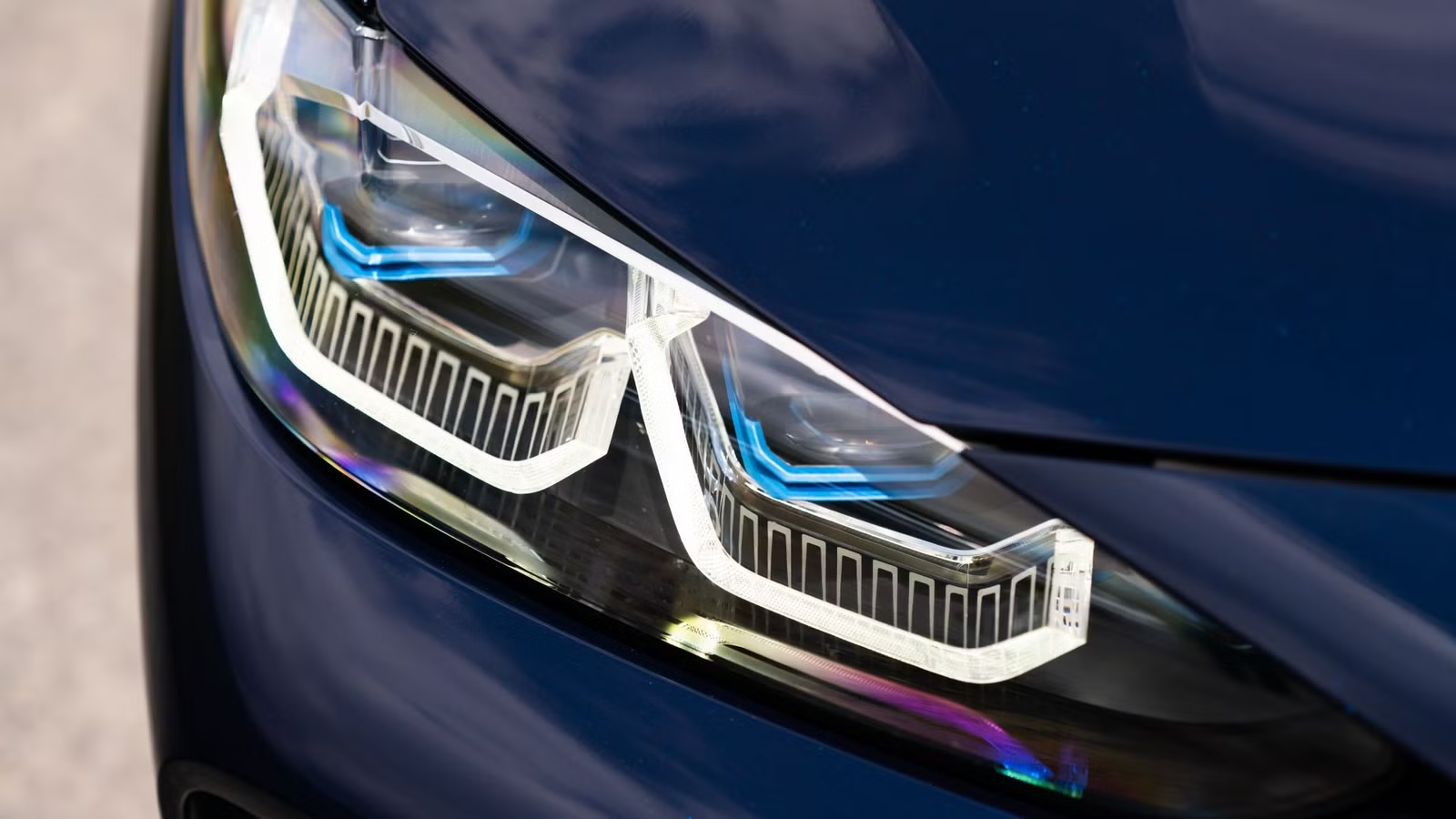
Diesels aren’t just about great efficiency and long legs. The modern turbocharged diesel engine is also a master of stump pulling torque, with a lazy wave of oomph that can make a four- or six-pot feel like an eight-cylinder. Some diesels in recent years have utilized four turbos — just like a Bugatti Veyron — to devastating effect. For this reason, diesel still has a place in sporting cars as well as Autobahn cruisers, and this brings us neatly to the BMW M440d xDrive. This is a car that definitely isn’t just designed for a boring commute, fitting into the 4 Series lineup of two-door 3 Series models, which makes sense. Amazingly, you can still buy one new in various parts of the world, with prices hovering around $100,000 and above.
But if the price is surprising, wait until you hear about the car itself. This is peak diesel, essentially where diesels would be in another dimension if Dieselgate hadn’t killed them off in other markets. It’s sleek, available as a coupe and convertible, full of tech, and, most importantly, very, very fast.
This Oil-Burning Beemer Has the Same Power as a Ten-Year-Old Porsche 911

How is that possible? But it’s true, this fairly innocuous-looking slippery mid-level diesel BMW has the kind of power that Porsche was giving its flagship gas-powered sports car not long ago. These days, the Porsche 911 comes with nearly 400 horsepower, but ten years ago in the (then) brand-new 911 (991) Carrera there was a 3.4-liter flat-six that developed 350 hp and 287 lb-ft of torque. The inline-6-cylinder diesel engine with M TwinPower fitted under the hood of a BMW M440d xDrive convertible has 340 hp. An integrated 48-volt mild-hybrid system produces an electric boost of 12 hp for better response. The new power unit’s high-pressure and low-pressure stages both feature variable turbine geometry.
The M in the car’s name relates to all the goodies you also get, including Adaptive M suspension that automatically reacts to road conditions and driving style, variable sport steering with Servotronic, an M sport differential for optimized traction, and an 8-speed Steptronic Sport transmission. The car is also helped off the line by the intelligent xDrive all-wheel-drive system. There is even a “Sprint” function built into the transmission — pulling the left lever back for at least a second engages the Sport accelerator response, engine note, and gearshift characteristics, while dropping into the lowest possible gear for maximum acceleration.
The M440d Gives A Mustang A Hard Time

How fast is the M440d? The official sprint to 62 mph is listed in some documents as low as 4.7 seconds, which would be a shade faster if measured over the more standardized American and British benchmark of 0 to 60 mph. That means it would be faster than a 2015 Ford Mustang 2.3-liter EcoBoost Automatic, which in one test reached 60 mph in 5.2 seconds, and on a par with a 2026 Mustang EcoBoost. The latest four-cylinder Ford Mustang logged a time of 4.5 seconds, although some sources claim the M440d can go as low as 4.2 seconds. What we can take from all this is, side by side, there really wouldn’t be much in it. A Mustang GT, incidentally, will reach 60 mph in 3.7 seconds, so it will have the edge on the diesel BMW.
The M440d xDrive Has Another Trick Up Its Sleeve

But the surprises don’t end there with the M440d. While Porsche 911 levels of power may sound impressive, they are nothing compared to the torque on offer in the small Bavarian coupe and convertible. The twist in one of these diesels is an eye-watering 516 lb-ft. That’s more than a Ferrari Enzo. It’s more than a McLaren F1. It’s more than three Mazda Miatas. To put it another way, the torquiest muscle car of the ’60s, the 1968 Dodge Charger R/T Hemi had 490 lb-ft from its 426-cubic-inch (7.0-liter) V8. The Buick GS 455 Stage 1 made more torque than any other muscle car of its era, and that had 510 lb-ft — still short of the M440d.
Here’s Why You Can’t Buy A M440d xDrive In America

There are a number of reasons why diesel cars like the M440d haven’t made it to America. Slow diesel models of the ’70s and ’80s tarnished the reputation of these types of vehicles in the USA, and fast cars (ie muscle cars) are intrinsically linked to the performance, gasoline-powered V8. The fact that gas is cheaper in the USA than in parts of Europe also means that consumers didn’t need to focus on the fuel-economy benefits of diesel, which helped them take off in other markets.
When BMW tried out the high-tech 540d in America, in a bid to change perceptions of diesels, it didn’t fare well, with some sources suggesting fewer than 300 were sold. The G30 was another fast diesel, reaching 60 mph in 4.5 seconds. Ultimately, with EVs and hybrids taking over, diesels have become something of a niche product again. But for those in the know, they offer devastating performance that can embarrass far sportier-looking cars at the lights.
Sources: BMW, The ICCT

Related posts

Latest Post


No Comments