
Ford’s 7 Most Powerful Factory Big-Block V8 Engines
Ford undersold its own engines on purpose, more than once, for the better part of a decade. Chevy had the 409, Chrysler had the Hemi, and Ford’s answer was seven big-block V8s that all did more than the spec sheet admitted. The 428 Cobra Jet’s factory rating didn’t even beat Ford’s own mild-mannered Thunderbird engine. The Boss 429 hid a NASCAR weapon behind a number built for insurance adjusters. Ranked here by the horsepower Ford actually printed, not the horsepower a dyno eventually found, this is Ford’s decade of quietly building more than it claimed.
7
428 Cobra Jet
335 Horsepower

The Cobra Jet was supposed to be the hot version of Ford’s 428, same line, same block, upgraded cylinder heads and rods the only real difference. That standard 428, tuned for cruising rather than racing, was rated between 345 and 360 hp depending on trim. The Cobra Jet came in at 335 hp and 440 lb-ft of torque, meaning Ford’s own mild-mannered luxury engine officially outranked its performance twin.
Decades of independent dyno testing and rebuilds land the Cobra Jet in the high 300s to low 400s at the crank, a gap Ford built in on purpose to dodge rising insurance rates and tightening regulations. A stock 1968 example has run the quarter mile in 13.4 seconds at 108 mph, numbers that undercut the printed rating on their own. The whole Cobra Jet package cost about $500 over a standard Mustang. It reached the Mustang, Cougar, Torino, Fairlane, Comet, and Cyclone, plus a one-year run in the Shelby GT500KR for 1968.
6
460 Big Block
365 Horsepower


The 460 showed up in 1968 wearing a tuxedo, not a race suit. Ford’s last big-block in the 20th century, built at the Lima plant as the biggest member of the same 385-series family as the Boss 429, went straight into the Lincoln Continental Mark III at 365 gross hp and 485 lb-ft of torque. It stayed a Lincoln exclusive until 1972. Unlike almost everything else on this list, that number checked out. It was rated under the era’s standard gross method, ahead of the emissions cuts of the 1970s.
Everyone else here burned out young. The 460 just kept working, shrugging off emissions cuts through the 1970s and quietly outliving every high-compression sibling it had, moving into F-Series trucks and E-Series vans, picking up fuel injection in the late 1980s, and still rolling off the line in the late 1990s. This one was never about hidden power. It was about outlasting everything else in the room.
5
429 Boss
375 Horsepower

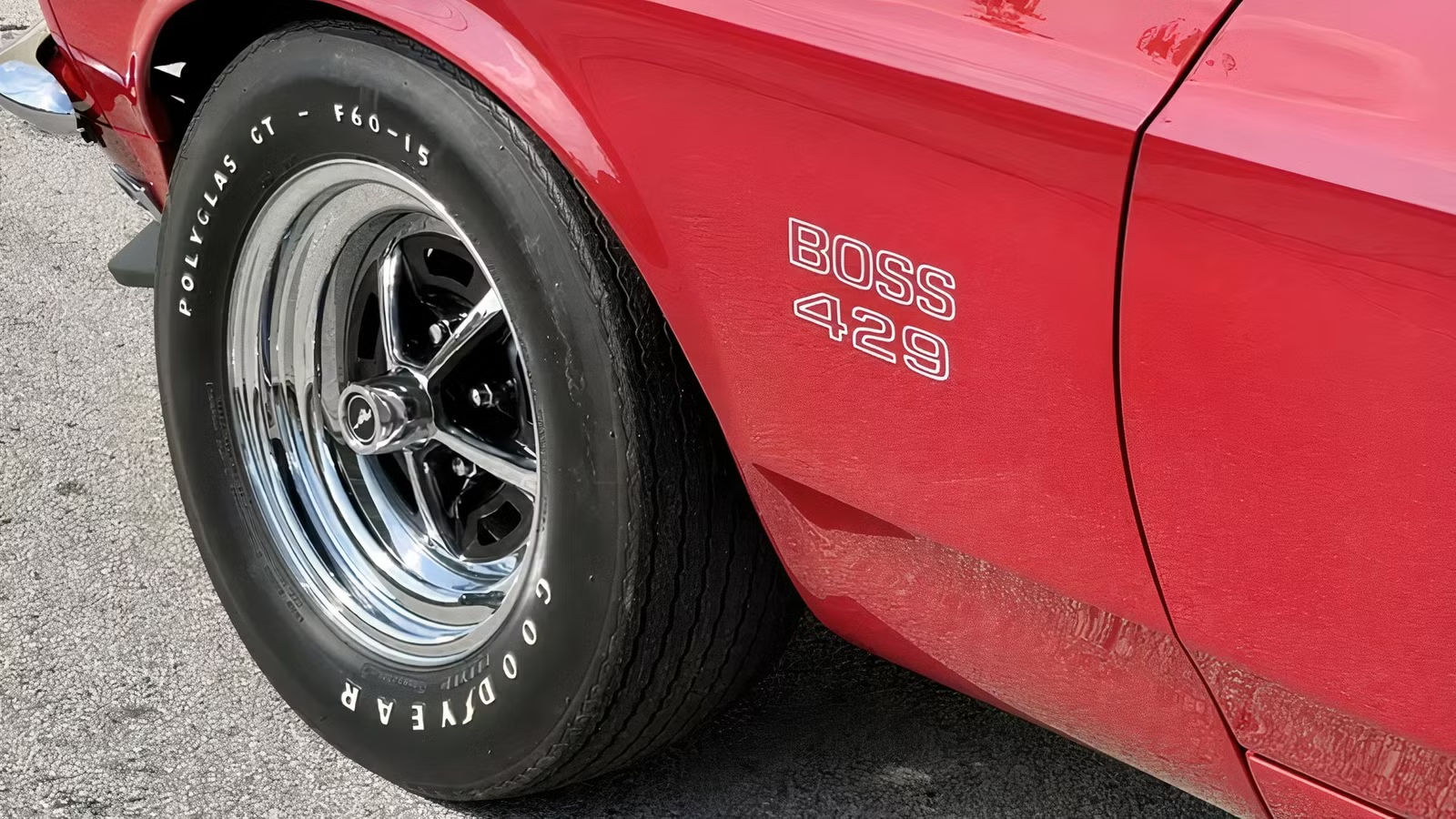
The Boss 429 existed because Chrysler’s 426 Hemi was dominating NASCAR and Ford needed a homologated answer. Getting there meant radical semi-hemi aluminum heads and finding 500 street buyers willing to take the engine home, NASCAR’s minimum for approval. The Mustang got the job, though not gracefully: the engine was too wide for a stock engine bay, and Ford had to ship partially built cars to Kar Kraft in Michigan, which modified the front suspension towers just to make it fit. Only about 1,358 were built across 1969 and 1970, rated at 450 lb-ft of torque and priced near $4,975, roughly double the price of a base Mustang.
Ford’s number held up better than internet legend wants to admit, at least as-delivered. While Ford sold the engine with 375 hp as the official rating to please insurers, modern engine builders with uncorked exhaust normally pull north of 500 hp. That is proper modern engineering at work on a legendary engine.
4
390 Tri-Power
401 Horsepower

Ford’s answer to Chevy’s 409 arrived in 1961 as the 390 High-Performance, fitted with three Holley two-barrel carburetors on an aluminum intake and sold as a dealer-installed option on the Galaxie and Starliner. The factory rating came in at 401 hp, the highest of any American production engine built that year. Unlike most of the engines on this list, that number wasn’t quietly walked back later. The 390 Tri-Power gave Blue Oval racers the firepower needed to take on Chevrolet’s 348 and early 400-horsepower Chrysler offerings on the street and strip.
Chevy’s real-world street rival was the 348, rated at 350 hp, and the 390 routinely beat it on the street that year. Period magazine testing backed up the factory rating with real quarter-mile results in the 13-second range. Anyone could walk into a Ford dealership, order the triple-carb setup, and drive off with more advertised horsepower than anything else in Detroit. For once, the factory told the truth.
3
406 Big Block
405 Horsepower

The 406 was the 390 with a bigger drink. Ford bored it out for 1962, officially christened it the Thunderbird Super High-Performance V8, and offered it two ways: 385 hp on a single four-barrel or 405 hp and 448 lb-ft of torque with three two-barrels stacked on top. This one’s boring in the best way. No period test or modern rebuild has turned up a real gap, mostly because the 406 beat Ford’s own insurance-era sandbagging by about a year.
Ford even rolled a gull-winged 406 concept car onto the show circuit that year and slapped a Cougar badge on it, five years before that name meant anything. The Galaxie 500 and 500XL got dibs on the real thing, extra block webbing included to survive actual racing. It didn’t have long to enjoy it. Ford bored the block out again partway through 1963 and handed the crown to the 427.
2
427 Side Oiler
425 Horsepower
427 Dual-Quad

The 427 is the FE family’s high point, the engine at the center of Ford’s Total Performance era, and the dual-quad version is the one that matters, two four-barrels for an official 425 horsepower and 480 lb-ft of torque against 410 horsepower for the single-carb version. The standard street version holds up under scrutiny, too, with owners running original, untouched engines on a dyno and measuring output in line with, or even under, the factory number.
The exception was Ford’s own factory drag package, the Fairlane Thunderbolt, built on the 427’s high-riser tune and commonly reported at closer to 500 hp against that same 425 rating. Ford built the standard version to win, not cruise, and the same basic hardware ended up in R-code Galaxies, Shelby Cobras, and the Le Mans-winning GT40 Mark II. It delivered. The 427 carried Ford’s NASCAR effort through 1963, taking 23 wins that season including the top five finishing spots at that year’s Daytona 500. It stayed in production through 1967 and remains the engine most associated with Ford’s pushrod racing era.
1
427 Cammer
657 Horsepower

The biggest number on this list belongs to the 427 SOHC, better known as the Cammer, built in 1964 to answer the Chrysler Hemi. Swap pushrods for overhead cams and true hemispherical chambers and you get 616 hp on a single carburetor, or 657 hp and 575 lb-ft of torque with dual quads, the highest factory figure Ford ever printed.
There’s no hidden number to chase here either. Ford rated this one aggressively, not conservatively, and full race builds have made considerably more since. The underselling happened at NASCAR’s hands, not Ford’s. NASCAR banned it before it ran a single competitive lap, calling it a race motor rather than a production option after Chrysler protested.
Ford never put one in a car on a showroom floor. Instead, it sold the Cammer over the counter as a crate engine for racers, where it became a fixture of NHRA’s Factory Experimental class, popping wheelies down a quarter mile that nothing else here could touch.
Sources: Classic.com, Bring A Trailer, Mecum, Hagerty

Related posts
Latest Post


No Comments