This Used Porsche Now Undercuts A Fresh Mustang Dark Horse
9 minutes reading
Thursday, 27 Aug 2026 17:00 0 7 autotech
The 2026 Ford Mustang Dark Horse starts at roughly $63,080 with destination, and that number has quietly turned into a benchmark for cross-shopping buyers. For that same money, a well-sorted used Porsche Cayman S is not just attainable but often a bargain by comparison, with clean examples from three separate generations trading well under that ceiling. That price crossover raises an obvious question for anyone deciding between a warrantied muscle car and a used mid-engine Porsche. Is the badge and the driving experience worth trading new-car certainty for older-car risk? The answer depends heavily on which Cayman S you’re looking at.
Porsche’s mid-engine coupe has depreciated into genuinely different territory than it occupied a decade ago. Early 987.1-generation Cayman S models from 2006-2008 now average around $27,000, less than half the Dark Horse’s sticker price, and low enough that buyers can add a serious pre-purchase inspection budget and still come out ahead. Move up to the 987.2 generation (2009-2016) and prices stratify further. Pre-facelift cars from 2009-2012 average $37,000-$43,000, while the facelifted 2012-2016 cars with the revised MA1 engine sit in a $45,000-$55,000 sweet spot. Even the newer 981-generation Cayman S (2013-2016) averages around $50,000, still comfortably under Dark Horse money.
That’s four distinct price tiers, all beneath a new Mustang’s window sticker, and all delivering some version of a mid-engine Porsche ownership experience. The gap isn’t marginal, either. At the low end, you’re looking at a $36,000 spread between a 987.1 and a Dark Horse, which is real money that can go toward maintenance reserves, a PPI, or an extended warranty product.
How Transmission Choice Can Shift The Calculus
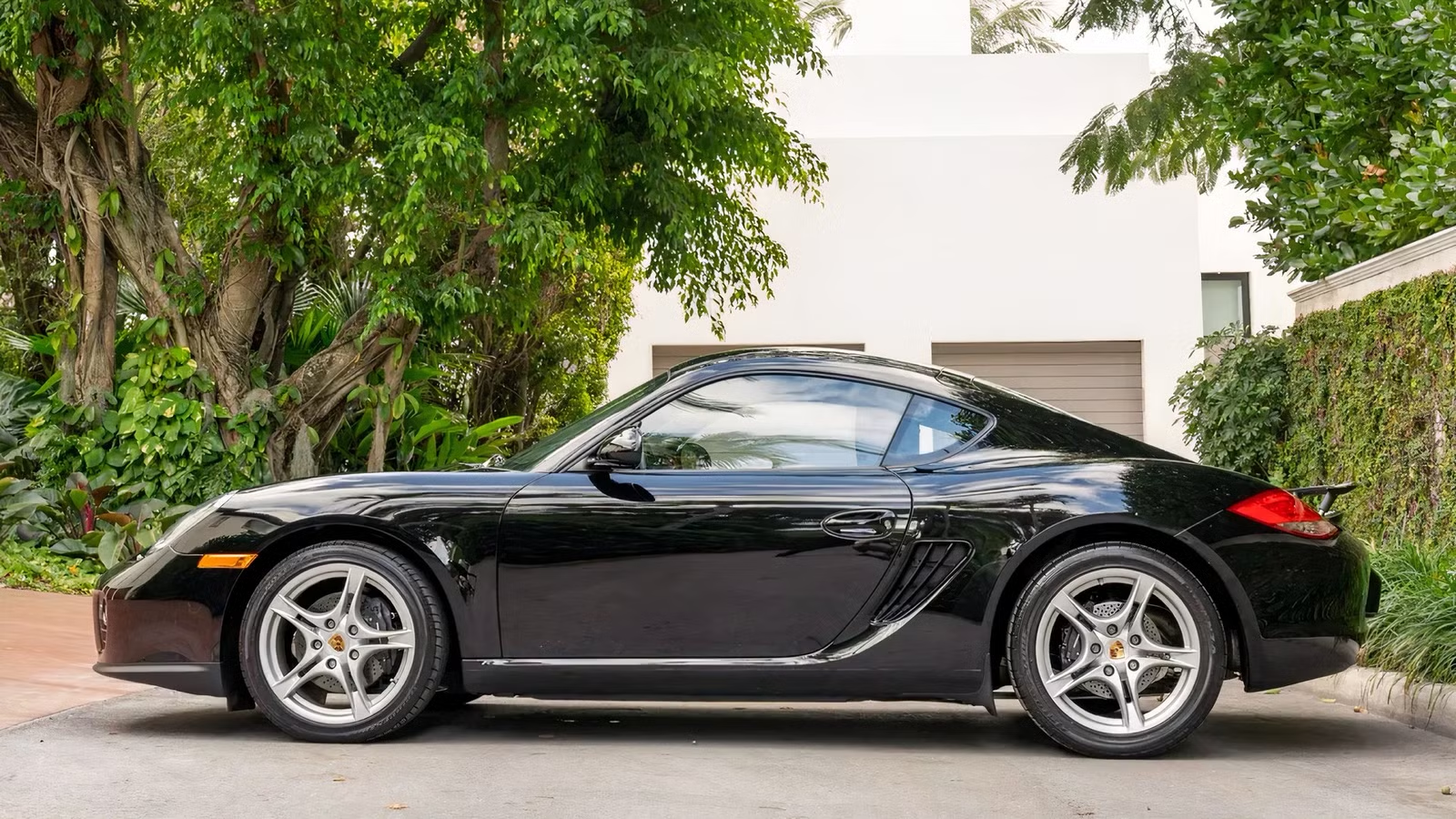
2009 Porsche Cayman side by sidePorsche
One variable worth flagging before diving into generations is that transmission choice moves these numbers meaningfully. A PDK-equipped Cayman S typically commands a $3,000-$7,000 premium over an otherwise comparable manual car across every generation. That’s not trivial in a $30,000-$50,000 purchase. It can be the difference between budgeting for a manual clutch job down the line or not, and it shapes which generation actually fits a given budget. A shopper set on a facelifted 987.2 with PDK, for instance, might find the price creeping close to 981 territory, which changes the calculus considerably.
Three Cayman S Generations Offer Very Different Porsche Experiences For The Money
Front 3/4 shot of 2009 Porsche CaymanBring A Trailer
Treating “the Cayman S” as a single used-car proposition is where a lot of buying guides go wrong. In practice, there are three meaningfully different cars here, split primarily by engine architecture.
The 987.1 (2006-2008) uses Porsche’s M96 flat-six, the same architecture found in contemporary Boxsters and 911s of that era. It’s the cheapest entry point by a wide margin, but it’s also the generation most associated with the intermediate shaft (IMS) bearing failure mode that plagued this engine family. Buying a 987.1 means the IMS bearing isn’t a footnote; it’s the central question of the purchase.
The 987.2 Splits Into Two Distinct Reliability Tiers That Shouldn’t Be Lumped Together
2014 white Porsche 981 Cayman S badgingBring A Trailer
Pre-facelift cars (2009-2012) still use a version of the M97 engine and still carry IMS bearing exposure, though Porsche made incremental improvements to bearing durability during this window compared to the earliest 987.1 units.
Facelifted 987.2 cars from 2012 onward are a different story entirely. Porsche introduced the MA1 engine, which eliminated the intermediate shaft design altogether. No IMS bearing, no IMS risk, full stop. This is arguably the most underrated tier in the used Cayman S market: you get modern styling updates, a materially different (and less failure-prone) engine, and pricing that hasn’t fully caught up to how much risk it removes compared to earlier cars.
Profile shot of 2012 Porsche CaymanBring A Trailer
The 981 (2013-2016) also runs the MA1 engine and adds a stiffer aluminum-intensive platform, sharper steering, and a genuinely modern interior. Its known issues are different in character from the IMS-era cars: TPMS sensor failures and clutch wear on high-mileage manual examples are the recurring themes, not catastrophic engine failure. It’s the safest generation from a mechanical-risk standpoint, and its pricing reflects that, sitting closest to Dark Horse money of the three.
Knowing which generation to target is only half the equation. The other half is understanding how dramatically the ongoing cost picture differs from a warrantied Mustang — and where that $36,000 price gap actually goes.
IMS Bearings, Clutches, And Specialist Labor Make The Porsche Budget More Complicated
Shot of 2011 Porsche Cayman undersideBring A Trailer
The sticker price gap between a used Cayman S and a new Dark Horsetells only part of the ownership story. Total cost of ownership is where the comparison gets genuinely complicated, and it varies significantly by generation. For 987.1 and pre-facelift 987.2 cars, the IMS bearing is the line item that dominates every conversation.
A proactive IMS retrofit, replacing the factory bearing with an aftermarket unit before it fails, typically runs $2,000-$5,000 depending on whether other work (like a clutch replacement, which shares labor with the IMS job) is bundled in. Buyers who skip this on an early car aren’t necessarily buying a ticking time bomb, since failure rates were never as high as internet lore suggests, but they are accepting a real, non-zero risk of a catastrophic engine failure that a Mustang buyer simply doesn’t have to think about.
Close-up shot of 2011 Porsche Cayman cockpitBring A Trailer
MA1-equipped cars (facelifted 987.2 and all 981s) sidestep that specific risk, but they’re not maintenance-free. Clutch wear on manual-transmission examples with higher mileage is a legitimate cost consideration, and TPMS sensor replacement crops up more often than owners expect. Across all generations, routine service (annual fluid changes, brake fluid flushes, suspension bushing wear) runs $1,500-$2,500 a year at a specialist shop, and that’s the operative phrase: a specialist shop.
Independent Porsche specialists typically bill $200-$300 per hour, roughly double what a Ford dealer charges for Mustang service at $100-$150 per hour. Parts sourcing is similarly less convenient than mainstream Ford channels. None of this makes the Cayman S a bad financial decision. It does mean the $30,000-$50,000 purchase price is the entry fee, not the full picture, and a buyer should budget accordingly rather than comparing sticker prices in isolation against a warranty-backed Dark Horse.
Mid-Engine Balance And Porsche Steering Deliver What The Mustang Cannot Replicate
Front 3/4 shot of 2012 Porsche CaymanBring A Trailer
None of the maintenance math matters much if the driving experience doesn’t justify it, and this is where the Cayman S makes its real case. The mid-engine layout puts mass low and centered, giving the car a rotational balance and turn-in response that a front-engine Mustang, however well-sorted the Dark Horse chassis is, simply can’t replicate through geometry alone. Body roll is minimal, weight transfer is progressive rather than abrupt, and the car communicates grip levels through the seat in a way enthusiasts consistently describe as more transparent than front-engine layouts.
The steering is the other half of the argument. Even in the electrically-assisted 981, Porsche’s steering tuning retains a level of feedback and precision that’s become something of a benchmark in the segment, and the earlier hydraulic-assist 987 cars are, if anything, even more communicative. It’s the kind of detail that doesn’t show up on a spec sheet but defines how a car feels on a back road.
Rear 3/4 shot of 2010 Porsche Cayman SBring A Trailer
There are real tradeoffs, though, and a fair comparison has to name them. Rear three-quarter visibility in a Porsche Cayman is genuinely compromised by the roofline and thick pillars. Trunk space is split awkwardly between a small frunk and a rear cargo area, neither of which competes with the Mustang’s usable trunk. And it’s a two-seater; there’s no back seat option at all, which rules it out for buyers who occasionally need one. The mid-engine layout is a genuine advantage in the corners; it’s a genuine compromise everywhere else.
Warranty Certainty Versus Porsche Character: Which Sub-$65,000 Sports Car Makes More Sense?
The front 3/4 view of a gray 2014 Porsche Cayman.Bring A Trailer
The rear 3/4 view of a gray 2014 Porsche Cayman.Bring A Trailer
There isn’t a universally correct answer here, but there is a clear framework for reaching one. A buyer who wants predictable costs, a manufacturer warranty, mainstream dealer support, and doesn’t want to think about their car between service intervals should buy the Dark Horse. It’s a genuinely excellent driver’s car in its own right, and the certainty is worth paying for.
A buyer who’s comfortable budgeting for specialist maintenance, who’s willing to pay for a thorough pre-purchase inspection, and who values steering feel and chassis balance above outright reliability predictability has a real opportunity in the current used Cayman S market, provided they’re honest about which generation matches their risk tolerance. That means steering toward a facelifted 987.2 or a 981 if peace of mind matters, and reserving the cheaper 987.1 and early 987.2 cars for buyers who’ve specifically budgeted for an IMS retrofit as a condition of purchase rather than an unlikely contingency.
The passenger side interior view of a 2014 Porsche Cayman.Bring A Trailer
Resale expectations should stay realistic too. Cayman S values have held up respectably, but they don’t carry the collector momentum of an air-cooled or even early water-cooled 911. Buy one for what it is: a genuinely great mid-engine sports car currently priced, in several generations, below a new Mustang, not a guaranteed appreciating asset.
The practical takeaway is that a buyer’s risk tolerance should dictate generation choice as much as budget does. Someone chasing the lowest possible entry price into Porsche ownership is buying into 987.1 IMS exposure. Someone prioritizing peace of mind within the same rough price bracket as a loaded Mustang should be looking at 981s or late 987.2s specifically.
Base Trim Engine
2.7 L Boxer 6-cylinder
Base Trim Transmission
6-speed manual
Base Trim Drivetrain
Rear-Wheel Drive
Base Trim Horsepower
275 HP
Base Trim Torque
213 lb-ft @ 4500 rpm
Make
Porsche
Model
718 Cayman
Segment
Sports Car
Sources: Porsche U.S., Kelley Blue Book & iSeeCars







No Comments