
The 1-Of-1 Bugatti That Proves The W16 Isn’t Dead Yet
We bet you thought Bugatti didn’t have a hope of making it through the late 2020s. After global EV mandates and a suspect pairing with Rimac showed the world where the company’s ambitions lie, it was fair to say the glory days of the EB110, Veyron, and Chiron were well and truly finished just a few years ago. The tentative axing of its legendary W16 engine was the biggest signifier that the good times were over, except, well, that engine isn’t going away just yet. There’s a new one-off Bugatti hypercar to discuss. But first, a history lesson, if we may.
Bugatti and Crazy Engines, Like Red Wine and a Juicy Steak

If you think about it, Bugatti has always had a near-obsessive relationship with engines so massive they command attention, or so audacious they defy belief. As far back as 1909, when Ettore Bugatti himself established his workshop in the French town of Molsheim, his line of racing cars and luxury grand tourers championed cubic displacement and/or raw cylinder count as the cornerstone of the Bugatti brand. Take the Type 45 and 47, for instance, which used an extraordinary U-16 layout made of two straight-eights with separate crankshafts joined together in a single block.
The zenith of this philosophy under Old Man Bugatti came in 1936, via the iconic Type 57SC Atlantic and its supercharged straight-eight that made no less than 200 horsepower. Back in the mid-1930s, that might as well have been the equivalent of a thousand horsepower today. On the pure CCs side of things, the Type 41 Royale’s 12.7-liter straight-eight was quite necessary to lug the 21-foot, 7,000-pound body down the road. That’s without mentioning the company’s moonlighting as an aerospace manufacturer during World War I and the interwar years. After Ettore’s death in 1947, the company entered a steep decline until the firm went under in 1952. From there, it’d take 39 years for the Bugatti nameplate to see the light of day, all thanks to the bewitchingly fast EB110 and its quad-turbocharged V12.

In 1998, the VW group acquired the Bugatti brand, and doubled down on its core philosophy of fitting engines that make people’s jaws hit the floor. We know where you think we’re going: right to the Veyron and its eight-liter quad-turbocharged W16. Yet Bugatti built and tested an even more audacious 6.3-liter W18 in the 18/3 Chiron, EB118, and EB218 prototypes. It was a wondrous time to be a Bugatti engineer, and it was a surefire indication of the good times that were soon to come. Suffice it to say, that future was very fast, and very, very powerful.

Evolution, Mergers, and the Fear of Losing it All

As should come as no surprise to anyone, the Veyron became the quickest production car in the world almost as soon as it arrived on showroom floors. Top speeds north of 250 mph became commonplace, and the Bugatti nameplate went from an obscure trivia question for classic car enthusiasts to one synonymous with wealth and exclusivity. By the time the Veyron Super Sport hit the scene in the early 2010s, that same quad-charged W16 was pumping out 1,183 horsepower and pushing 270 mph when maxed out.
Knowing they had captured something truly special, Bugatti opted against replacing its W16 with something smaller and more practical when it came time to develop the Veyron’s replacement, the Chiron. Now producing as much as 1,479 hp in its base trim, and 1,578 hp in the record-breaking Super Sport 300+, the Bugatti W16 sustained the brand well into the Rimac merger years. Still, the merger was a signal to the industry, an indicator that the EV-focused Mate Rimac wouldn’t let the historic engine last for much longer.
The engine lasted somewhat longer via special-edition models like the EB110 tribute Centodieci, the track-focused Bolide, and the open-top Mistral. Still, those fears were confirmed when the Chiron’s direct replacement, the Tourbillon, debuted with a Cosworth-built V16 and three electric motors. By all accounts, it should have been the end of the road for the Bugatti W16, one of the most remarkable engines ever put into production. Except, it turned out not to be, all thanks to a Bugatti corporate initiative called Programme Solitaire. As an ultra-exclusive, coach-built method for the ultra-rich to spec the Bugatti of their dreams, the program gave the perfect excuse for Croatia-based Bugatti Rimac to keep the W16 around for just a little bit longer.
The Destrier: Great Name, Better Ultracar

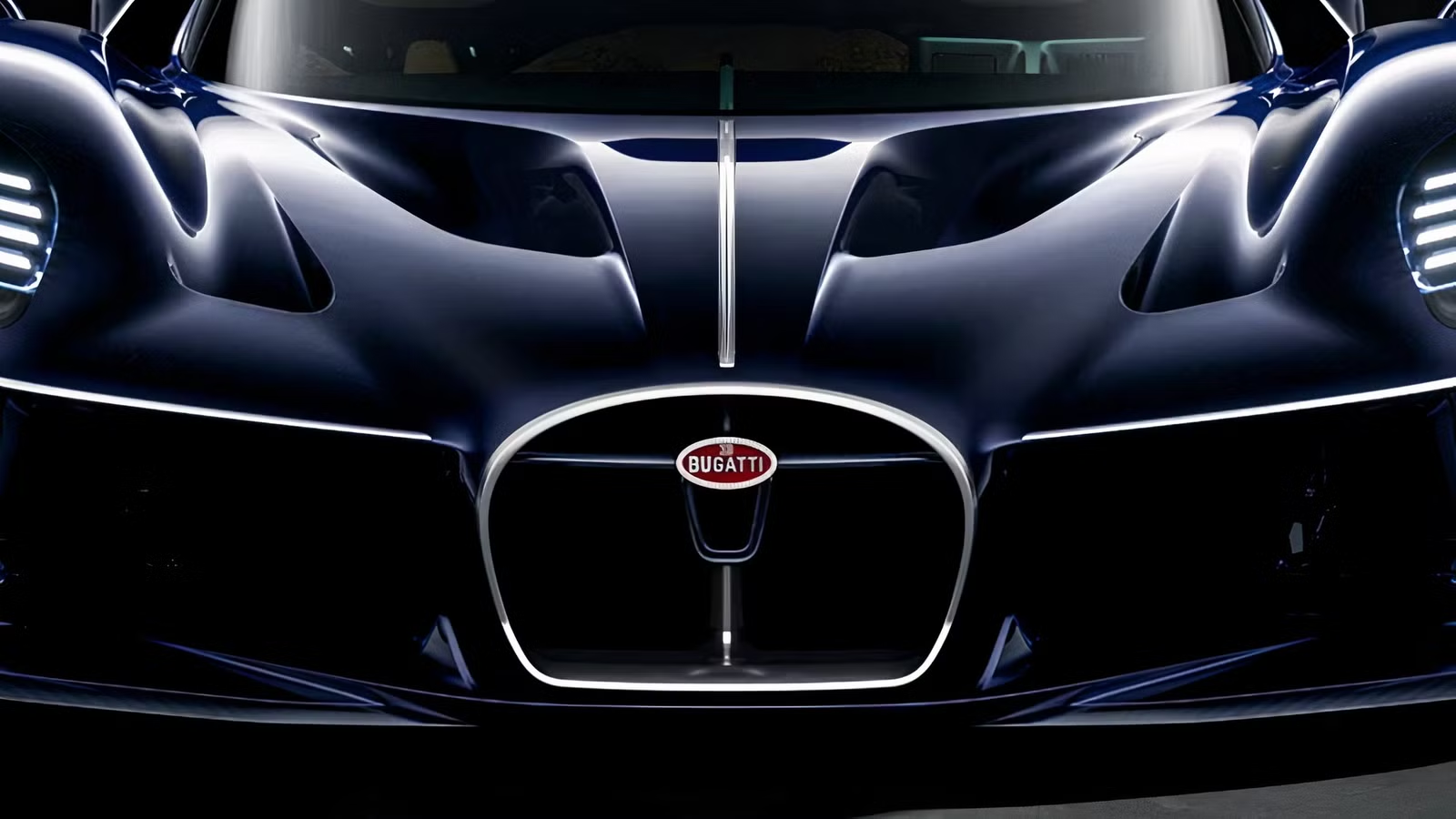
Named after the strongest type of medieval knight’s warhorse, or a giant piloted mech walker from the Warhammer 40K series depending on one’s frame of reference, the Bugatti Destrier is very possibly the last vehicle of any kind to feature the iconic W16. Based largely on the Bolide, the Destrier takes its bare-bones foundation and sheds the aggressive aerodynamics and other track-day hardware in favor of smooth, sweeping lines and clean styling motifs that look as though Ettore himself could have designed them. With a height of just one meter or 3.28 feet off the ground, the Destrier is the lowest Bugatti ever built.
It is one of the lowest road-going automobiles ever to make the leap from the drawing board to reality. Its lines take direct inspiration from the Type 57G tank that once won Le Mans, as well as the Type 57SC Atlantic, widely regarded as one of the best-looking cars of all time. Massive polished wheels, 20 inches in the front and 21 in the rear, give the car an elegant look when viewed from the flanks. At the back, a subtle blended wing takes the place of the Bolide’s massive rear racing spoiler. Finished in a bespoke, multi-layered Sapphire Celeste paint with diamond-inspired sparkle accents, the exterior is complemented by supple Ambre Voyageur brown leather and nubuck wrap in the cockpit for a look all its own.

The seats and leather-wrapped trim pieces are accented with sparkling copper yarn, a direct homage to the warhorse that gives the car its name. Under the rear hatch, the W16 looks right at home in this one-of-one machine, sending 1,578 hp to the tires and paired with a seven-speed dual-clutch gearbox. Top speed? Well, we don’t know for sure yet, and we might never know for certain. Still, available evidence suggests its sister cars can top 300 mph. As for the price, the figure is appropriately stratospheric. Someone paid at least $15 million to have it built, and likely closer to $20 million when all is said and done.
The End of the Line for the W16? Very Possibly

In truth, Bugatti Rimac hasn’t given an official stance on whether the Destrier is the absolute end of the road for the W16. Of course, the firm had indicated at one point that the Mistral’s 99-unit production run was the end of the line for the engine. Yet it’s clear from the Destrier’s debut at this year’s Monterey Car Week that, for the right amount of money, nothing is truly off the table.
Not long ago, many worried that Bugatti was doomed to become an all-electric brand, its character eroded by impending EV mandates set to affect the entire automotive industry. Well, it’s 2026, and global EV mandates have either been postponed indefinitely, or in the case of the United States, rolled back entirely. With that said, don’t be surprised if one or two more Programme Solitaire commissions use the W16 as well. Yet if this really is the end, it’s hard to argue it wasn’t one of the greatest runs in the history of the motor vehicle.
Source: Bugatti

Related posts




Latest Post


No Comments