
The Long-Running Turbo Engine That Quietly Became Bulletproof
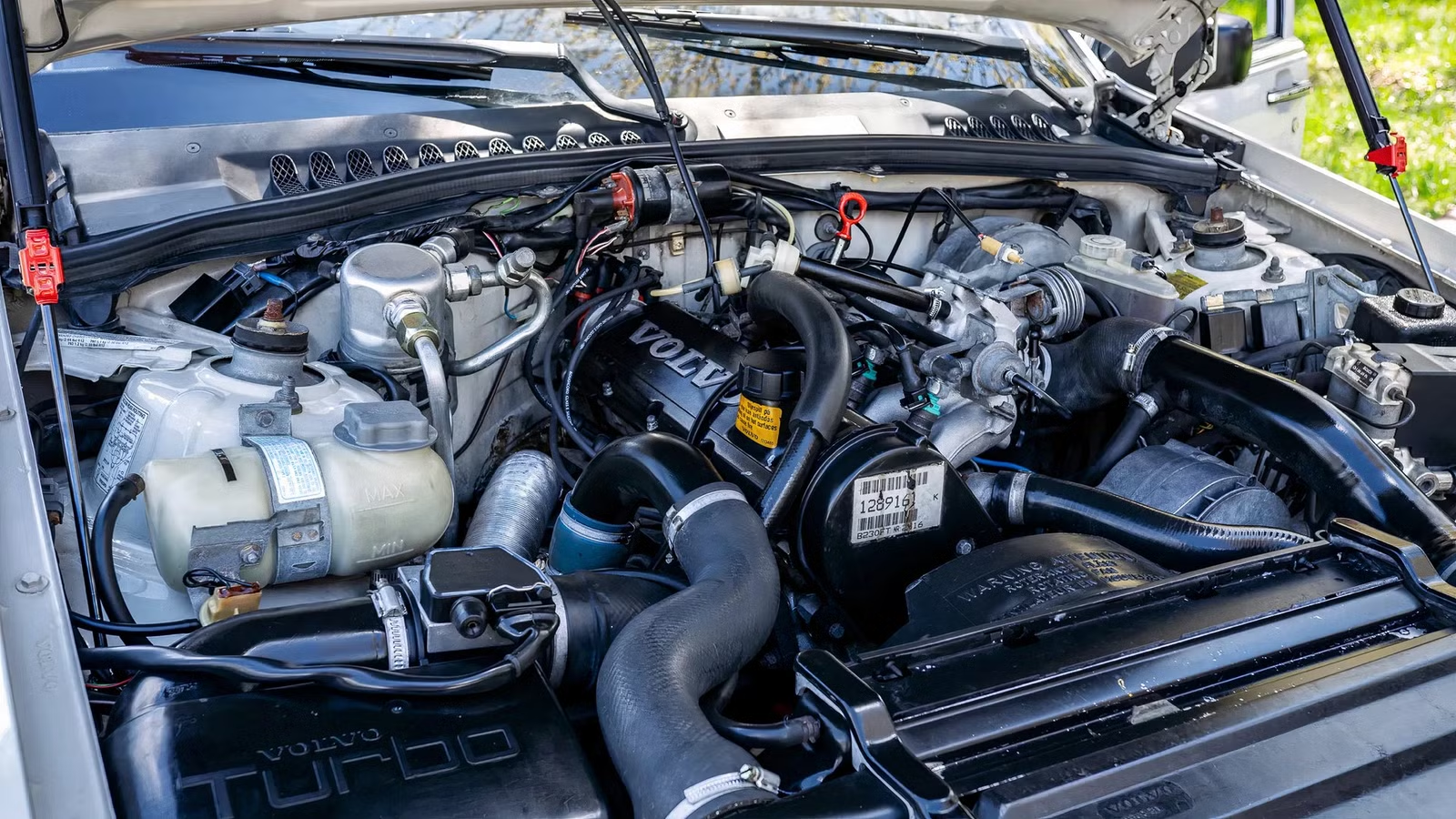
When we speak of long-living engines, we tend to speak about big displacement, naturally aspirated monsters with overbuilt components and low running stresses. We usually don’t consider that higher-strung, turbocharged engines are capable of reaching high numbers.

However, this Volvo turbo-four is built differently. Used in some of the best Volvo sedans and wagons, this turbocharged inline-four is just as capable of reaching big numbers as some of the most revered engines ever made.
Some Turbo Engines Just Refuse To Die
The evolution of turbo tech has led to some of the best engines on the market today in terms of easy power and slightly better fuel returns. However, turbocharging adds complexity; a naturally aspirated engine doesn’t need an intercooler, wastegate, boost-control hardware, or the additional oil and coolant plumbing that comes with forced induction. There is more to go wrong, and the engine itself has to cope with higher temperatures and cylinder pressure.

Some brands have managed to make all that complexity surprisingly durable. Toyota’s 2JZ-GTE has become known for its staunch construction and ability to handle big mileage and power. Honda’s K20C1 has shown that modern turbocharging doesn’t necessarily mean sacrificing durability, and Mercedes-Benz’s M276 turbocharged V6 has also earned a reputation for being durable when properly looked after. As we find with a lot of reliability concerns, the design and engineering matter the most.
Simple Engineering Keeps Some Turbo Engines Running For Decades

The likes of the BMW B58 inline-six are one of the best examples. Its single-scroll turbo is only part of a fairly sophisticated engine, but the underlying design is very tough. It gets a closed-deck block, forged crankshaft, and a good cooling system. It isn’t BMW’s oldest engine, but it has already become a favorite among tuners, while also powering everything from BMWs to the new Supra.
The Volvo B230FT Was Built To Take A Beating

With this in mind, this is why the Volvo B230FT inline-four is such a strong turbocharged engine. As part of Volvo’s “Redblock” family, the B230FT was used for 14 years between 1985 and 1998, and in that time made a serious name for itself in terms of solid usability and tuning potential.
Conservative Engineering Helps The B230FT Rack Up Serious Mileage

Some B230FT examples have easily exceeded 250,000 miles with simple maintenance, while some of the highest mileage examples have gone past 500,000 miles, and even over 820,000 miles. Alongside maintenance, there is a very good reason why they keep going: very conservative design and low stress output. The maximum stock horsepower for a B230FT is just 165, while maximum torque is just 197 pound-feet.
The modest output is important when considering what the B230FT turbo-four is asked to do. It is a 2.3-liter iron-block four-cylinder with a forged crankshaft, five main bearings, and a relatively understressed bottom end. Depending on model year, the B230FT is equipped with Garrett and Mitsubishi turbos, including the T3 and TD04. They are relatively straightforward single-scroll units, without variable geometry or the complicated electronic boost management found in a lot of modern models.

Like all good reliable engines, the B230FT went through years of refinement during its production run. Early models had weaker connecting rods than later versions, and Volvo made a series of internal revisions as the engine matured. Later “Turbo+” versions produce a bit more power thanks to higher boost levels, but the standard B230FT is conservatively tuned. It is the sort of engine that is designed to keep doing the same job over and over rather than showing off on the spec sheet.
That’s the real appeal. A modern turbocharged engine can use multiple turbochargers, variable geometry hardware, complicated boost control, direct injection, and numerous sensors to produce a great deal of power from a small displacement. The B230FT doesn’t have that much to go wrong. Its turbocharger can wear and all the components needed to make it work can go wrong, but the basic engine is doing relatively little work for what it is. When you combine that with a stout bottom end and sensible boost levels, it’s no surprise we see big miles from them.
The B230FT’s Simple Formula Is Hard To Kill

Volvo kept the entire engine uncomplicated, with a single overhead camshaft, two valves per cylinder, a belt-driven valvetrain, and hydraulic lifters. There is no variable valve timing or complicated intake system to add failure points. Considering it is a turbocharged engine, it is fairly simple.
Early B230FT versions use a Bosch LH-Jetronic injection system, while mid-age versions get the LH 2.2 system, before Volvo added LH 2.4 in the latest versions. This injection system brought along more sophisticated fuel and ignition control, along with onboard diagnostics, but still got the straightforward electronic port fuel injection instead of high-pressure direct injection.

Many versions get a relatively low 8.7:1 compression ratio which suits turbocharging, giving it useful headroom against detonation while keeping cylinder pressure under control. The mechanical side is equally simple. The large cast-iron block provides strength and thermal mass, while the oil and cooling systems were designed to combat the additional heat generated by the turbo.
Like we find with naturally aspirated legends like the 1GR-FE and 1UZ-FE, the B230FT wasn’t designed to squeeze every last drop of horsepower from its displacement. Instead, Volvo gave it a substantial margin of mechanical strength, which means it can handle years of regular use without constantly working near to its limits.
From Family Wagon To 1,500-HP Drag Car: The B230FT’s Hidden Range

This reliable turbocharged Volvo engine was used in a fair few models in its time. It sits under the hood of the 1985 to 1995 740 Turbo sedans and wagons, the 1985 to 1990 760 Turbo sedans and wagons, the 1987 to 1991 780 Turbo Bertone Coupe, and the 940 Turbo sedans and wagons.
In short, it was originally used in many sensible, safe, everyday vehicles designed for easy everyday use. However, that is nowhere near just what it is good for. There is a reason why boxy Volvos are still cool.
The B230FT’s Tuning Ceiling Is Surprisingly High

Because the factory horsepower is so low, there is a lot of room for improvement. The usual route starts with a larger turbo, a better intercooler, a freer-flow exhaust, larger injectors, and upgraded engine management. The stock turbos can be replaced with a modern Garrett, BorgWarner, or Holset unit, while a larger throttle body and a ported cylinder head for better flow can help the engine make use of the additional airflow.
The bottom end is where it gets interesting, though. Later engines get stronger connecting rods than the early B230s, and modders have taken advantage of that. Owners on the Turbobricks forum talk about examples equipped with custom Crower rods and Arias pistons for extremely high power outputs, some as much as 1,500 horsepower for drag cars. Obviously, this took a lot more than some new rods, though.

For more moderate mods, the upgrades don’t need to be particularly exotic to get good results. A three-inch exhaust, larger intercooler, higher-flow fuel system, and programmable ECU can make a big difference when paired with a beefier turbo.
Once power climbs well over its factory limits, the standard rods and pistons also need changing. That’s where custom rods and head studs come into play, and the B230FT handles them very well. In short, there is a lot that can be done with the humble, lower-powered B230FT. Its reputation isn’t about making unlimited horsepower on stock internals, but about the architecture that provides an exceptional platform to start from.
The B230FT Made The $10,000 Volvo 740 One Of The Best Budget Sleepers On The Market

When it comes to sleeper sedans, the likes of the Kia Stinger GT, the Buick Regal GS, the Acura TLX Type S, and the Infiniti Q50 Red Sport 400 come to mind. But then there is the Volvo 740. The B230FT was mostly used for the rear-wheel drive models, and the engine and driveline configuration is just a good starting point for this quiet-looking sedan.
Turbocharged 740 sedan models have a stock 0–60 mph time of between 7.4 and eight seconds, and while that isn’t bad for a family car from the mid-1980s and early 1990s, much has been done to them—the engine especially—to make them mid-five-second cars. The four-speed AW71 automatic transmission is a common pairing, while the four-speed M46 manual option gets an electrically operated overdrive.

Both are fairly old-school today, but the rear-wheel-drive layout of the 740 gives it the right bones for a sleeper. The best part for budget modders: at the time of writing, Classic.com says the average auction price for a Volvo 740 Turbo is just under $10,000.
The 760 Turbo wagon is arguably even better as a sleeper. It has all the same qualities, but you also get a roofline that suggests grocery-store trips and school runs, and with the growing interest in the sports wagon market (thank you, BMW and Audi), a well-sorted and modified B230FT can make something like the 760 Turbo wagon properly quick while looking almost harmless. Again, budget-friendliness is key here; Classic.com says the average auction price is just over $7,400.

The B230FT gives the likes of the 740 and 760 something most family cars of the era don’t have: a RWD chassis with a turbo-four that can be developed without having to totally reinvent it. That makes these Volvos unusually good project cars. You can leave the body pretty much alone while putting money into engine upgrades that turn them into weapons.
While it doesn’t get the limelight of some other reliable engines, the B230FT’s real win is that it has quietly become memorable to people in the know. It can offer easy-to-live-with performance and impressive longevity in stock form, while also giving enthusiasts plenty of scope to make things better. There are few engines that manage to balance both being a dependable daily driver and a proper performance foundation, but the B230FT has spent decades quietly doing it. That it did so in boxy Volvos makes it even better.
Sources: Volvo, Classic.com, and Turbobricks

Related posts





Latest Post


No Comments