
The Rarest Ford Production Car Ever
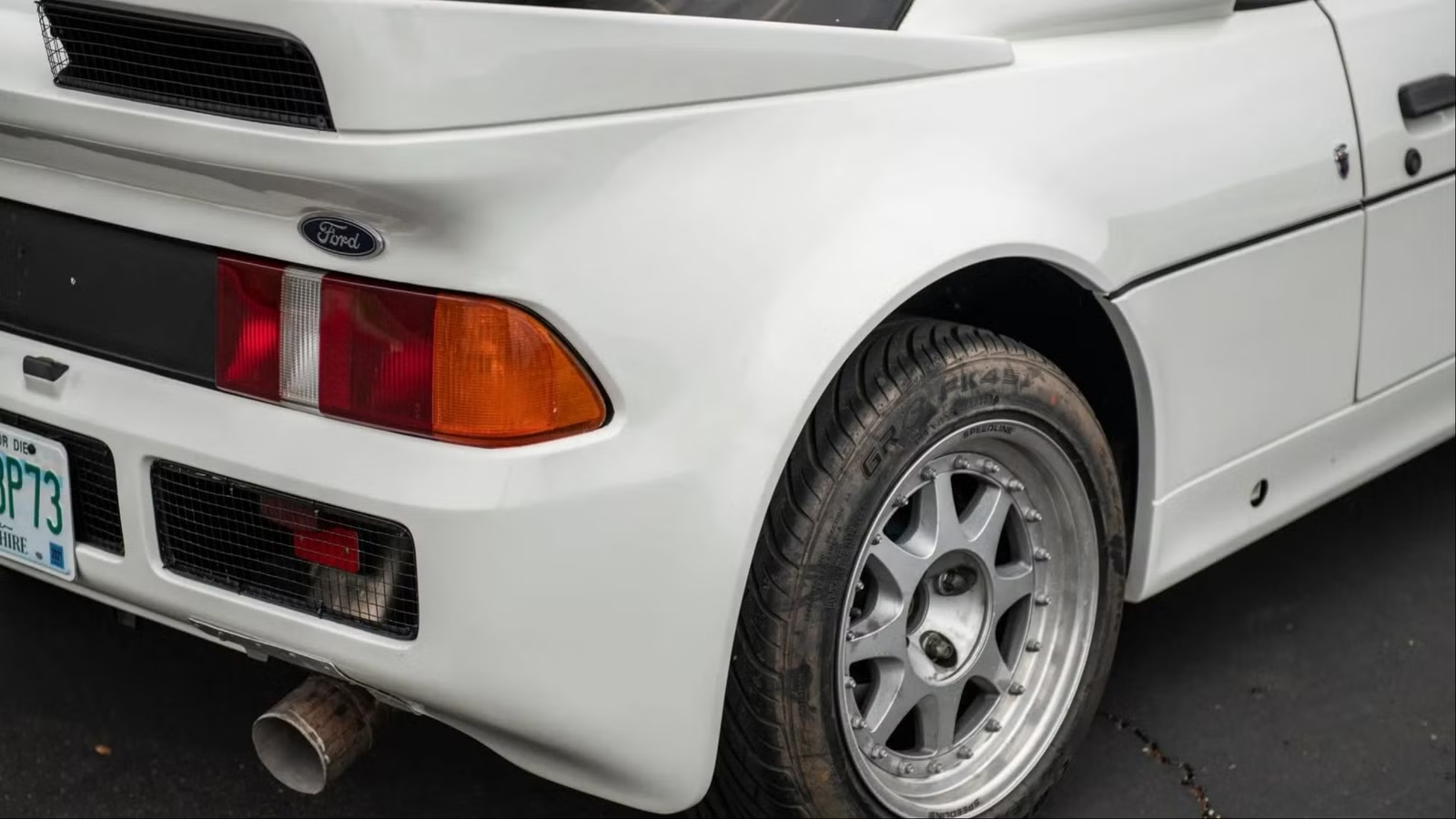
Group B rally was the most brutal, uncompromising motorsport formula the world had ever seen — and to compete at its highest level, automakers had to build something truly extraordinary. For Ford, that meant engineering a mid-engine, all-wheel drive weapon from scratch, then producing just enough road-legal copies to satisfy the FIA’s homologation rules. The result was the RS200: a car so rare, so purposeful, and so deeply rooted in one of motorsport’s most legendary eras that it remains one of the most coveted Fords ever to turn a wheel.
The Ford RS200 Is The Rarest Ford Production Car Ever

The automaker needed to homologate its RS200 Group B rally car, building 200 road-going versions to meet the FIA’s rules. The cars were built in partnership with Reliant Motors PLC, and the mid-engine, all-wheel drive machines stand as some of the rarest production vehicles Ford has ever sold. Even rarer, just 24 of the 200 were built as modified Evolution cars after Ford made changes to its rally car that had to be separately homologated.
Group B rallying was banned before the Evolution models reached the public, and without a racing series to promote the cars, Ford struggled to move them off the lot.
In an effort to push more units out the door, the automaker sold a handful with wider seats, better air conditioning, and a more refined interior, but the RS200 only ever saw a couple hundred units across its entire production run. This article will dive into the RS200’s specs, its racing pedigree, and the features that make it such a unique and enduring production car.

The road-going Ford RS200’s mid-mounted, turbocharged 1.8-liter inline-four-cylinder engine produced 250 horsepower and 215 pound-feet of torque. Power reached all four wheels through a five-speed manual transmission with no modern driver aids of any kind. Acceleration and handling remain ferocious to this day, despite those output numbers not looking especially impressive on paper.
Though it wasn’t quite as raw as the rally car it was based on, the road-going RS200’s massive 23 pounds of turbo boost pressure and rally-bred all-wheel drive system make it a genuine thrill to drive. That said, some have noted that it’s almost too much car for the road, and its performance is difficult to fully exploit in everyday situations.
Ford RS200 Highlights
- Ford only built 200 units of the RS200
- The turbo-four makes more than 400 horsepower in racing form and 250 hp in road form
- The RS200’s (some versions) 0-60 time of 3.8 seconds makes it quicker than many modern cars
- The cars came exclusively with a manual transmission
Ford RS200 Exterior Dimensions
|
Ford RS200 |
|
|
Length |
157.5 Inches |
|
Width |
69 Inches |
|
Height |
Varies |
|
Wheelbase |
99.6 Inches |
|
Front Track |
59.1 Inches |
|
Rear Track |
58.9 Inches |
|
Curb Weight |
2,315 Pounds |
(Source: Ford)
Ford RS200 Engine Specifications And Performance

Rally cars have long relied on smaller, turbocharged engines in compact hatchback and sedan body shapes to get the job done. The Cosworth four-cylinder used in the RS200 runs a massive 23 pounds of boost in racing form, though the road cars were considerably more restrained. The specs below reflect the road-going versions; keep in mind that the Evolution models and the full racing variant are substantially more powerful.
Specs
|
Engine 1 |
|
|
Horsepower |
250 HP |
|
Torque |
215 LB-FT |
|
Engine |
Cosworth Turbocharged 2.0-liter Four-Cylinder |
|
Transmission |
Five-Speed Manual |
|
Fuel Economy (CMB) |
MPG |
|
0-60 MPH |
3.8 Seconds – Some variants |
(Source: Ford)
While those specs don’t look terribly impressive on paper, remember that cars from the 1980s are much lighter than their modern counterparts, and the RS200’s compact exterior dimensions play a significant role in its surprising speed. It’s also an all-wheel drive car, which allows it to put power to the ground more efficiently, making launches more brutal and helping it reach speed far more quickly.
It’s also a mid-engine design, so it handles and maintains weight balance like a true race car. Ford engineers mounted the five-speed gearbox behind the front axle, achieving a balanced weight distribution, while double-wishbone suspension with twin dampers kept the car composed through corners. Ventilated disc brakes at all four corners provide confident stopping power to match the car’s performance.
The Ford RS200 Versus Its Competitors

The Ford RS200 might have been an ultra-rare homologation special, but it had plenty of competition from similar vehicles in its class. The most obvious — and likely the most popular — alternative is the Subaru Impreza WRX, of which there are a head-spinning number of limited variants and upgraded configurations.
Its flat-four engine and legendary all-wheel drive make it a solid alternative to the RS200, and its comparatively long production run means it’s much easier to find, with more accessible parts and service options.
If you’re feeling more adventurous, the Lancia Delta S4 Stradale is an Italian take on a rally-bred hot hatch, though nicer examples can be exceptionally pricey given their rarity and desirability. It’s also all-wheel drive and wears a boxy hatchback body, but its exaggerated proportions and somewhat unreliable mid-’80s Italian electrical engineering make it a slightly more obscure choice than the Subaru.
Finally, there’s the legendary Audi Quattro, another rally homologation icon. Its inline-five engine and Quattro all-wheel drive system have made it a prized commodity among 1980s car collectors, and it continues to serve as a performance platform in some circles today. Like the other cars in this comparison, finding a good example is difficult, and well-preserved specimens are far from affordable. That said, the five-cylinder engine is renowned for making big power and produces one of the sweetest, most distinctive exhaust notes in the automotive world.
How Much Does A Ford RS200 Cost?

Nailing down values on RS200s is tough business. Their rarity and extreme desirability mean that even the less powerful models sell for serious money. That’s even truer for the Evolution cars and race-prepared versions that have made their way into private hands. In 2017, an RS200 Evo sold at a Bonhams auction for $550,000, and in 2023, one crested the $600,000 mark at a UK auction. A racing example sold for $446,739, demonstrating that even the raw, stripped-out versions of the RS200 command remarkable collector premiums.
While it may be possible to locate a “barn find” RS200 that needs extensive work, any savings on the purchase price will be quickly erased once restoration costs are tallied. Ford and its partners built just 200 cars, and many of the spare parts generated during that production run were consumed by racing efforts, leaving very little in the aftermarket. Any bodywork damage or panel replacements may require completely custom fabrication — and that won’t come cheap.
Is It Worth Buying a Ford RS200?

If you have the means and a genuine passion for Group B rally cars, it doesn’t get much better than the Ford RS200. It’s one of very few mid-engine cars from that era, and its rarity alone elevates it well above the rest. Its legitimate performance and rally-bred styling are perennial head-turners, and it can still hold its own against many modern cars on the road. It might be the ultimate car of its generation — but we’re talking about a literal unicorn that almost no collector will willingly part with.
That said, it’s hard to recommend chasing an RS200, even if you’ve got the money to support the purchase. Could you imagine driving a one-of-200 car that would be nearly impossible to repair or replace if something went wrong? The performance is impressive, but there are other cars with similar numbers for considerably less money. Modifying the RS200 would be considered a mortal sin in most enthusiast circles, and any changes would negatively impact the car’s value. If you’re at all interested in using and pushing a car to its limits, the RS200 is likely not the right choice for you.
Another Of The Rarest Fords Is The GTX1
The Ford GTX1 debuted at the SEMA show in 2015. It’s a special edition version of the Ford GT, which received a comprehensive overhaul and became a very different animal in subsequent years.
The open-top car featured custom bodywork and a 550-horsepower V8, though some received engine upgrades that pushed output closer to the 700-horsepower mark. It also got custom wheels, a carbon fiber targa top, a new rear deck, and more. We did not include this car as the rarest Ford — despite its lower production numbers than the RS200 — due to discrepancies in reported production figures.
Sources: Hagerty, FIA Historic Database

Related posts





Latest Post


No Comments