
Audi’s Biggest SUV Uses A Small V6 To Move A Mountain Of Luxury
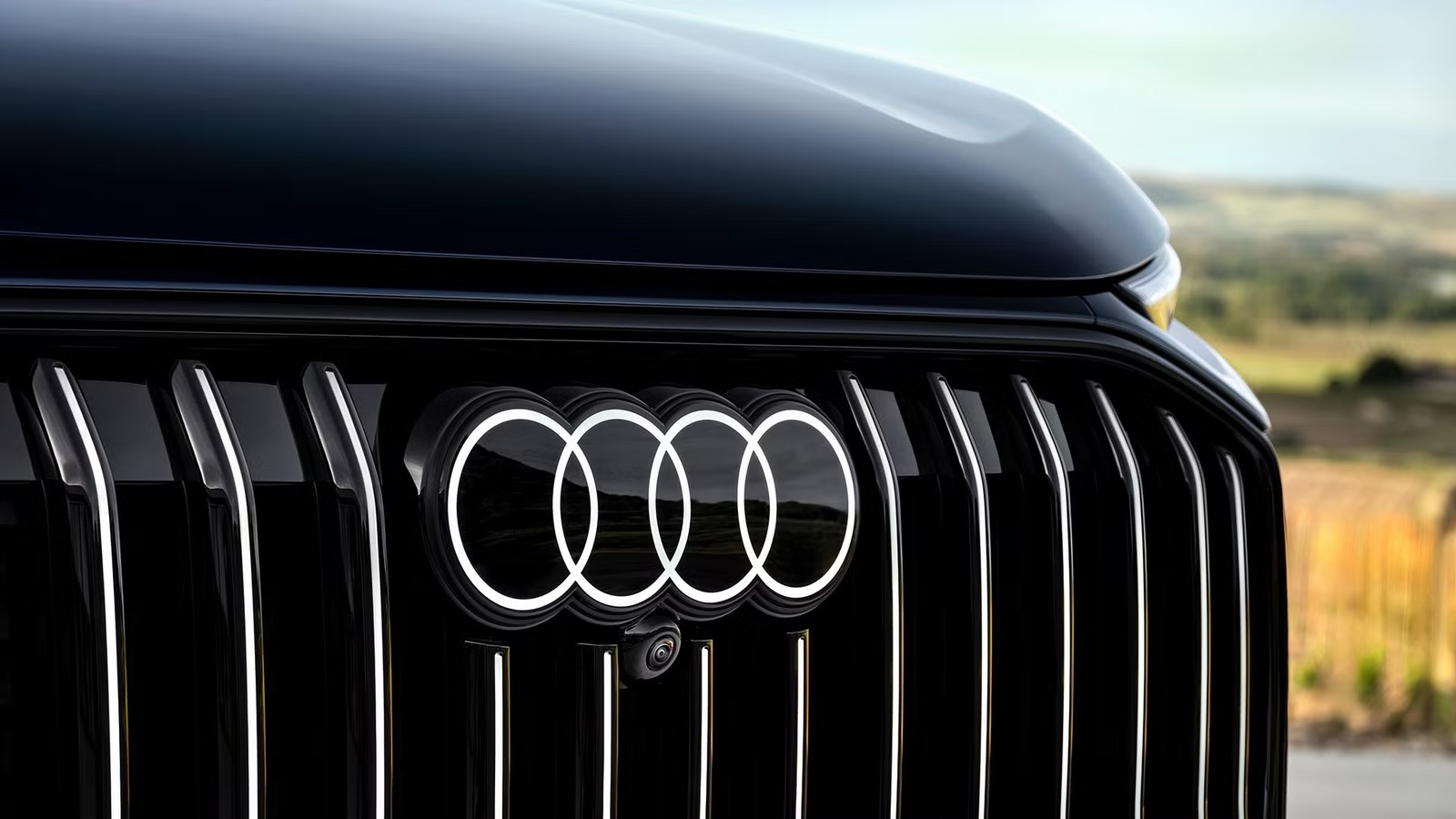
Audi is making its first foray into the large full-size SUV segment. The German manufacturer is hedging its bets on a bold new flagship that sits above its current SUV platforms and is aiming at a whole new tier of competitors and customers.

Going head-to-head against the BMW X7, Mercedes-Benz GLS, as well as established American rivals such as the Cadillac Escalade and Lincoln Navigator, does Audi’s new range-topping three-row SUV have what it takes to succeed in this popular segment – especially as it has the smallest engine of the lot?
Going One-Up On Q7 And Q8
Audi’s presence in the all-important sport utility vehicle segment thus far has been with the compact five-seat Q5, and the larger seven-seat Q7 which first debuted in 2007, was facelifted in 2010 and ran through to 2015. The second generation was built on the Volkswagen Group’s updated MLB Evo platform, and was launched in the US in 2017. It had a mid-cycle facelift in 2020 and has remained largely unchanged since then, fulfilling the requirement for a three-row SUV.

However, the Q7 is much shorter and less spacious than extended wheelbase offerings from its German rivals, such as BMW’s X7 and the Mercedes-Benz GLS. It also hasn’t been able to take on the US-built contenders produced by the likes of Cadillac and Lincoln.
Audi did spice things up in 2019 with the launch of the Q8 as the sportier, coupe-style five-seat sibling of the Q7, but it hasn’t been in a position to compete in the large full-size SUV game – until now.
Introducing the Q9: The Largest Audi Ever

Developed primarily for the US market, the new 2027 Q9 is Audi’s largest vehicle to date – a fact that Audi is exceptionally proud of, as evidenced by the language carried in the launch press releases: “The Audi Q9 is unapologetically high status,”, “it is the largest Audi of all time”, “maximum business-class comfort”, “lounge-like comfort”.
The Q9 is based on the Volkswagen Group’s latest modular Premium Platform Combustion (PPC) architecture that was developed for a new generation of longitudinally mounted combustion-engine vehicles. The new platform is already shared with the latest Audi A5, A6 and Q5, and will soon be joined by the new 2027 Q7. It is designed to accommodate greater levels of electrification – specifically mild hybrids for now – along with wider scalability, making it the perfect fit for the super-sized, ultra-luxurious and sophisticated Q9.
More importantly, it thrusts Audi straight into the sharp end of the large full-size SUV game, and convincingly so.
Straight To The Top

At an overall length of 209.1 inches, the Q9 dwarfs the outgoing Q7 in all dimensions and is almost 10 inches longer than the new 2027 Q7, with the additional benefit of 51% more cargo volume. This generous overall length makes it significantly bigger than its German rivals (beating the X7 by 5.4 inches and GLS by 4 inches), and it’s only fractionally shorter than the standard-length versions of the Escalade (211.9 in) and Navigator (210.0 in).
It’s the wheelbase measurement of 123.6 inches that really matters, though, as the Q9 not only gains 5.6 inches over the 2027 Q7, but it tops the large full-size SUV class, even beating Merc’s previously class-leading GLS (123.4 in).

This frees up a lot more space for second and third-row passengers compared to what Audi was previously able to offer its customers. As with the Q7, it can be ordered with two individual electrically adjustable center-row seats for a more luxurious six-seat configuration, or with the traditional three seats in the middle for a practical seven-seat layout.
Exceptional Space Without The Weight Penalty

Despite the substantial dimensions of the Q9, at a claimed 5,302 pounds it is, surprisingly, only 165 pounds heavier than the smaller Q7. It also undercuts the comparable X7 XDrive40i (5,452 pounds) and GLS 450 4Matic (5,523 pounds), and is around 500 pounds lighter than the body-on-frame offerings from Cadillac and Lincoln.
There’s no doubt that the Q9 is designed with exceptional luxury and opulence in mind, yet with the weight advantage over its rivals, it has the potential to be the more athletic choice – in relative terms for this full-size segment, of course.
The 2.9L V6-Sized Elephant In The Room

The Q9 uses the smallest capacity engine of the large luxury full-size SUVs, relying on a new 2.9-liter twin-turbo V6, which will also be introduced on the updated 2027 Audi Q7. As with the outgoing 3.0-litre single-turbo V6 used in the current Q7 and its other German rivals, the new Audi engine uses a 48-volt mild hybrid system.
It’s only marginally smaller than the 3.0-liter inline turbocharged sixes used in the entry-level BMW X7 xDrive40i and Mercedes-Benz GLS 450 4Matic, but on paper it has them stitched up on performance – as you would expect of an all-new vehicle compared to its rivals that have been on the market for several years.
Audi’s new V6 produces 429 hp, which is a significant increase compared to its older 3.0-liter V6 that only offers 335 hp; it delivers 54 hp more than the BMW or the Mercedes, and comes exceptionally close to nudging the Navigator’s 432 hp 3.5L unit off the top spot.

More importantly for all-round drivability, overtaking acceleration, hauling families and all their clobber, or making the most of the 7,700-pound towing capacity, the 2.9L V6 churns out 442 lb-ft of torque – 20% (73 lb-ft) more than the engine it replaces, and compared to the Merc GLS, which is especially noteworthy. It’s also 44 lb-ft up on the equivalent BMW X7. This is an impressive figure, only beaten by the naturally aspirated 6.2L V8 Escalade (460 lb-ft) and twin-turbo 3.5L V6 Navigator (510 lb-ft).
0-60 MPH In Under 5 Seconds – From A V6

Although modern smaller-capacity turbocharged engines have redefined our concept of performance, perception remains a factor in buying decisions, especially in the US where large V8s have ruled the roost for so long.
Nevertheless, the Q9’s on-paper power and torque figures, combined with its class-leading weight, promise a claimed 0-60 mph acceleration time of 4.9 seconds – the only vehicle in this group and price point to break the five-second mark. It easily beats its six-cylinder German rivals, and will get to 60 mph faster than the Escalade or Navigator (estimated at 5.5 seconds and 5.2 seconds, respectively, based on published road test data).
If that wasn’t enough to settle the argument, it’s within a whisker of the V8-powered Mercedes GLS 580’s claimed 0-60 mph time of 4.7 seconds, and is a mere 0.4 seconds off BMW’s twin-turbo V8 X7 M60i.
Laden With Luxury

The Q9’s indicative performance is an impressive feat for an SUV laden with technology and luxury. The features available to customers is simply staggering, including electrically operated doors all round, which is a first for Audi and sets the tone for its high-end premium positioning. The wide-opening doors have integrated sensors with obstacle detection that stops the door if there isn’t enough room to open fully.
Once inside, occupants are treated to what Audi says is its largest-ever panoramic sunroof, which is standard across the range. It has a glass surface of more than 1.5 square meters (16.1 sq-ft), and can be opened or tilted. Buyers can opt for switchable transparency, and even illumination of the glass roof to match the ambient light settings – with up to 84 LEDs and 30 colors to keep your passengers enthralled, or suit any mood.

For that ultimate business-class travel experience, the six-seat configuration has two electrically adjustable individual seats in the middle row that incorporate active ventilation in the seat cushion and backrest. And, naturally, there’s power adjustment and folding functions for the rear seats too.
Add in the top-end Bang & Olufsen 4D premium sound system, and a seemingly endless list of standard and optional features (such as alpaca fiber wool; Dinamica microfiber, leather and leatherette blends; fine Nappa leather; and so much more) and it’s quite evident that Audi’s premium aspirations are aimed at the stars.
SQ9 – Potent Performance

If the prospect of a V6-powered large SUV doesn’t do anything for you, then the full-fat SQ9 should do the trick. It calls on Audi’s 4.0-liter twin-turbo V8 to deliver 591 hp and 590 lb-ft, enabling it to blast to 60 mph from standstill in a mere 3.8 seconds, despite weighing around 250 pounds more than the standard Q9.
Once again that’s 0.7 seconds faster than the 523 hp X7 M60i, and 0.3 seconds better than Merc’s 603hp AMG GLS 63 – the benefit of progress and continuous evolution. Why any full-size SUV needs this level of performance is a debate for another day, but it certainly ticks the box for bragging rights.
Sources: Audi, BMW, Mercedes-Benz, Cadillac, Lincoln

Related posts


Latest Post


No Comments