
The Motorcycle You’ll Probably Keep Longer Than Your Car
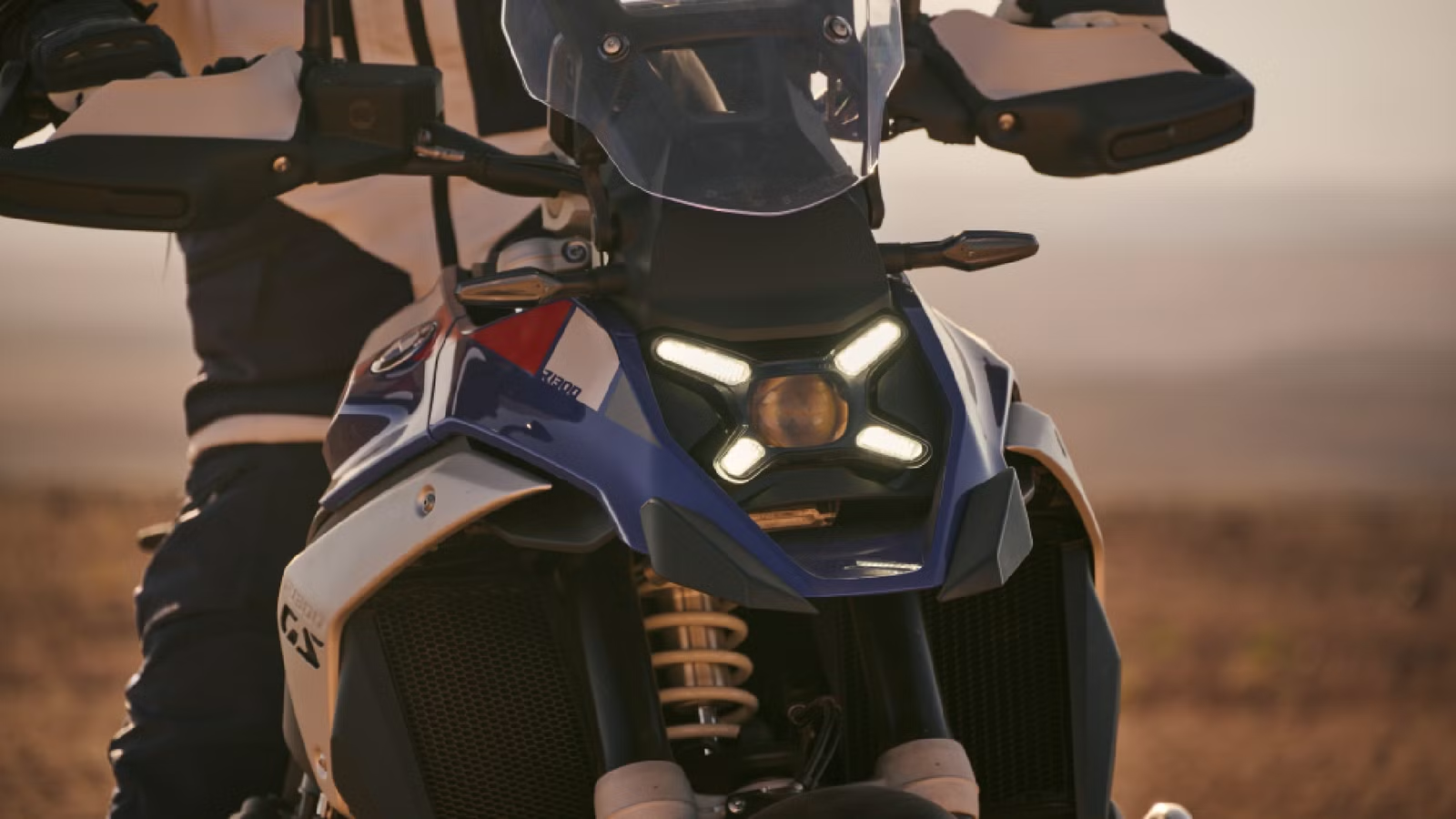
The love for motorcycles, they say, is an everlasting one. One man proved it, as much for himself as he did for the rest of the world. Helge Pedersen, a Norwegian photojournalist from Kristiansand, sold nearly everything he owned, bought one of the first BMW R80 G/S motorcycles to reach Norway, and spent the next decade riding it around the world.

Ten years and 250,000 miles later, after becoming the first to cross South America into North America through the roadless Darien Gap, the bike he called Olga was still the same one he’d left home on. If that sounds inspirational, and you want one long-term bike as well, we have a solid recommendation for you. It belongs to an adventure bike lineup with an illustrious history and to a brand that usually makes long-lasting premium machines.
BMW Has Had Several Long-Term Customers
BMW back then set the tone for ADVs to follow as the GS cemented its place in history with four Paris-Dakar wins in the early 80s. Of course, back then, options in this new category of bikes weren’t many outside the endurance rallying circuits, and adventure riding itself was a concept reserved for a few like Pedersen.


Today, things are very different, and choices are aplenty. S&P Global Mobility (now Mobility Global) puts the average vehicle on American roads today at 12.8 years old, which, surprisingly, is a record high and still climbing. The number blends brand-new leases with tired commuter cars, so it says little about loyalty than it does about people simply holding onto what they already have for longer.
A motorcycle that intends to stay in the same garage past that mark, then, needs to be special. One that has almost nothing to prove now because its history is rich enough to have countless examples of it roaming various parts of the planet, some even in areas untouched by other vehicles. The problem with choices is that the modern motorcycle is a tech-laden spaceship on two wheels.

Pick a flagship-grade adventure bike, and you’re guaranteed the latest and greatest in electronic tech that’ll help you reach further into the wilderness. The part where the machine is solid enough to get you there and bring you back, now that isn’t something you can simply haggle for in a showroom. That’s built on the kind of legacy that the GS series of motorcycles almost exclusively enjoy. And the R 1300 GS is the latest flag bearer with ample reasons to be your forever bike like its predecessor.
The BMW R 1300 GS Is The Adventure Bike Built To Be Your Last One

The current R 1300 GS starts at $20,395 and replaces the 1250’s engine with a completely redesigned 1,300cc ShiftCam BMW boxer, a new two-part frame, and the EVO Telelever front end, an evolution rather than a reinvention of what’s kept the platform trustworthy this long. It’s a familiar shape too, but with a new face and bodywork, packed with a new engine making 145 hp and 110 lb-ft while running smoother through the rev range than the boxer twins that came before it.
Living With The GS Is Easy Enough To Achieve Six-Figure Mileage And Beyond

BMW is no stranger to premium engineering, and the 1300 GS is simply built to last. One of the ways it does so is also by simplifying its upkeep. For starters, the 1300 GS needs to visit a service center every 6,000 miles for an oil change and every 12,000 for a valve clearance check on the ShiftCam system. The shaft drive removes any need for chain adjustment or maintenance at the service center or by yourself.

The horizontally opposed boxer layout also runs with less inherent vibration, so that’s a structural head start in relieving the rider of additional fatigue from vibrations. This, in no measure, is a small feat, as vibrations, especially over distances, are a major contributor to fatigue, and the big GS eliminates it.

This combination of low and easy maintenance simply makes owners keep riding it worry-free. It’s also why generations of GS owners have pushed their bikes past six figures on the odometer without a rebuild. To make the initial ownership even simpler, BMW backs the R 1300 GS with a 3-year, 36,000-mile warranty, a stretch long enough that most owners will clear several service intervals before they ever need to use it.
Chassis And Electronics Built To Never Be Outgrown

While the reliability of the R 1300 GS is unquestionable, the chassis backs up the engine with ample tech of its own. The EVO Telelever front end and EVO Paralever rear, working with a new monocoque frame, give the R 1300 GS a planted, communicative front end that riders trust on loose surfaces without the need for constant electronic intervention to stay upright.

Another reason for the big GS to be your do-it-all forever bike is the advanced suite of electronics that provide a layer of tech that’ll keep it future-proof. Four standard ride modes plus an optional Dynamics Package covering Pro-level settings and electronic suspension. This means that the same motorcycle can be dialed in for gravel or the interstate without feeling out of its depth in either environment.

The optional Automated Shift Assistant (ASA) adds another way the GS avoids being outgrown, letting a rider swap the clutch lever for fully automatic shifts or flick through gears manually with paddle triggers on the handlebar. This matters most years down the road, when a bad wrist or an aging clutch hand might otherwise be the reason for a rider to give up on riding.
You Can Keep The GS Longer Than The Africa Twin Or Multistrada V4

There are numerous people who keep cars for a long time, and only a few adventure bikes can make that cut to share the garage space with equally iconic cars. Honda’s Africa Twin Adventure Sports ES DCT is built on the same reliability-first premise with comparable pedigree to boot. At $18,599, it undercuts the GS by nearly $1,800, and its 1,084cc parallel twin makes a more modest 101 hp and 82.6 lb-ft. But what’s more enticing for long-term ownership is Honda’s own reputation for engines that simply don’t quit. It also boasts Showa electronic suspension and a tech suite to cover similar ground as the GS, but the current Africa Twin platform has only been in production since 2016, against the GS boxer’s continuous refinement since 1980.

Ducati’s Multistrada V4 sits closer on price, starting at $19,995, and it out-muscles the GS outright with 170 hp and 91 lb-ft from a 1,158cc V4. The V4 Granturismo engine inside it also breaks with Ducati’s own desmodromic tradition specifically to chase long-term reliability, and the payoff is a 37,000-mile valve service interval, roughly triple the GS’s.

The Multistrada, though much loved for its versatility, has only used its V4 Granturismo engine since 2021. Thus, the GS stands apart with its boxer architecture that has already spent more than four decades proving itself in the hands of owners racking up countless miles on and off the beaten path. It has all the makings of a bike that can even replace everything in your garage, maybe even the car.
Source: BMW Motorrad

Related posts

Latest Post


No Comments