
Over 150 Buyers Tried To Spec This Toyota Supercar Before Orders Even Opened
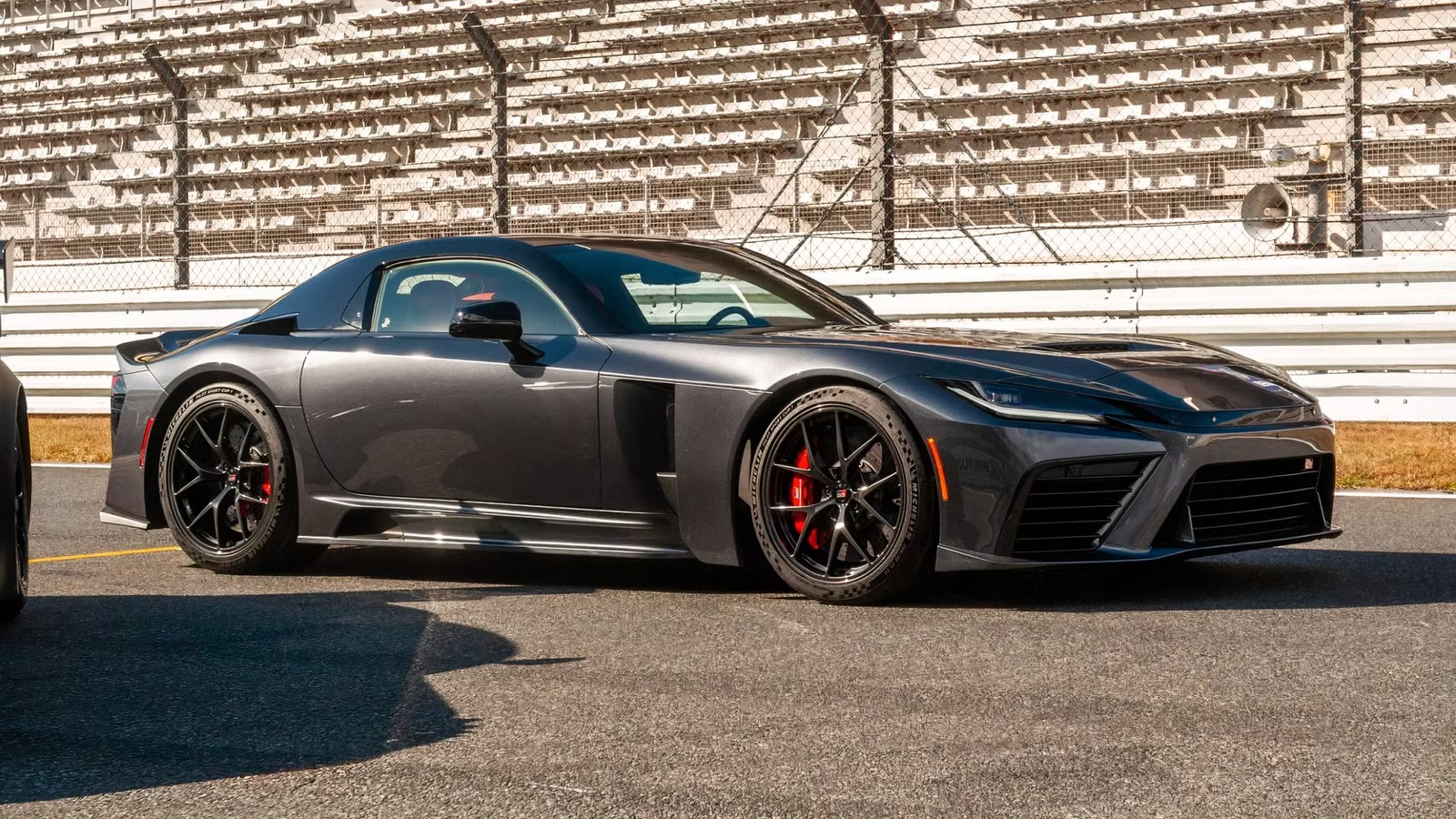
Toyota’s GR GT hasn’t reached a single customer yet, and the US allocation is already gone. Toyota Senior Vice President of Automotive Operations Andrew Gilleland confirmed at Monterey Car Week that the 200–250 units earmarked for America are fully spoken for — and that’s not a supply problem. It’s a policy.

“We’re not going to have enough to meet demand, and that’s by design,” Gilleland told The Drive. “It’s a passion project and made because Akio [Toyoda] wants a world-class performance car. We don’t want to sell cars to flippers, we only want people who are going to drive it. The first allocation is already sold.” The proof of demand arrived at The Quail during Monterey Car Week, where over 150 prospective buyers sat down with Toyota representatives to configure their GR GTs — even though Toyota wasn’t officially taking orders.
Toyota Is Vetting Buyers, Not Just Taking Checks
Getting approved to buy a GR GT requires more than having $225,000-plus to spend. Gazoo Racing Sports Car Program Director Jeff Bal confirmed earlier this year that customers must clear a vetting process before Toyota will green-light an order. The company is prioritizing buyers from its existing pool of known GR drivers — people with a documented history of actually using performance cars — rather than opening the order books to anyone willing to wire a deposit.

The mechanics of how Toyota enforces that commitment remain somewhat open. Gilleland didn’t spell out whether buyers will be required to sign a no-sale contract the way Ford famously did with the GT, which barred owners from selling within the first two years of ownership. That restriction created its own complications — most notably for John Cena, who sold his GT early and ended up in a legal dispute with Ford. Toyota appears to be taking a softer approach, relying on curated lists and factory-level oversight rather than legally binding resale restrictions. Whether that proves sufficient to keep GR GTs out of auction catalogs is a question the secondary market will eventually answer.
The Ferrari Playbook, Now With a Toyota Badge

What Toyota is executing here is a well-worn strategy in the supercar world, but one that Japanese manufacturers have rarely attempted at this level. Ferrari has spent decades controlling who receives its most desirable cars — La Ferrari, the FXX K, the SF90 XX — by requiring purchase histories, relationship depth with a dealer, and sometimes a personal sign-off from Maranello. The result is a secondary market where allocated Ferraris routinely appreciate because genuine scarcity meets verified demand.
Toyota is applying the same logic to the GR GT, and the conditions are favorable. Global production numbers haven’t been disclosed, which means the 200–250 US units represent an unknown fraction of total output. If worldwide production stays comparably tight, the scarcity premium on the secondary market could be significant — especially given that the cars are going to drivers, not collectors parking them in climate-controlled garages. A driven, documented GR GT with a verified ownership history could command a very different price than one that never turned a wheel.
What the GR GT Actually Is — And What Might Come Next
For context on why demand is running this hot: the GR GT is powered by a newly developed 4.0-liter twin-turbo V8 with hybrid assistance, producing 641 horsepower and 627 lb-ft of torque, routed to the rear wheels through a rear-mounted eight-speed automatic with a triple wet-clutch setup. Development drivers Tatsuya Kataoka and Jack Hawksworth have both emphasized its drivability and its close relationship to the GR GT3 race car heading to IMSA competition — this isn’t a road car that happens to look fast, it’s a road car built from a racing program outward.
First customer deliveries are expected in late 2027. And if the rumors hold, the GR GT lineup may not stop at one variant. Prototypes have already been spotted with larger wings and more aggressive front-end bodywork, pointing toward a track-focused RS version. Toyota hasn’t confirmed anything officially, but the sightings suggest the company is already thinking about what comes after the base car — which, if the allocation strategy carries over, will likely be even harder to get.
For anyone still hoping to land an early GR GT, Gilleland’s mention of a “first allocation” leaves a narrow door open — Toyota hasn’t ruled out additional production runs. But if this rollout is the template, the next batch won’t be easier to access. Toyota has made clear that money alone isn’t the qualifier. Knowing how to use the car is.

Related posts




Latest Post


No Comments