
The 1969 Dodge Wagon That Secretly Shared Its 440 V8 With CHP Pursuit Cars
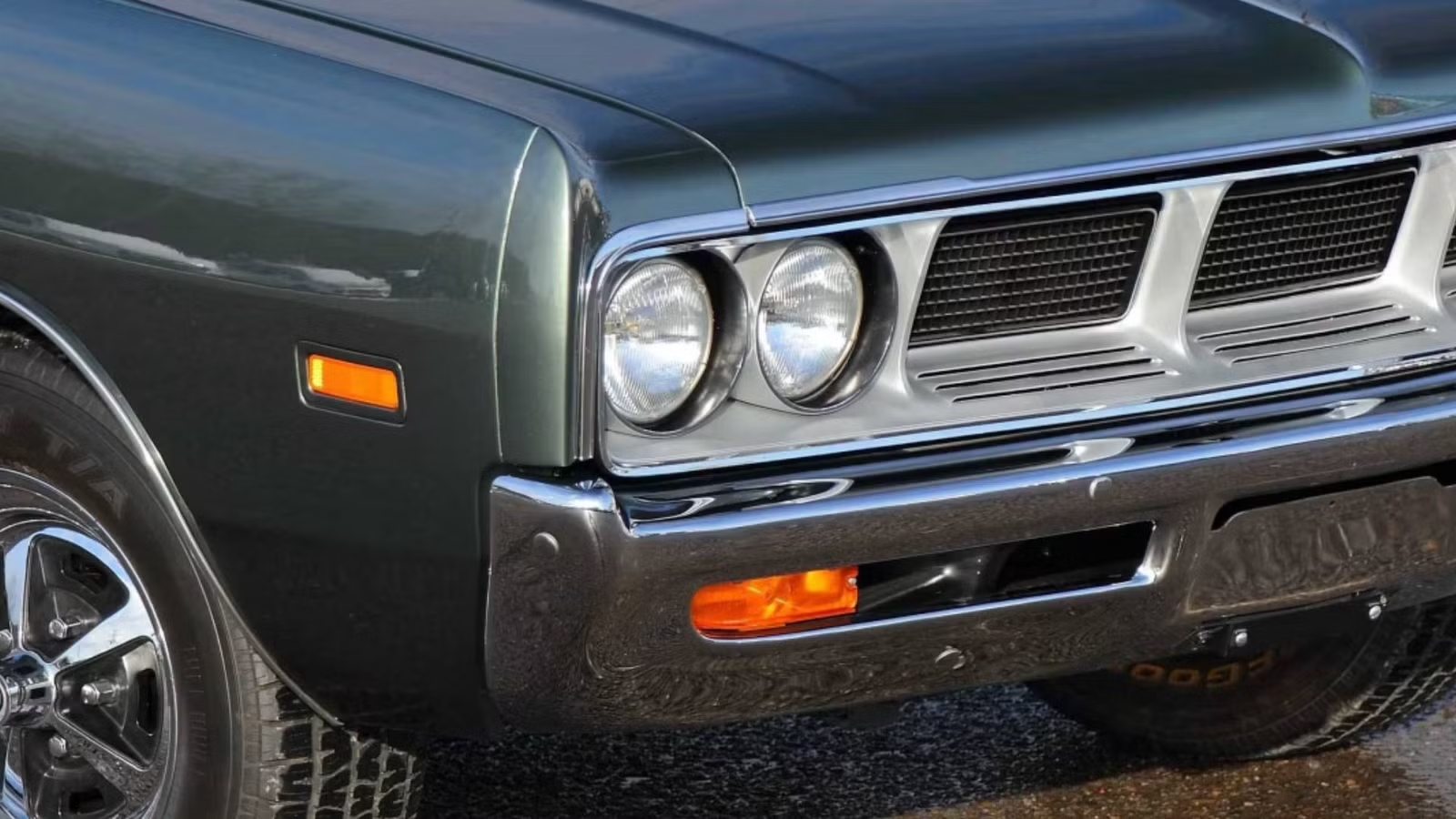
A full-size American wagon in 1969 was supposed to haul kids, luggage, and maybe a cooler the size of a small apartment. This one could also be ordered with 440 cubic inches of Chrysler big-block muscle under the hood—that same engine family powered some of California’s fastest police pursuit sedans, which paired huge torque with serious high-speed hardware. The wagon used a milder tune and carried more weight, but the connection still made it one of the strangest family haulers of the muscle-car era.
California Needed Police Cars That Could Catch Detroit’s Fastest Machines

By the end of the 1960s, American highways had become hunting grounds for increasingly serious machinery. Detroit sold big-block Chargers, Road Runners, GTOs, Torinos, Chevelles, and other cars with enough power to make an ordinary patrol sedan look hopeless once the road opened up. California made that problem especially clear – the state had spent decades expanding its freeway network, while the CHP held statewide authority over traffic enforcement on California highways. A patrol car that worked fine around town could face a very different job on long stretches of freeway, because it needed to close a gap quickly and stay there without cooking itself in the process.
That changed what a serious police package needed to do. Highway patrol work demanded hard acceleration, stable high-speed running, repeated braking, and enough cooling and durability to survive hours of use that would make an ordinary family sedan beg for retirement. Manufacturers answered with much more than radios, spotlights, and black steel wheels. Pursuit packages could combine large engines with stronger suspension pieces, bigger brakes, tougher electrical equipment, carefully chosen axle ratios, and other hardware meant for severe service.
California provided an unusually hard test. Fast roads, long distances, heat, and a huge enforcement territory rewarded cars that could maintain speed rather than merely produce a good stoplight launch. The CHP also expanded during the 1960s, and its equipment needs grew with it. By 1968, the agency had already started testing roof-mounted light bars on enforcement vehicles, another small sign that the patrol fleet kept evolving with the job. Whatever car won favor there had to function as a tool first.

Detroit’s Option Sheets Blurred The Line Between Cop Car And Family Car

The fun part about late-1960s Detroit came from how freely manufacturers mixed bodies, engines, transmissions, suspension parts, and axle ratios. Two cars wearing the same model name could have almost nothing in common once a buyer finished checking boxes. A Dodge Polara might leave the factory as a mild full-size cruiser with a small V8, or it might receive enough engine to embarrass cars with stripes and hood scoops.
Fleet hardware and civilian performance equipment also lived closer together than modern categories suggest. Police departments could specify severe-duty components as a coordinated package, while ordinary buyers could order some similar pieces individually or through towing and heavy-duty equipment groups. Dodge listed heavy-duty suspension choices, front disc brakes, power brakes, different tires, and other chassis options for Polara and Monaco customers, for example.
One pursuit sedan showed how far Dodge could take that formula. Its E86 440 Magnum produced 375 gross horsepower and 480 lb-ft of torque, and Dodge backed it with a TorqueFlite automatic, suitable gearing, heavy-duty suspension pieces, and big front discs. The closely related wagon approached the same idea from the civilian side.
The 1969 Dodge Polara Wagon Was The Pursuit Car’s Family-Hauling Cousin

The civilian half of the story arrived in the shape of the enormous 1969 Dodge Polara station wagon. The automaker offered two-seat and three-seat versions, translating to six- and nine-passenger layouts. The company wrapped them in its new full-size “Fuselage” styling, a smoother, rounder shape that tried to make more than 18 feet of automobile look relatively sleek. Dodge’s advertising talked about room, storage bins, carpeting, luggage space, and its clever Dual Action tailgate.
Then came the part that rarely made the family-sales pitch. Polara wagon buyers could step up to a 440-cubic-inch four-barrel V8. Dodge reserved a special 350-hp version for the wagon rather than installing the full 375-hp Magnum offered in other Polaras. Across the same model family, however, the CHP went considerably further. The California Highway Patrol bought 1,564 1969 Polara pursuit cars, according to period-car research that includes CHP-supplied fleet photography. Those sedans used the 440 Magnum with 375 horsepower and 480 lb-ft of torque, along with heavy-duty suspension hardware and 11-inch front discs.

The pursuit sedan earned its reputation with numbers that remain startling. Sources differ slightly, but published figures put 0–60 mph between roughly 6.3 and 6.8 seconds. Recorded or reported maximum speed lands between about 147 and 149.6 mph, with the higher figure tied to testing at Chrysler’s Chelsea, Michigan, proving ground. For a giant four-door sedan with 1969 tires, aerodynamics, and a uniformed officer behind the wheel, those numbers bordered on absurd.
The wagon carried more weight and dragged a larger, boxier rear body through the air, so nobody should treat it as a 149-mph interceptor with extra glass. Its significance comes from proximity rather than identity – it used the same 440-cubic-inch RB big-block family, kept the massive 480 lb-ft torque rating, and lived on a chassis whose option sheet could include serious brake and suspension equipment. Modern performance estimates put a 440-powered 1969 Polara wagon at roughly eight seconds to 60 mph, comfortably under nine seconds even with all that sheet metal. That made it seriously quick by family-wagon standards.
Dodge Barely Told Family Buyers What They Were Getting

Dodge’s own advertising campaign at the time helps explain why the 440 Polara wagon never earned the cultural status of a Charger R/T or Super Bee. The company sold the wagon as useful transportation. Period literature devoted its attention to storage space, seating, carpeting, tailgate design, luggage, comfort, visibility, and family convenience. The Polara wagon appeared as the sensible big Dodge, the car that made a camping trip easier and a hardware-store run less awkward.
That made the optional 440 wonderfully out of character. Dodge marketed its dedicated performance cars very differently. Its 1969 Scat Pack literature shouted about the Charger R/T, Coronet R/T, Super Bee, Swinger 340, heavy-duty suspension, four-barrel engines, dual exhausts, and straight-line muscle. The Polara wagon lived several pages away in another universe, surrounded by talk of cargo floors and window washers. Yet Dodge engineering allowed both universes to draw from the same corporate parts bin. The wagon’s 440 made less peak horsepower than the 375-hp Magnum, but 350 gross horsepower and 480 lb-ft remained enormous numbers for a vehicle designed to carry as many as nine people.

That distinction separates the Polara from cars that enthusiasts now deliberately celebrate as “muscle wagons.” Its appeal does not depend on proving that Dodge secretly built a station-wagon version of its police interceptor, because the factory records show it did not. The more interesting story concerns the option-sheet crossover – one version of the Polara platform became a 375-hp highway pursuit machine ordered by the CHP in four-figure quantities. Another carried families and could receive a 350-hp version of the same 440 big-block architecture. Civilian buyers could also add serious chassis equipment.
Detroit would soon have less freedom to create combinations like these. Congress passed the Clean Air Act in 1970 and gave federal regulators broad authority over motor-vehicle emissions, pushing automakers toward major reductions in new-car pollution during the following years. Performance cars also faced growing insurance pressure, while the 1973 energy crisis changed the public conversation around fuel consumption. Engines lost compression, priorities shifted, and full-size cars no longer enjoyed the same carefree relationship with cubic inches.
Dodge itself began reducing 440 compression and output after 1969. Seen from that angle, the big-block Polara wagon belongs to a narrow window when a customer could order a family hauler with nearly 500 lb-ft of torque and nobody at the dealership needed to hold an intervention.
The Ultimate Sleeper Was Hiding In The Station-Wagon Aisle

That leaves the 1969 Polara wagon with one of Detroit’s better contradictions. On Monday morning, a black-and-white Polara with a 375-hp 440 Magnum might patrol a California freeway, backed by heavy-duty suspension and brakes and capable of nearly 150 mph under the right conditions. Across town, another Polara could sit in a suburban driveway with three rows of seating and the proportions of a studio apartment. One existed to chase fast cars, the other existed to carry children, suitcases, groceries, lumber, and whatever else a family could fit through its enormous tailgate.
That makes the 440 Polara wagon a better sleeper than a wagon wearing an obvious muscle-car costume. It came from a moment when Detroit’s option sheets allowed combinations that now sound like someone clicked the wrong boxes. The CHP’s 1,564 pursuit Polaras showed what Dodge could do when it sharpened the full-size platform for enforcement duty. The civilian wagon showed how much of the same big-block spirit could hide inside a car marketed around vacations and cargo room.
Source: Dodge, Automobile Catalog, California Highway Patrol, Hagerty

Related posts
Latest Post


No Comments