
A $40M Ferrari EV Just Became The Most Expensive Electric Car Ever Sold — Here’s What That Means For Anyone Buying One Now
The Ferrari Luce Chassis 0 sold for $40 million at RM Sotheby’s Monterey auction on Sunday — more than 35 times the standard car’s €550,000 retail price and the highest sum ever paid for a new vehicle at auction. The previous record, set just last year by a bespoke Ferrari Daytona SP3, was $26 million. This one blew past it before most bidders had time to process the opening jump from $1 million to $5 million in a single breath.

The headline number is extraordinary, but the more interesting question is what it signals beyond the charity spectacle. Mainstream EVs have shed value at a punishing rate as supply expanded and battery technology advanced. This sale — a first-production-chassis electric car commanding a 35× premium — suggests that heritage brands with strict production limits may operate on a fundamentally different depreciation curve. Whether that logic extends to the buyers of standard Luce production cars, or to early adopters of other limited-run luxury EVs, is worth thinking through carefully.
What Made Chassis 0 Worth $40 Million
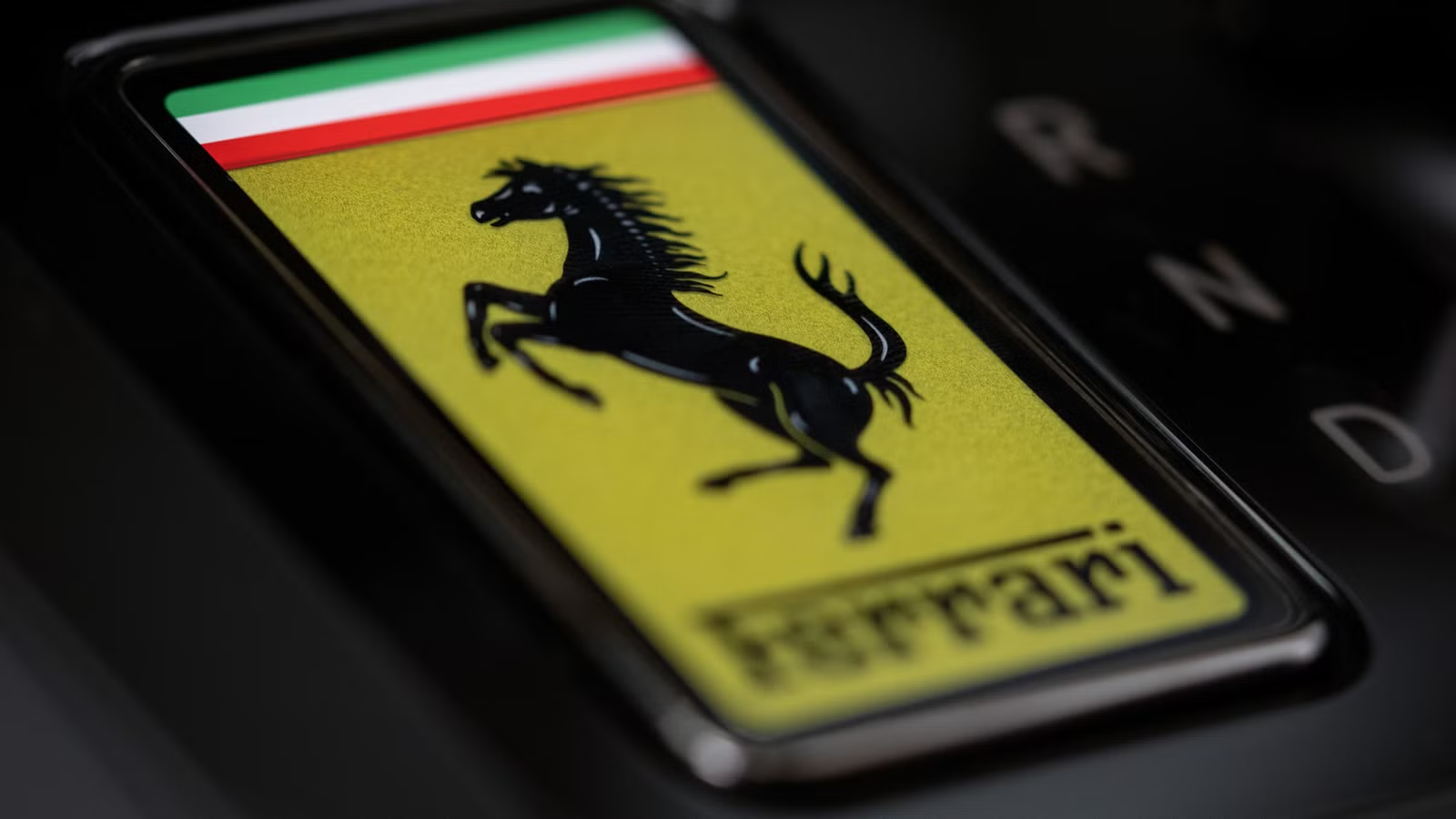
The car that crossed the block in Monterey was not simply the first Luce off the line, though that alone carries provenance value. It was also a fully bespoke Tailor Made commission: a unique Madreperla Semi-Gloss exterior developed exclusively for this car, with iridescent pigment that shifts from green to violet depending on the light, matched wheels and brake calipers, and a cabin trimmed in Le Mans metallic leather sourced from selected Swiss hides. The Ferrari badge sits against an optical-white background, and a plaque identifies it as Chassis 0. Nothing else will ever be exactly this car.
Under that paint is the full Luce powertrain: four electric motors, one per wheel, producing a combined 1,050 horsepower. Ferrari quotes 0–62 mph in 2.5 seconds and a top speed of 310 km/h, with a 122 kWh battery offering a claimed range of more than 530 km. Performance sits firmly in modern supercar territory. The charity element added a final layer — RM Sotheby’s waived its buyer’s premium, meaning the full $40 million flows to the Ferrari Foundation’s educational programs. The buyer, who has not been named, will wait until Q1 2027 for delivery while the car returns to Maranello.
The Depreciation Divide: Halo EVs vs. Mass-Market Reality

Mainstream electric vehicles have had a difficult few years on the resale market. Rapid model-year updates, expanding inventory, and improving battery technology have combined to erode used values faster than almost any comparable segment. A three-year-old Tesla Model 3 or Rivian R1T can trade at a steep discount to its original sticker, and early Lucid Air buyers have watched residuals compress sharply as the brand scaled production.
The Luce Chassis 0 sale doesn’t directly contradict that trend — it’s a charity one-off, not a market transaction — but it does illustrate the underlying logic that separates limited-production, heritage-brand EVs from mass-market alternatives. Scarcity is the key variable. Ferrari’s production volumes are deliberately constrained, and Tailor Made commissions are by definition unrepeatable. The same dynamic has historically protected values on combustion-era Ferraris; the question is whether it translates to electric ones. Early signals from the Luce suggest it might: reports indicate Ferrari has hit its 2026 production allocation, with strong demand from China absorbing early inventory. Sold-out production is the first prerequisite for residual value stability.
What This Means — And Doesn’t Mean — For Buyers

The honest caveat is that Chassis 0 is an extreme outlier. A no-reserve charity auction during Monterey Car Week, targeting deep-pocketed collectors who wanted the first all-electric Ferrari ever built and a philanthropic headline, is not a price signal for the showroom. Standard Luce production cars carry a €550,000 starting price — elevated, but a different universe from $40 million.
For buyers of standard Luce allocations, or prospective early adopters of similarly positioned EVs from Porsche or Lamborghini, the more relevant data points are production volume, brand consistency, and how quickly the broader EV market matures. Ferrari’s track record with limited combustion models — where first-owner cars frequently appreciate — offers a reasonable historical analogy, but battery technology evolution introduces a wildcard that didn’t exist for a 458 Speciale or an F40. The Luce’s 122 kWh pack is state-of-the-art today; whether it reads that way in a decade is genuinely uncertain. What Chassis 0 confirms is that collector appetite for first-generation electric supercars from the right brand is real and substantial. It doesn’t guarantee that every Luce buyer will see appreciation — but it makes the case that the depreciation cliff haunting mainstream EVs isn’t an iron law.
The Luce was controversial from the moment it appeared in May — former Ferrari chairman Luca Cordero di Montezemolo called it a risk to the brand’s legend, and Ferrari’s share price dropped sharply after the reveal. The $40 million sale won’t silence every critic, but it does reframe the conversation. Collectors voted with serious money on the first electric Ferrari ever built. That’s not nothing.

Related posts






Latest Post


No Comments