
Acura Once Built A High-Revving Coupe That Slipped Through The Cracks
Japanese fast cars of the ’80s and ’90s made their name because they were cheap. Well, cheaper than a lot of the competition, anyway, with cars like the Nissan R32 GT-R offering supercar performance for supermarket money. The turbo Toyotas and VTEC Hondas did the same, giving everyone the chance to have a fast and reliable car, just without the price tag of a high-end European marque. So what went wrong? Search the classifieds and all those JDM classics that seemed to be disposable once are now changing hands for crazy money. And, us mere mortals have all missed the boat. Or have we? It turns out that one legit JDM classic has been long forgotten — and it could be yours for a lot less than you imagine.


The ’90s Was JDM Heaven

TheGolden Era for muscle carswas the ’60s, with high-output V8s being slung into svelte coupe bodies, and affordable price tags being slapped on the windshield. This high-displacement party came to an abrupt end in the early ’70s, with gas prices skyrocketing and emissions regs becoming rapidly tougher. Since then, Japanese sports cars have acted as a replacement.
The philosophy wasn’t actually that different from muscle cars. The JDM classics of the ’80s and ’90s had a ton of power, but this time it was supplied by techy and highly strung fours and sixes that had at least one turbocharger strapped on, and sometimes a supercharger too, for good measure. Like muscle cars, the high-performance Japanese models were often based on standard coupes and sedans, with a few cheap common parts, making them relatively affordable next to European exotics. It’s no wonder that this era of Japanese cars, fueled by Initial D and touge racing, captured the imagination of enthusiasts like no other time.
The Usual Suspects Get All The Headlines

There are plenty of cars that define this era. The Acura NSX was the supercar that changed the way we looked at supercars, and the A80 Supra turbo was a Ferrari GT killer with optional nitrous. The Toyota AE86 is fun in its simplest form, and the Subaru Impreza WRX STI and Mitsubishi Evos brought WRC rallying to your daily commute.
Then there are the other Hondas. The Civic Type-R is the king of the Osaka Kanju loop, and the Integra Type-R is a coupe version of the Civic. Both come fitted with exotic VTEC engines that will rev until you swear the head will fire out of the hood like it’s Independence Day. You aren’t the only one who has noticed these JDM icons, of course. Anything fitted with a GT-R, Type-R, RX-7, or pretty much anything else from Japan fitted with a high-performance hyphen will create a bidding war at auction and go for an eye-watering amount. But there is one that everyone is forgetting.
The New 3000GT VR4 Mitsubishi Should Make
The Mitsubishi 3000GT VR4 was one of the quickest cars of the ’90s, and making a successor makes more sense than you think.
Everyone Forgot The Acura RSX Type-S

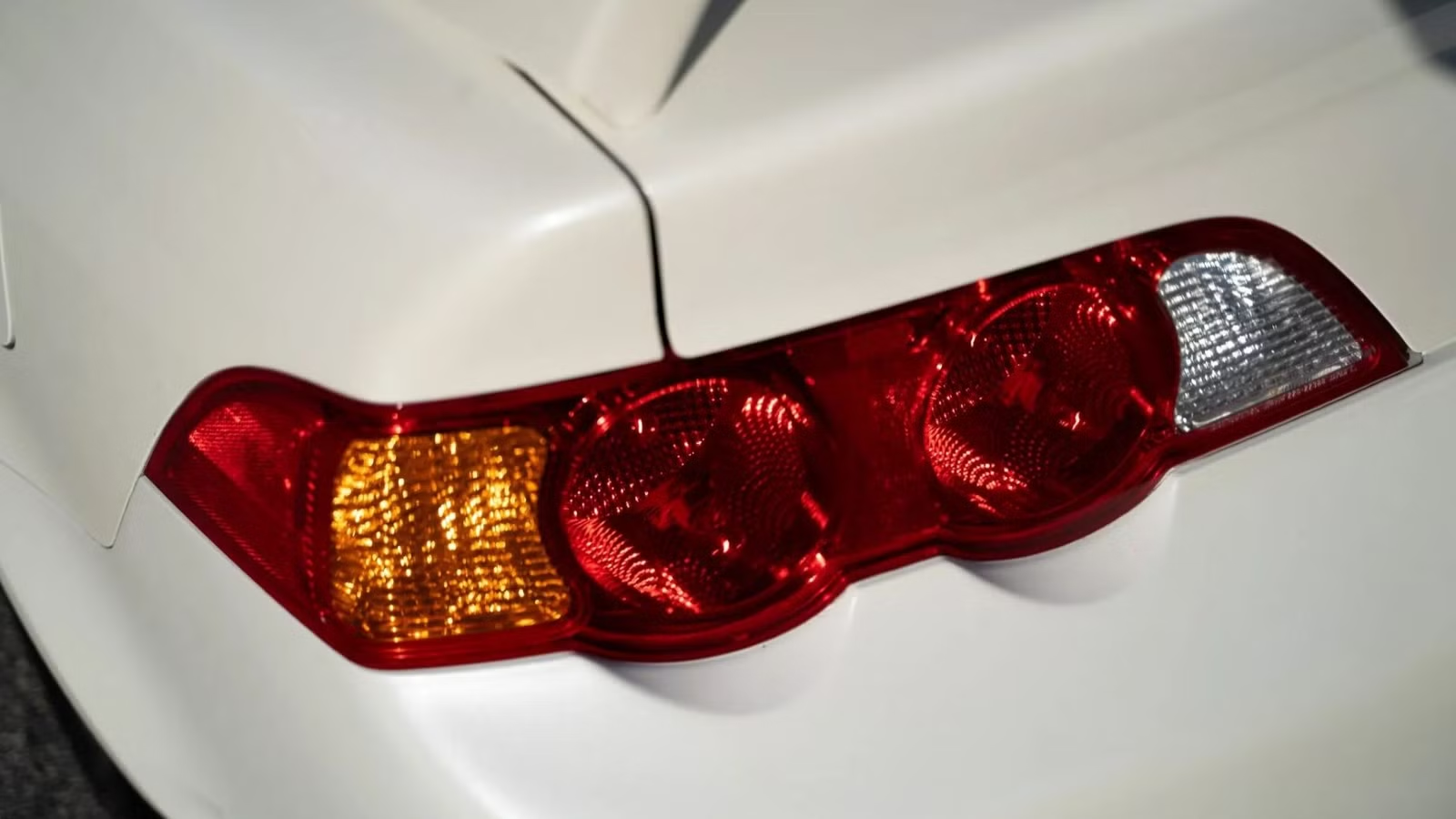
To be honest, it’s not exactly difficult to see why. The Acura RSX Type-S may have been trying to appeal to a more upmarket audience, but Honda certainly played the looks down to the point of it being aesthetically dull. You wonder whether the whole point of the RSX Type-S’s pebbly, unadorned skin was to provide the ultimate blank canvas for stick-on wings and wraps. In fact, even Acura later said that the car “hit the heart of the red-hot tuner market, which was fueled by The Fast and the Furious movie franchise that launched in 2001.” Anyway, the RSX Type-S may look a bit bland, but in reality, this was an Integra (it even had the Integra DC5 name from 2001 to 2006 in Japan), and under the hood were all the ingredients for JDM madness, even if there weren’t any red badges in sight.
The RSX Type S Has All The Ingredients To Be A JDM Legend

At the heart of the Acura RSX Type-S is the legendary K20A2 four-pot. This is the same engine you will find in an EP3 Civic Type-R. In the Acura, output sat at 200 hp and 142 lb-ft of torque, with a screaming 8,000 rpm redline. The mill is connected to a close-ratio 6-speed manual transmission exclusively.
The engine’s three-rocker arm VTEC design was similar to the NSX, varying the lift and duration of both the intake and exhaust valves to maximize power. At lower rpm, the valves followed low-lift, short-duration camshaft profiles, which ensured low-end torque, but past 5,800 rpm, the intake and exhaust valves were operated by high-lift, long-duration cam profiles for maximum high-rpm horsepower. Consider that the car had 100 hp per liter without a turbo in sight, and you realize how special it is.
The RSX Type S Has The Right Performance Credentials

2002 Acura RSX Type-S Specs
|
Engine |
2-liter VTEC four |
|
Power |
200 hp |
|
0-60 mph |
6.7 seconds |
The Integra Type-R version of the car has a 220-hp K20A, but its 6.5-second sprint to 60 mph wasn’t that much quicker than the RSX Type-S. The 2002 Type-S had a claimed sprint to 60 mph of 6.7 seconds. With a quarter mile of 14.8 seconds, it was quicker than the DC2 Integra Type R’s time of 15.2 seconds. Acura updated the RSX Type-S for 2005, giving it 210 hp and 143 lb-ft. There was also a larger eye-catching rear wing and slightly bigger 17-inch wheels wrapped in high-performance Michelin tires. This car will hit 60 mph in 6.2 seconds, and 100 mph in 16.6 seconds. That’s faster than a 2004 VW Golf R32, which comes with a naturally aspirated 240-hp 3.2-liter V6.
The Rarest Honda Ever Cost More Than Three Ferraris When New
This 2000s Honda cost hypercar money when it hit the market.
Here’s Why The RSX Type-S Is Overlooked

A lot of it comes down to the name. The Integra nameplate has become legendary in the world of fast Hondas, and, well, the RSX just hasn’t. Acura apparently wanted to have something more alphanumeric, which was seen as more contemporary at the time, as well as move the car slightly upmarket. The Type-R badge is perhaps also seen as more focused and niche (and in the past was outsold by the Integra GS-R), so Type-S was probably a bit more mass marketable. Then there are those looks. Whether Acura wanted to distance itself from the street racing image of the Fast and the Furious, or just figured that people could add their own mods, but the lack of any idiosyncratic badging or frills meant that they have become lost among other Hondas and Acuras. But now is the time to dig one out.
10 Legendary ’90s Japanese Cars That Still Crush Modern Sports Cars
Now bona fide classics, these Japanese cars remain faster than most modern sports cars.
The RSX Type S Is The JDM Icon You Can Afford

The fact that the RSX Type-S is overlooked is great news for those of us who don’t have deep enough pockets for the more obvious JDM classics. The 1997 to 2001 Integra Type-R can fetch more than $80K in top condition, says Hagerty, not to mention the insane eye-$151K record for a Type-R set in 2023. The RSX Type-S offers much of what the Type-R has, just without the hardcore image. Cars from 2002 go for $15,600 in good condition, with the more powerful (and newer) 2006 models costing $18,000. But look at the classifieds, and you’ll see slightly high-mileage cars going for more like $12,000. If you thought the JDM classic train had left the station, the RSX Type-S suggests otherwise.
Sources: Acura, Hagerty.com

Related posts


Latest Post


No Comments