
Porsche’s Secret Flachbau RS Is A 935 ‘Moby Dick’ Homage Built For The Road
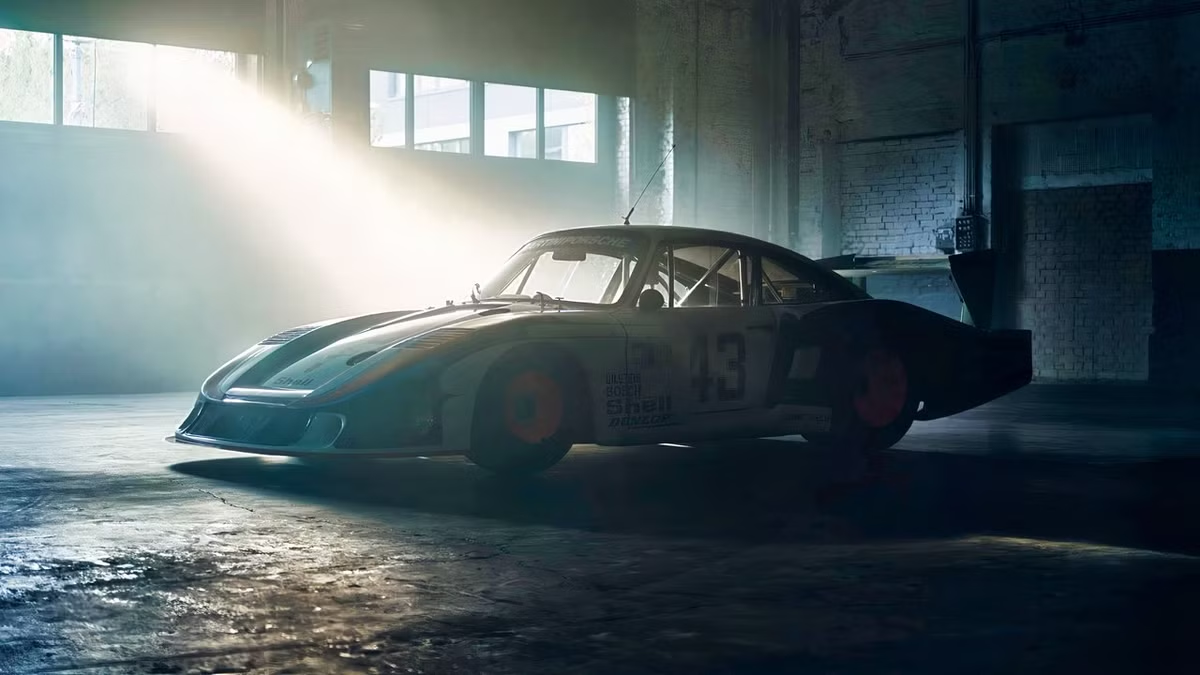
When Porsche quietly registered the model designations ‘Flachbau’ and ‘Flachbau RS’ with the European Patent Office in May 2025, the sports car world started asking questions nobody at Weissach would answer. Now, revealed on August 14, 2026, the secret is out: those filings existed because of a single, extraordinary commission—a road-legal one-off that transforms a 2018 Type 991.2 911 GT2 RS with Weissach Package into a modern Flachbau RS, built as a direct homage to the legendary 935/78 ‘Moby Dick’ Le Mans racer.

The project took nearly three years and drew on a multidisciplinary team spanning the Sonderwunsch department, Style Porsche, Weissach development engineers, Porsche Motorsport, and Manthey. The result is a road-homologated collector’s piece finished in Grand Prix White, wearing bespoke flat-fender bodywork, a new rear wing producing up to 1,221 lbs. of downforce, and a stripped interior that saves almost 70 lbs. from a car that was already obsessively weight-optimized from the factory.
The Flachbau Legacy And Why It Still Matters
The Flachbau—or Slant Nose, as it became known in English—has been woven into 911 lore since the early 1980s. Porsche offered a bespoke version of the Type 930 911 Turbo with redesigned, lower-profile front fenders and pop-up headlights, a look derived directly from the 935 racing cars that were dominating endurance circuits worldwide. Between 1982 and 1989, just 948 examples of this special version were sold through the Sonderwunsch program. Even accounting for later third-party conversions, Flachbau 911s remain among the rarest and most sought-after variants in the entire model family.

The 935 itself, developed from the Type 930 911 Turbo, arrived in 1976 and immediately rewrote the endurance racing record books. Porsche won the World Championship for Makes four consecutive times with it, claimed multiple victories at the 12 Hours of Sebring and 24 Hours of Daytona, and scored both class wins and outright victories at Le Mans. The 935/78 variant—stretched, widened, and dramatically lowered—earned its ‘Moby Dick’ nickname from the elongated, whale-like silhouette that set it apart even in a field of purpose-built racers. That shape is what the new Flachbau RS is reaching back toward.
Grant Larson’s Design: Honoring The 935 Without Copying It

Porsche brought in retired designer Grant Larson to lead the project, and the choice was deliberate. Larson was the designer behind the modern 935 clubsport racer that Porsche unveiled at Rennsport Reunion VI in 2018 to mark 70 years of Porsche sports cars—a 700 PS limited run of just 77 units. Having him interpret the Flachbau RS meant the car would be shaped by someone who had already thought deeply about how the 935’s design language translates into contemporary form.
The front fenders sit lower than on a standard GT2 RS and incorporate slatted louvers that vent the wheel arches and reduce internal air pressure—a functional nod to the 935’s aerodynamic philosophy. Because the new fender contour changes the front-end geometry, the fuel filler flap and its underlying mechanism also required modification. The front bumper was completely redesigned, and subtle canards developed by Manthey reinforce aerodynamic performance at the nose.

Headlights were a particular challenge. The round units of the standard GT2 RS were replaced by a stacked three-element LED system—high beam, low beam, and daytime running lights arranged in tiers. The low beam and high beam each measure just under 1.5 inches in height; the daytime running light strip is even slimmer at less than 0.78 inches. The result is the narrow, horizontal lamp signature that echoes the 935’s racing-spec lighting without resorting to period-correct pastiche.
The color scheme completes the homage. Grand Prix White—a Porsche color introduced for the 911 in 1974—was matched precisely to a historic 911 from the Porsche AG collection, making the shade specific to this car rather than pulled from a current paint catalog. Hood and roof stripes, a center stripe in exposed carbon fiber, and a U-shaped contrasting graphic at the front directly reference the Martini livery of the 935/78. Matte black sections and carbon-fiber accents provide contrast against the white, while Grand Prix White aero discs on the rear wheels and deep-black brake calipers tie the exterior together.
The Rear Wing: S-Shaped Mounts, Three Positions, 1,221 Pounds Of Downforce

The most technically significant element of the Flachbau RS is its rear wing, and it’s the component that required the most engineering work. Inspired by the wing on the 911 GT3 R rennsport (Type 992) but mounted almost two inches higher on this car, it uses distinctive S-shaped mounts that are now patent-protected along with the adjustment mechanism and position markings.
The wing adjusts manually to three positions, each calibrated for different track requirements. In both the ‘High Downforce’ and ‘Low Downforce’ settings, rear-axle downforce is two and three percent higher, respectively, compared to a standard 911 GT2 RS fitted with a Manthey Kit in the equivalent wing positions. At a top track speed of approximately 211 mph in the ‘High Downforce’ setting, the Flachbau RS generates approximately 1,221 lbs. of downforce on the rear axle alone. The front splitter, Manthey underbody structure, and rear diffuser work in concert with the wing to manage the full aerodynamic picture, while carbon-fiber aero discs on the rear wheels reduce drag.
Spartan Inside: Stripping 70 Pounds From An Already Lean Machine

The interior of the Flachbau RS tells the story of a car built for performance above comfort—but not without character. Forward of the seats, the original red Alcantara, black leather, and exposed carbon fiber of the GT2 RS were retained. Behind the seats, the approach shifts entirely.
Porsche removed the Porsche Communication Management (PCM) system and replaced it with a leather-trimmed storage compartment. Every component of the audio system was taken out. Sound-deadening materials and floor coverings throughout the cabin and luggage compartment were largely eliminated. The newly routed wiring harness has been left deliberately exposed, covered only by protective sheathing, with individual wires that served deleted components removed entirely. Exposed metal surfaces in the rear of the cabin are painted in Grand Prix White—a detail that reads as race-car honest rather than unfinished.

Selected surfaces, including the armrest extension, are trimmed in carbon fiber. The carbon-fiber bucket seats carry ‘Flachbau RS’ embroidery on their headrests, and behind them the stylized outline of the Nürburgring-Nordschleife is visible—a quiet acknowledgment of where this car was validated. On the passenger side of the dashboard, a gold-colored badge reads ‘Sonderwunsch,’ and an engraved plate carries the inscription ‘Werksunikat 2026 – Flachbau RS’—factory one-off.
Even mandatory road-car items like the warning triangle and towing eye were reconsidered. Their conventional body-mounted locations were removed; the items now live in a removable box that can be taken out entirely when the car is used on track. The total weight saving across all these measures comes to almost 70 lbs.—a figure that Alexander Fabig, Porsche’s Vice President for Product Offering and Individualization, described as anything but trivial: ‘The 911 GT2 RS with Weissach Package is a sports model that is already uncompromisingly optimized in terms of weight reduction.’
Three Years Of Validation: Crash Sims, CFD, And 50 Laps On The Nürburgring Nordschleife

A one-off of this complexity doesn’t reach road-legal status without a testing program that would be recognizable to a production-car engineer. Porsche’s validation process began in the digital domain: crash simulations, airbag deployment validation, structural analysis focused on the loads imposed by the large rear wing, and CFD aerodynamic modeling to optimize the overall design. Only after those virtual tests were completed did tooling production for the modified components receive approval.
Physical testing followed. The rear wing was subjected to extreme vibrations on a hydropulse test rig—simulating road-use loads at an accelerated rate—and its static load-bearing capacity was independently verified. Three test vehicles were constructed to carry out validation in lighting and wind tunnels, and for real-world road work. Numerous test sessions at Mendig airfield, endurance testing at the Weissach development center, and 50 laps on the Nürburgring-Nordschleife combined to simulate approximately 93,200 miles (150,000 km) of customer use on the rear wing alone.

Porsche test driver Lars Kern drove the car on the Nordschleife and offered a direct assessment: ‘The Flachbau RS remains extremely stable and precise even at very high speeds. This is exactly the kind of feedback needed in order to validate such a radically altered body design.’ The camouflaged test car’s Nordschleife laps didn’t stay secret for long—videos appeared on social media almost immediately, adding to the months of speculation that the May 2025 patent filings had already generated. The car is now homologated for road use in Europe.
Sonderwunsch And The Meaning Of A True Factory One-Off
The Sonderwunsch program—the name translates literally as ‘special wish’—has always existed to fulfill commissions that fall outside what any configurator can offer. In this case, the customer brought a like-new 2018 GT2 RS to Porsche and asked for something that required nearly three years of engineering, design, and testing to deliver responsibly. The powertrain was left untouched by agreement with the customer, which meant every performance gain had to come from aerodynamics and weight reduction rather than additional power.
The depth of the team assembled—Style Porsche, Weissach development, Porsche Motorsport, and Manthey, the Nürburgring-based racing and engineering company in which Porsche AG holds a 51 percent stake—reflects how seriously the project was treated. Manthey’s involvement is particularly relevant given the company’s record on the Nordschleife and its existing GT2 RS performance kit work; earlier in 2026, a GT2 RS with Manthey Kit reclaimed the production car lap record at Michelin Raceway Road Atlanta.
For collectors and Porsche historians, the Flachbau RS sits at the intersection of several significant threads: the Sonderwunsch tradition, the Flachbau lineage with its 948-unit production run, and the 935/78’s racing mythology. There is exactly one of these cars in existence. The ‘Werksunikat 2026’ plate on the dashboard says everything that needs to be said about its place in the 911 canon.

Related posts


Latest Post


No Comments