
The LS-Powered Australian Family Sedan Americans Can Finally Import
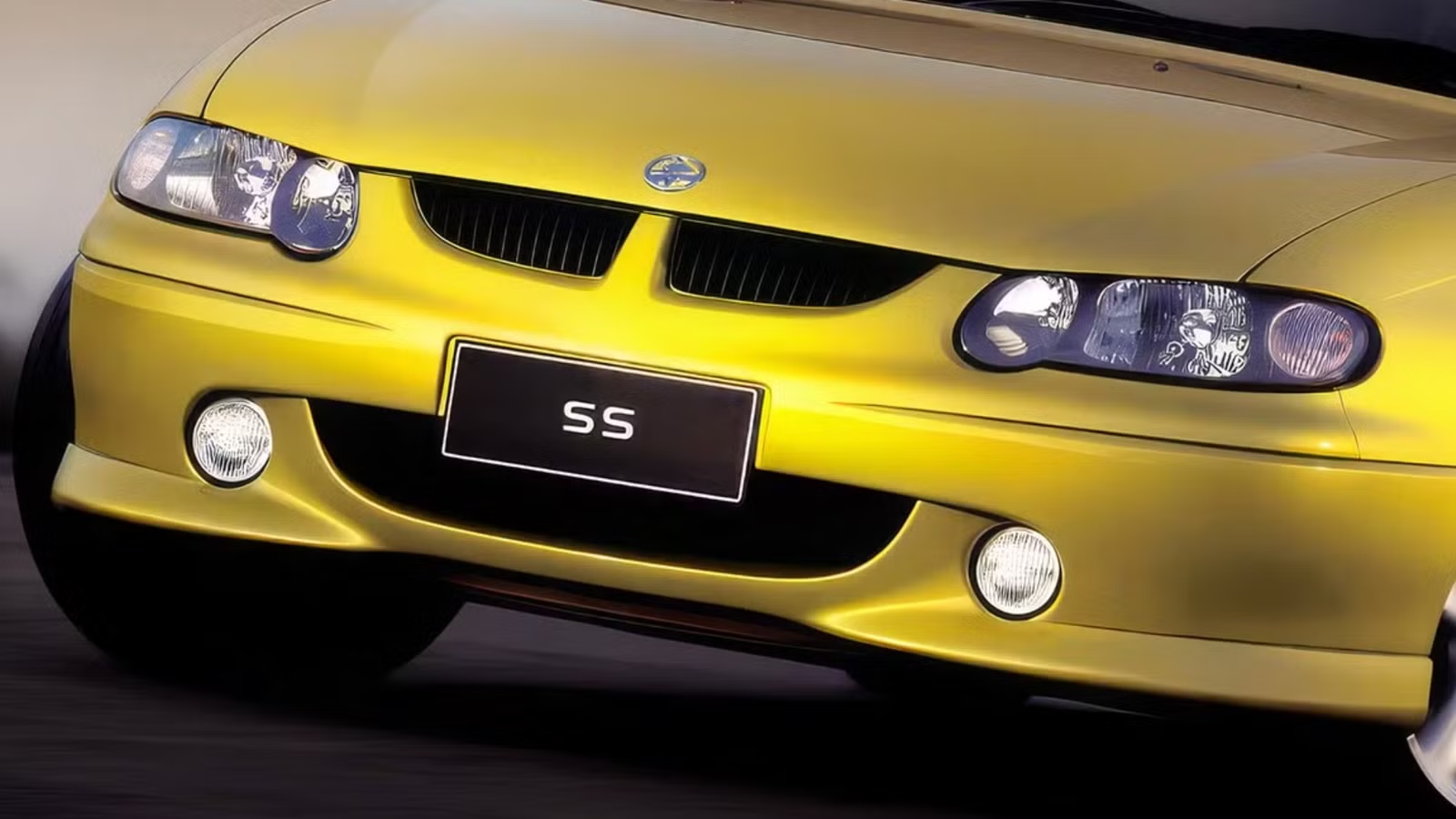
The LS1 engine was General Motors’ go-to small-block V8 engine from 1997 to 2004. As the first engine in the Gen III V8 family, the 5.7-liter mill was used in several applications within the GM fold, including the Chevrolet Corvette, Camaro and the Pontiac Firebird.

It was also shipped to Australia and installed in a humble four-door family car and a quirky pickup, and now these LS1-powered sleepers are eligible for import to the US, making them a fascinating proposition for V8 enthusiasts.
The LS1 – An Instant Hit
GM’s introduction of the LS1 in 1997 was a watershed moment for the company, replacing the Gen II LT1 that debuted in 1992. The LS1, with its all-new design and third-generation architecture, provided the foundation for basically every GM performance V8 that followed over the next two decades.

Its key upgrades over the LT1 included six-bolt main bearing caps for increased strength, improved cylinder head and intake design, and reduced weight. It also came with a much greater scope for a wide range of affordable and easily unleashed performance upgrades.
From Sports Cars To Hot Rods, Desert Racers And More

The LS1 was first seen in the 1997 Corvette, producing 345–350 horsepower. The following year, it was rolled out to the Camaro Z28 and SS with 305–325 horsepower on tap, as well as the Pontiac Firebird (up to 325 hp). It was later also used in the fully imported Pontiac GTO, albeit just for the 2004 model year before it was replaced with the LS2. This GTO was produced by GM’s Australian division, Holden, based on its Monaro coupe.
Not surprisingly, the LS1’s reach extended well beyond its production car roots. With a rapidly growing support base and readily available parts supply, it was soon widely adopted by car tuners and modifiers, and commonly used for engine swaps in all manner of vehicles – from classic muscle cars to hot rods, off-road trucks and race cars. And it ended up becoming a huge hit far away from its Michigan home, in The Land Down Under.
Across the Pacific And Into A Family Sedan

While the LS1 was reserved for GM’s sports car lineup in the US, it was shipped to Australia and installed in a regular rear-wheel drive four-door family car. It became the mainstay of the top-spec luxury and high-performance Holden Commodore models, encompassing several generations comprising the VT (1999–2000), VX (2000–2002) and VY models (2002–2004), as well as the first model year of the VZ generation that was launched in late 2004. As with the Vauxhall brand in the UK, GM owns the Holden nameplate in Australia.
The Aussies loved their big family sedans, with two major contenders going head-to-head for sales domination. The original Ford Falcon was launched in 1960, while the first Holden Commodore (VB) followed in 1978, setting off an instant war on the sales charts.
This battle was further intensified on the country’s racetracks, too, as Holden and Ford fought it out for supremacy in the Australian Touring Car Championship, which was later replaced by its extremely competitive and entertaining V8 Supercars series, headlined by the internationally renowned Bathurst 1000, held annually at the Mount Panorama Circuit. Predictably, this on and off-track rivalry led to fiercely patriotic followers that fell into either the Holden or Ford camp.
Australia’s Best-Selling Car

The Commodore ended up being Australia’s best-selling passenger car for 15 consecutive years, from 1996 to 2010. Approximately 2.9-million units were produced over its lifespan of 39 years, cementing its place in Australia’s automotive history.
The popularity of this large, rear-wheel-drive sedan (along with the wagon and Ute pickup variants) wasn’t limited just to Australia, though, as it was also exported to selected overseas markets badged as the Chevrolet Lumina (sold in South Africa from 2004 to 2013, and in the Middle East), or the Chevrolet Omega (Brazil).
The V8-powered SS models garnered an enthusiastic following in these countries, which continues today – even though production ended in 2017 with the demise of domestic vehicle manufacturing in Australia.
A New Era In V8 Performance

During the heyday of the V8-powered family muscle car era in Australia, the introduction of the LS1 marked a significant change in Holden’s V8 heritage. For the 1999 model year, it replaced the company’s Australian-built pushrod 5.0-liter V8 that had been in production for more than three decades and developed just 240 hp at its peak.
Although some enthusiasts lamented the switch to the imported LS1, the benefits were immediately clear. It was significantly lighter than the old Holden V8 thanks to the aluminum block and heads, had superior performance with sequential electronic fuel injection and modern ignition, and allowed extensive and affordable tuning ability.

Overall, it was a much better package, with the Commodore SS offering thrilling performance. Power progressively climbed from 295 hp in the VT to 302 hp in the VX – the latter achieving a 0-62 mph time of six seconds, with the four-speed automatic around half a second slower. This made it one of Australia’s fastest production cars at the time.
LS1 Family Muscle Car, Pickup And Coupe

It’s hard to beat the combination of an LS1 V8, rear-wheel drive, and a six-speed manual, all packaged in a spacious, comfortable, and slightly obscure full-size four-door family car. This recipe eventually did make its way to the US as the fully imported Chevrolet SS, which was produced by Holden in Australia (based on the VF Commodore) in left-hand drive, and sold from 2014 to 2017 with the later 415 hp LS3 V8.

The Commodore Ute was a madcap but characterful addition to the line-up, and available in various generations from 1990-2017. The term “ute” was a colloquial abbreviation for “utility” and was formally adopted as the model name in 1990. It was certainly no hard-slogging utility vehicle but rather a muscle-bound brute dressed in a tailored suit, especially in V8-powered SS guise from 1997. As with its four-door siblings, the first SS model initially used the old Holden V8 for the first two years of production, before moving to the LS1 engine in 1999, followed by the L98, L77 and ultimately the 6.2-liter LS3.

Holden also set out to position the Commodore platform as a more upmarket and exclusive two-door sports coupe. Badged as the Holden Monaro in Australia (and the Vauxhall Monaro in the UK), the GM-powered car was, rather ironically, converted to left-hand drive and exported to the US as the Pontiac GTO, which was sold from 2004 to 2006. The 2004 Pontiac GTO had a 350 hp LS1, while the later cars used the 6.0-liter LS2 that produced around 400 hp.
So, although American V8 enthusiasts can get their Commodore-based kicks with the LHD Chev SS and Pontiac GTO, there’s a unique charm and intrigue offered by the original RHD Commodore SS, in sedan or the quirky Ute body styles, or the Monaro coupe for something a bit sleeker and more sophisticated. All of these are guaranteed to garner significant interest at any Cars and Coffee event.
Pick Of The VX-Generation Bunch

While there are a variety of luxury-oriented Commodore models that used the LS1 V8 (Executive, Acclaim, Berlina, Calais), the VX-generation SS is the pick of the bunch (in six-speed manual, of course) for anyone keen on importing a car to the US under the 25-year import rule. Although based on the VT, the more evolved VX had several styling tweaks, improved suspension tuning, enhanced safety features and increased horsepower and torque – especially in the tweaked VX Series II that was launched in late 2001.
Commodore SS prices vary according to mileage, condition, and exclusivity, but in Australia you’re looking at around AUS $16,000 (US $11,300) at the low end with high mileage, to over AUS $30,000 (US $21,200) for a decent Commodore SS that has been exceptionally well maintained with fewer than 60,000 miles. Collector cars will be upwards of AUS $35,000–50,000 (US $24,700–35,300).
Later Models, LS3 Power

In coming years, the later generations will also be worth considering when they hit the 25-year mark, with the benefit of even beefier engines (up to the mighty LS3) delivering a significant boost in performance, along with sharper styling, greater refinement and features.
While the Commodore SS was built by Holden, Holden Special Vehicles (HSV) produced even more extreme versions of the Commodore as a joint venture between Holden and Tom Walkinshaw Racing (TWR). HSV also ran the manufacturer’s motorsport program from 1990. The Commodore SS served as the base for a dazzling variety of limited-run special editions, such as the GTS, GTSR, Clubsport, SV6000 and Maloo – most of which will be prized collectors’ cars, and more valuable than the standard SS.

If you’re patient and looking for something really unusual to import to the US in the next couple of years, the HSV Ute Maloo R8 will be an intriguing option, although very limited in numbers. The VZ-gen Maloo R8 was credited as the “World’s Fastest Ute” when it was launched in 2004, clocking an average speed of 168.7 mph—wild and wacky indeed. High-mileage examples start at around AUS $25,000 (US $18,000), jumping to mid-range options between AUS $40,000-65,000 (US $28,000-46,000) for cars with 43,000-80,000 miles on the clock. For an immaculate 2004 low-miler, you can expect to pay AUS $85,000 (US $60,000).
Sources: Holden, Holden Special Vehicles, General Motors, Car Sales, Cars Guide, Just Cars

Related posts


Latest Post




No Comments