
The Ancient Chevy V8 That Hot Rodders Pick Over The LS In Crate Catalogs
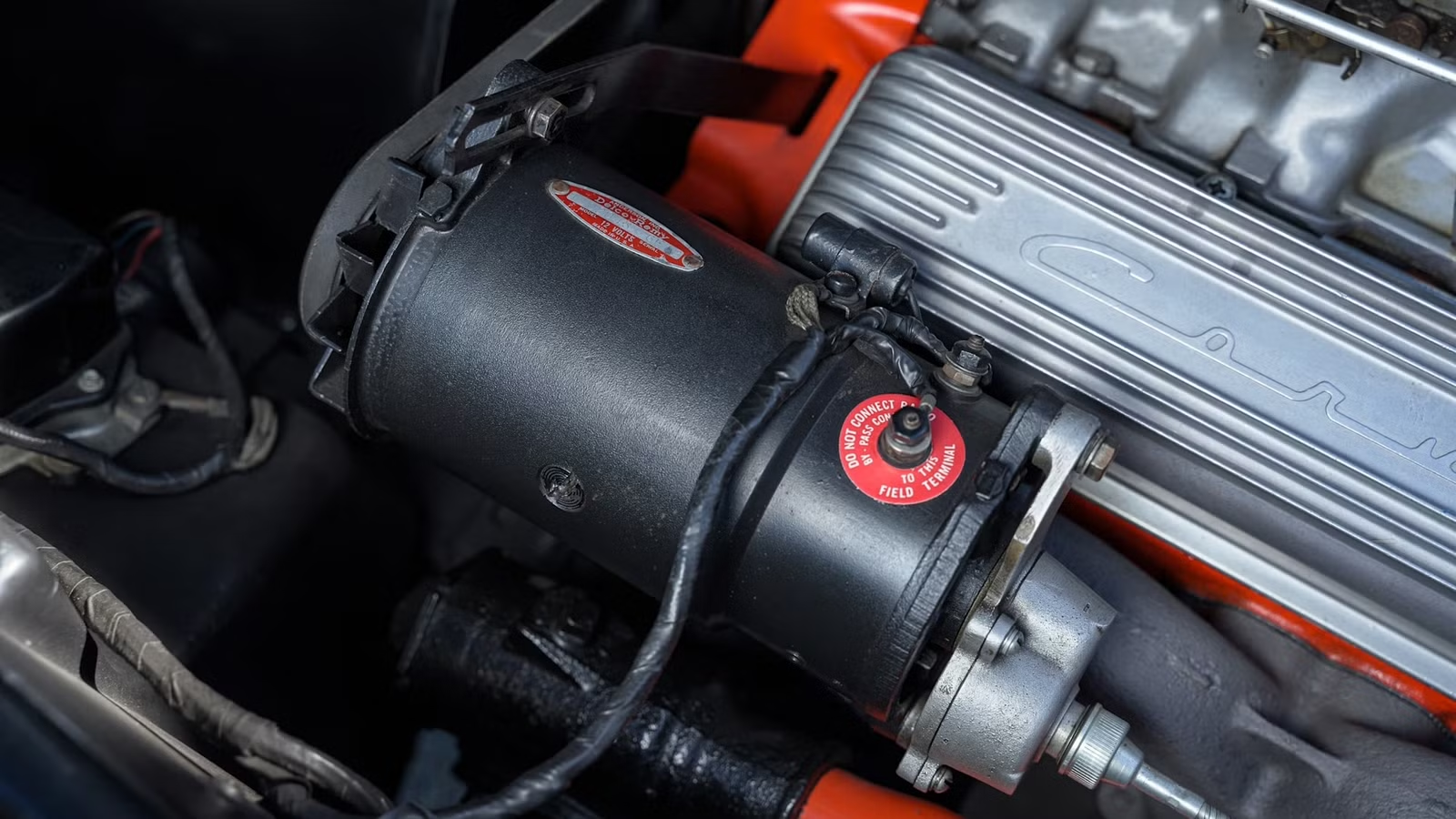
Look, I’m not here to throw shade on the iconic LS crate engine. It’s an excellent piece of Chevrolet engineering that plenty of builders choose for its strong power. However, it overshadows an older engine that remains highly popular despite being decades older. The LS engine is oversaturated in the hobby, as it stands out as the incorrect option for period-correct builds at cars-and-coffee and other enthusiast events. Plus, this V8 engine is affordable, easy to work on, and nearly as popular as the LS engine.
Chevy Needed A Better V8 To Compete Against Rivals

In the early 1950s, Chevy was lacking a little muscle. Sure, there was the 216.5 cubic-inch (3.5-liter) Stovebolt six with its 90 horsepower and 170 lb-ft of torque. Also, there was the 235.5 cubic-inch (3.9-liter) Blue Flame overhead-valve inline-six engine with between 115 and 150 hp and 209 to 223 lb-ft of torque.
Meanwhile, the Ford overhead-valve (OHV) V8 suddenly became extremely popular as soon as it hit the streets. The 239 cubic-inch (3.9-liter) Y-Block engine delivered 130 hp and 214 lb-ft of torque. That engine was easy to tune and upgrade. As a result, the 292 cubic-inch variant in 1955 churned out 198 hp in the Thunderbird and Mercury police packages.
Also, the Chrysler FirePower Hemi was getting started. It debuted with 331 cubic inches (5.4 liters) while producing between 250 and 300 hp and 340 to 345 lb-ft of torque. It later evolved to crank out 345 hp, becoming an unrelenting king of drag racing. So, Chevy needed to quickly go back to the drawing board to develop a new V8 engine that could compete with rivals.

The 265 Small-Block V8 Saved The Day

Unlike the oversaturated LS engine, the small block Chevy V8 engine has true historical heritage. Famous Chevy Chief Engineer Ed Cole designed the “Turbo-Fire” 265 cubic-inch small-block V8, which helped launch his career. He later became the head of General Motors. Plus, the 265 V8 engine turned Chevy passenger cars into popular high-performance options.
The engine features a 90-degree V8 layout, overhead valves, and 4.4-inch bore spacing. This allowed for massive future displacement increases up to over 400 cubic inches. It is compact and weighs about 40 to 50 pounds less than the older Stovebolt engine. Its thin-wall casting is only 1.25 inches, which dramatically cuts weight while improving heat transfer.
The over-square dimensions include a 3.75-inch bore and a 3.00-inch stroke for high-RPM breathing. High-turbulence, wedge-shaped combustion chambers improve efficiency and complete fuel burn, while the stamped rocker arms pivot on a spherical ball-stud design that eliminates heavy shafts to allow self-alignment.
The base two-barrel carburetor variant provides 162 hp and 257 lb-ft of torque. Then the dual four-barrel carburetor version produces 240 hp and 270 lb-ft of torque in the Corvette. Speaking of which, the Corvette was actually in a sales slump before this engine arrived, and the 265 is credited with saving the life of the iconic sports car. Where would enthusiasts be today if the beloved Corvette met an early grave?
The 265 Has Quite The Legacy

Your favorite muscle car or engine may exist because of the mighty Chevy small block’s adaptability. For example, in 1957 the original 265’s cylinder bores were increased to 3.875 inches diameter, bringing displacement up to 283 cubic inches. As a result, the Chevy Corvette was able to become the first American production car to achieve 1-hp-per-cubic-inch with fuel injection. It provides 283 hp and 300 lb-ft of torque and helps the Corvette accelerate from 0 to 60 mph in about 5.2 seconds with a 14.3-second quarter mile time.
In 1962, the engine was expanded to 327 cubic inches with a 4.00-inch bore and a 3.24-inch stroke. It was enhanced to provide more power for high-performance passenger cars, and you guessed it, the Corvette. The Corvette 327 delivers up to 375 hp and 350 lb-ft of torque. It accelerates from 0 to 60 mph in roughly 5.5 seconds and completes a quarter mile in about 14.2 seconds when equipped with the four-speed manual transmission.

This timeline continues with the 350 cubic-inch variant in 1967. The V8 engine gained a 3.48-inch stroke, allowing it to become a small-block workhorse in trucks and dominate rival muscle cars. With the Camaro SS, this engine was rated at 295 hp, but historians believe the figure is actually closer to 350 to 400 hp. It churns out 380 lb-ft of torque with the ability to accelerate from 0 to 60 mph in around 7.7 seconds and clear a quarter mile in about 15.4 seconds.
In 1970, the 400 cubic-inch (6.60-liter) small block Turbo-Fire V8 was born. It features a 4.124-inch bore and a 3.75-inch stroke. It was designed for low-end torque in utility vehicles and passenger cars like the Chevy Impala and Suburban. The engine pumps out 150 to 265 hp and 400 lb-ft of torque. This variant helps cars accelerate from 0 to 60 mph in about 9.5 seconds, but it doesn’t have a dedicated quarter-mile time, as it wasn’t placed in a high-performance muscle car or dedicated drag racer.
The Small-Block Chevy Remains Highly Popular Among Hot Rodders

While the LS engine is highly coveted as the ultimate engine for builders, the older small block has nearly matched it in terms of production and sales. The first-generation small-block V8 engine family lasted in production for 47 years until 2003. It’s still available as a crate engine, and General Motors has shared that it’s produced over 100 million units. The LS engine came out in 1997 and crossed the 100 million mark in 2011.
The small-block Chevy engine costs about $2,000 to $2,500, while the LS rings in at $7,000 to $10,000. However, LS engines can be found in junkyards and cost between $500 and $1,500 before rebuilding. A standard LS rebuild costs between $1,500 and over $9,000 depending on parts selections and if you do it yourself or hire a shop to handle it.
Plus, the small-block Chevy gives hot rodders that important period-correct status. They stand out from the crowded sea of LS swaps with the correct look and architecture for historical accuracy. They come with a unique story as well, maintaining the authentic factory identity and value of vintage cars rather than compromising them with tired rebuilds.
The SBC Engine Has Fewer Headaches

Using a small-block V8 for any classic build can save you time, money, and hassle. LS swaps aren’t necessarily complicated, but there’s more to it than simply dropping a motor in place. Its dependence on a high pressure fuel system and computers adds complex wiring and plumbing to the equation.
Conversely, the small block V8 uses a basic carburetor and distributor without a computer, sensors, or electronic fuel injection tuning. A mechanical fuel pump, V-belt pulley system, and its compact size also keeps expenses and frustrations at a minimum. To put it simply, these engines can easily find their place under the hood of any old-school ride, not just a Chevy.

Finally, the first-generation Chevy small-block V8 is incredibly durable. The short-stroke design reduces friction, and the high-grade iron block and heads easily manage daily stress without warping or cracking. Its respectable power is paired with a smooth and quiet operation for relaxed and dependable street cruising as well.
Source: Hagerty, Jegs, Chevrolet

Related posts



Latest Post


No Comments