
The Most Well-Judged Naked Bike On Sale Today
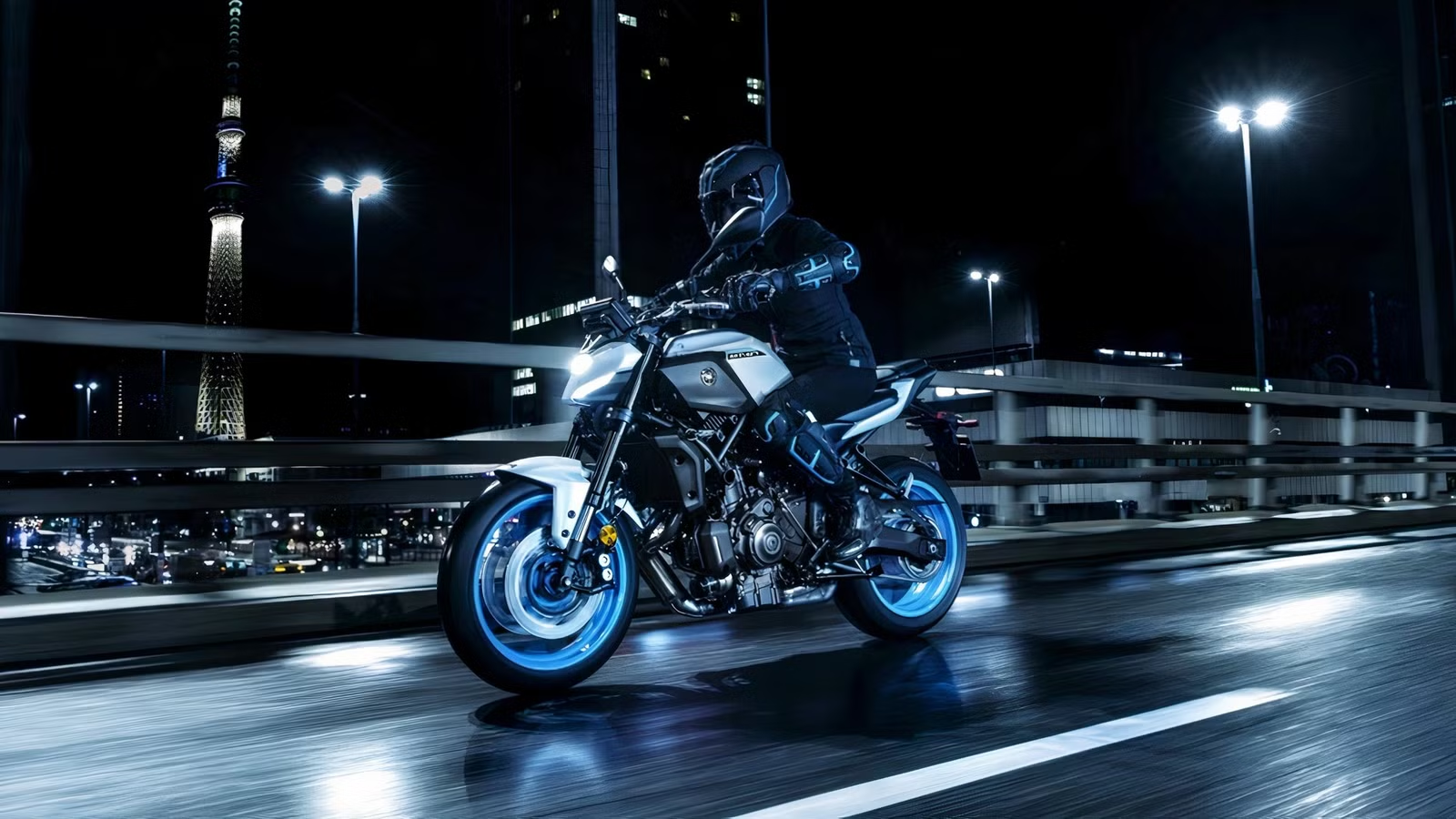
What actually makes a naked bike good? Horsepower is easy to measure, premium suspension looks great in a brochure, and a giant TFT gives manufacturers another excuse to plaster menus all over the dash. None of that can guarantee you’ll enjoy riding the thing. A truly well-judged motorcycle needs enough performance to entertain, enough accessibility to welcome newer riders, and enough personality that experienced riders won’t start browsing classifieds six months later. This is something a Yamaha MT does rather well, as backed up by its impeccable sales record.
The Spec Sheet Hardly Ever Tells The Full Story

Middleweight nakeds arguably occupy the motorcycle market’s sweet spot because they’re fast enough for highways and spirited back-road riding without becoming ridiculous everywhere else. They’re usually lighter, cheaper, and less demanding than superbike-derived hypernakeds, yet versatile enough to commute, carve corners, and disappear for a weekend. Trouble is, the class is packed with good bikes now, so having roughly 70 horsepower and handlebars isn’t much of a differentiator anymore.
More Performance Doesn’t Automatically Mean More Fun

There’s nothing wrong with performance, obviously. Modern naked bikes can offer IMUs, cornering-sensitive electronics, adjustable suspension, quickshifters, multiple engine maps, and power figures that would’ve embarrassed superbikes not long ago. Those features can make a motorcycle faster and safer, but they also add cost and capability that riders may rarely exploit. At some point, another 20 horsepower starts becoming something you own rather than something you actually use.
Sales Success Is One Of The Hardest Stats To Fake


Then there’s popularity. A glowing road test tells you what one journalist thought after a few days. Years of strong sales across different countries tell you something considerably broader. Riders have different budgets, roads, skill levels, and expectations, so when the same basic motorcycle keeps attracting buyers for more than a decade, chances are its manufacturer landed on a formula that works remarkably well.
That’s exactly what happened with one particular middleweight. Yamaha previously described it as the best-selling performance naked every year since its 2014 debut and said it held the number-one position in the class. Its current European model takes the slightly broader line that it’s been among Europe’s best-selling motorcycles since launch. Either way, that’s an impressive run in a segment that has become dramatically more competitive since the mid-2010s.
The Yamaha MT-07 Checks All The Necessary Naked Bike Boxes

We’re talking about the Yamaha MT-07. The bike has evolved substantially since the original arrived, but its basic mission remains recognizable. Yamaha’s MT philosophy was built around usable torque, agility, and character rather than chasing superbike-style numbers, and the MT-07 arguably expresses that idea better than anything else wearing the badge. The current 2026 US model starts at $8,599, putting it right in the thick of an increasingly serious middleweight fight.
It isn’t the cheapest bike in the category, nor the most powerful or the most technologically extravagant. That’s precisely why the MT-07 makes such an interesting case. You’re paying for a motorcycle whose individual components have been chosen around the whole rather than some giant headline number. At 403 pounds wet, with a 31.7-inch seat, a short 54.9-inch wheelbase, and relatively compact proportions, it’s still sized like something you’re supposed to play with rather than merely admire.
The CP2 Engine Is Still The Center Of Everything

At the heart of it is Yamaha’s 689cc liquid-cooled DOHC parallel twin, running a 270-degree crank as part of the company’s Crossplane Crankshaft Concept. Output is pegged at around 72 horsepower at 8,750 rpm and 50 pound-feet arriving at 6,500 rpm. Those aren’t terrifying figures, and that’s sort of the point. The engine makes its case through response, usable torque, and the way it delivers its performance.
The CP2 doesn’t require a racetrack-sized commitment before it starts being entertaining. There’s useful shove lower down, enough enthusiasm at higher rpm to reward revving it out, and a six-speed transmission backed by an assist-and-slipper clutch. Yamaha even uses its Acoustic Amplifying Technology to channel more intake sound toward the rider. It’s an engine that gives newcomers something manageable while still leaving experienced riders plenty of ways to be immature. Oh, and Yamaha estimates 57 mpg.
The Latest Generation Fixes Most Of The Old Bike’s Weak Spots
Previous MT-07s were frequently defined by what Yamaha didn’t spend money on. The basic suspension and brakes were perfectly usable, but neither exactly screamed premium. The latest generation attacks those weak spots directly. Up front, there’s now a 41mm inverted KYB fork with 5.1 inches of travel, while the rear KYB shock offers preload and rebound adjustment. Both ends get 5.1 inches of suspension travel. For braking, twin 298mm front discs are grabbed by radial four-piston calipers. Rounding things off is a set of SpinForged 17-inch wheels with 120/70 front and 180/55 rear Dunlop Sportmax Q5A tires.

The electronics have matured too. Ride-by-wire Yamaha Chip Controlled Throttle unlocks Yamaha Ride Control, with SPORT and STREET presets plus a customizable mode and switchable traction control. There’s also a five-inch full-color TFT with four display themes, Y-Connect smartphone integration, call and message notifications, music functionality, and turn-by-turn navigation through Garmin StreetCross. It’s modern without overbearing the rider with tons upon tons of technology.
Its Imperfections Might Actually Be Part Of The Formula

None of this makes the MT-07 untouchable. Depending on what matters to you, rivals from Honda, Kawasaki, Suzuki, Triumph, KTM, and others can offer more outright power, greater suspension adjustability, richer electronics, sharper components, or simply a different flavor of middleweight fun. If your buying decision comes down to winning as many individual specification categories as possible, another motorcycle may make more sense.
But that’s where “well-judged” differs from “best on paper.” The MT-07’s compromises rarely interfere with the reason somebody buys a naked bike in the first place. They’re part of what keeps the motorcycle light, approachable, relatively affordable, and easy to enjoy. Yamaha has spent more than a decade improving the edges of the formula without burying the thing that made it work.
The MT-07 Makes You Want To Ride

There are vastly more capable motorcycles on sale. Some will accelerate harder, brake later, carry more corner speed, or deploy electronics sophisticated enough to make you question your own riding skills. Capability is great, but capability and enjoyment aren’t interchangeable. On public roads, there’s a strong argument that a motorcycle you can actually explore is more rewarding than one whose limits remain theoretical almost everywhere you ride.
The MT-07’s long sales run suggests plenty of riders reached a similar conclusion. It has enough oomph to stay exciting, decent enough suspension to encourage playfulness, enough everyday practicality to make frequent use realistic, and enough refinement in its current generation to stop its price-conscious roots from becoming an excuse. More importantly, none of those qualities overshadows the others. The entire package still revolves around making the person behind the handlebars have a good time.
Source: Yamaha

Related posts




Latest Post


No Comments