
Kawasaki’s Most Complete Motorcycle Isn’t A Ninja ZX-10R
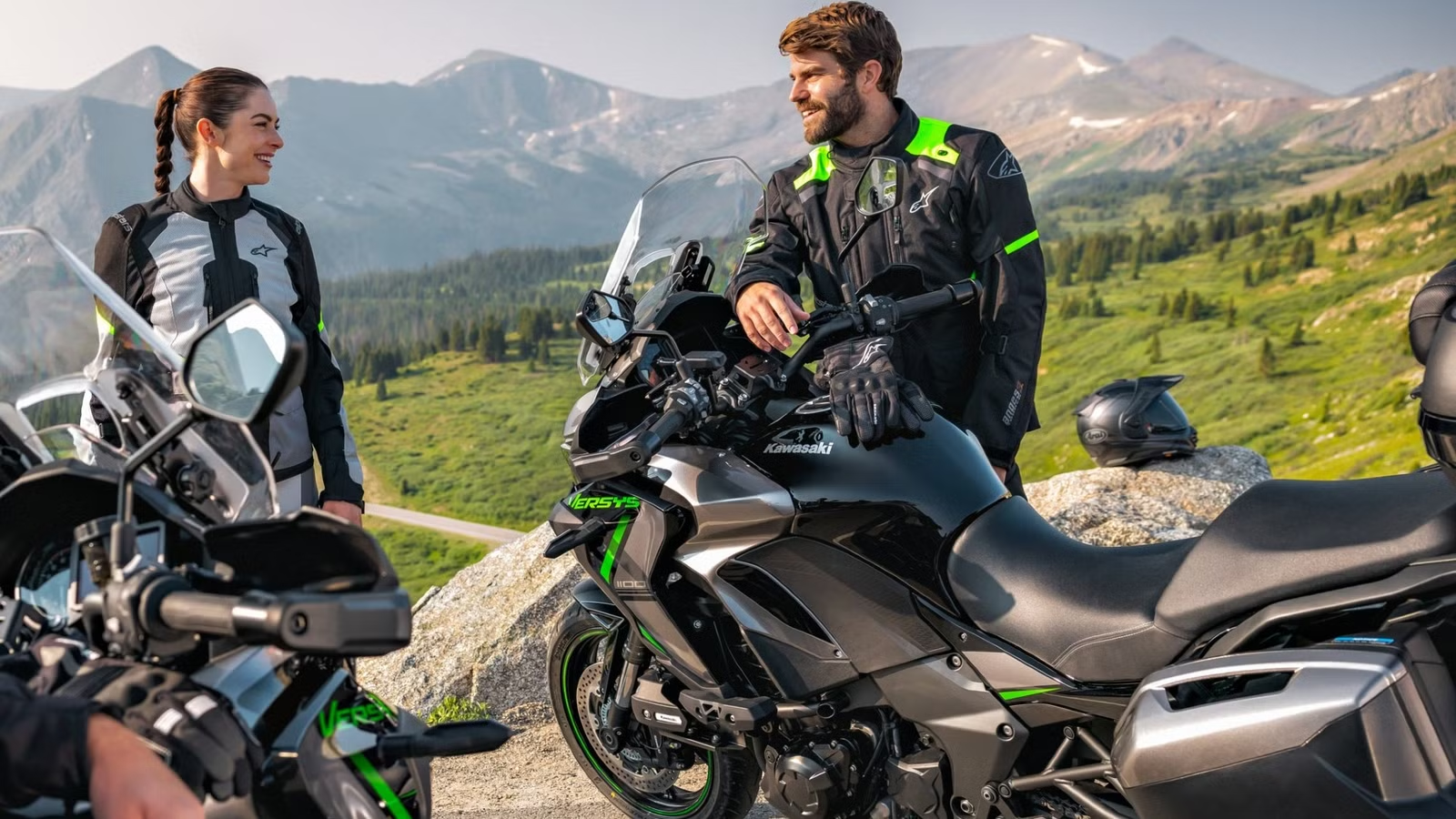
A complete motorcycle is the one that can do it all without making you feel like you’re compromising on a whole lot. And as much as your heart may want you to believe that the Ninja ZX-10R is that bike in Kawasaki’s lineup, that’s hardly the case. Instead, Kawasaki’s most well-rounded motorcycle is the one that often flies under the radar, yet it deserves a second look for being a fast bike that can wear multiple hats and still look good doing it. Oh, and versatility is in its name!
The Kawasaki Ninja ZX-10R Is Awesome But Far From Complete

The Kawasaki Ninja ZX-10R is an incredible liter-class sports bike, and it’s a true champion bike, too, with several WorldSBK titles under its belt. Kawasaki says it’s designed to help you explore your limits on a racetrack, and to that end, it gets everything you’d ever want from your superbike. A 190-horsepower engine, razor-sharp handling, monobloc brake calipers, winglets, and so much more.

It’s an excellent track bike, but it’s far from perfect on the road. Owners frequently report severe low-speed heat and twitchy fueling in the lower revs. Not to forget, its aggressive track-ready ergonomics will punish you on the street, especially if you’re stuck in traffic or going somewhere far. That’s why we say it’s not a complete motorcycle; it can help you shred a track, but anywhere else, it will leave you wanting more.

On any other day, we’d say judging a fish by its ability to climb a tree is wrong, but we live in a time where motorcycles are expensive, and so are insurance and fuel. For most of us, owning multiple bikes does not make sense, especially if it’s a highly focused superbike that requires expensive insurance and consumables. And that’s where the bike in question comes in. It’s a crossover that combines the best of multiple segments, offering a package that can do it all. Kawasaki’s most complete motorcycle is an excellent pick for a one-bike garage.

The Flagship Versys Is Ideal For A One-Bike Garage

The Kawasaki Versys has been around for a long time, and the flagship Versys has typically been a liter-class inline-four crossover. It’s celebrated for combining that inline-four performance with an advanced electronics package, long-distance comfort, and agile handling. In its current iteration, the Versys 1100 still retains that same nature, backed by a high-end suspension and electronics package, but offers more performance from its larger engine.

It’s a bike that can truly do it all, which is what makes it such a complete package. Right from the engine to the underpinnings and from ergonomics to electronics, everything on the bike is designed with versatility in mind. It even gets standard luggage that can be taken off quickly. Kawasaki only sells the SE LT version in the US, starting at $19,499, and the moolah is justified by a character that’s much easier to live with than the ZX-10R.
It’s The Logical Choice

You might be thinking, why are we comparing a crossover with a liter-class sports bike? It’s the choice between what you want and need. The ZX-10R is an excellent bike that looks good on a poster and even better on a racetrack. Unless you plan on doing that, you’d simply be wasting your money and that bike’s potential. For owners looking for a complete package, the Versys 1100 is the smarter pick. It can still go fast enough to have fun while being a much easier bike to maintain and live with.
Engineered For A Versatile Personality On The Road

At the heart of the Versys 1100 is what makes it so versatile and complete: a new 1,099cc engine. This relatively newer powerplant builds on the older 1,043cc engine, which proved to be ultra-reliable over 13 years. The newer version gets a 3mm longer stroke, a new piston shape, a higher compression ratio, a new intake funnel length, a new intake port shape, and a new cam profile. All of these combine to make the 1,099cc engine even better for on-road duties.

As a result, the four-banger unit produces 133 horsepower at 9,000 RPM and 82.5 pound-feet of torque. This may seem low compared to other liter-class crossovers, but the engine is not tuned for top-end rush but low-to-mid-range torque for a more well-rounded character. Kawasaki says the engine offers superb throttle response and strong torque right from low revs, while still retaining an exciting surge at the top end. The engine is said to handle everything from traffic to touring and even an occasional run up a mountain road.
Geared For A Wide Range Of Conditions

The four-cylinder engine is mated to a six-speed manual transmission, which features longer overall gearing for optimized performance and feel. Kawasaki says the gear ratios are chosen to suit a wide range of riding conditions: sporty, relaxed cruising, and fully-loaded touring. There’s also an assist and slipper clutch that keeps the clutch lever feeling light and reduces wheel hopping, while Kawasaki Quick Shift makes gear shifts easy and quick.
Advanced Semi-Active Suspension From Showa

The Versys 1100 uses a highly versatile chassis and suspension setup that is said to be highly intuitive and adaptive. The frame is a narrowly constructed twin-tube unit that uses the engine as a stressed member. This is paired with a steel trellis subframe, designed for high payloads for two-up touring with luggage. However, the highlight here is not the frame but what it sits on: Showa Skyhook EERA suspension.

The suspension consists of a 43mm Showa cartridge fork up front and a Showa BFRC Lite rear shock, which are tuned to offer a consistent, smooth ride with enough wheel travel to soak up bumps. It also features Kawasaki Electronic Control Suspension (KECS), a setup that builds on Showa’s Skyhook EERA tech and is tuned by Kawasaki engineers for a sporty riding character and a smooth ride. In short, this electronic suspension adapts to the road surfaces on the fly, regardless of whether you’re cornering or cruising on the highway.
Lightweight Wheels And High-End Brakes

The suspension holds onto a pair of 17-inch wheels that are said to offer quick, sporty handling. Braking comes from highly rigid 4-pot radial-mount monobloc calipers at the front, acting on 310mm discs and worked by a radial master cylinder for better feel and power. The rear features a large 260mm disc gripped by a single-piston caliper, adding even more stopping power when required.
Functional Design, Backed By A Suite Of Electronics

The Kawasaki Versys 1100’s design follows function, and while the sculpted bodywork and flowing lines may look aggressive, Kawasaki says it all serves a function toward comfort. For example, the upper cowl and surrounding bodywork scream Kawasaki but also offer plenty of wind protection, supported by a stepless adjustable windscreen that should keep the wind off your body on the highway. Even the paint is highly durable and self-repairing, just like the H2.

The bike’s design also enables a spacious, upright riding position that should feel comfortable in all riding conditions while offering a high level of control when needed. The seat features thick padding and sits 33.1 inches off the ground, making for all-day comfort and luxury. Adding to that comfort are adjustable levers, hand guards, and heated grips. Finally, the bike also gets standard Kawasaki Quick Release hard saddlebags at the back that can hold 28 liters of luggage.
All The Modern Rider Aids You’d Ever Need

The bike’s versatile comfort is backed by cutting-edge electronics that are designed to improve the ride and help keep the shiny side up. It starts with the all-digital TFT display that shows all the vital information, complemented by an analog-style tachometer. The TFT is paired with wireless smartphone connectivity and voice control. There’s also cruise control and an all-LED light setup with cornering lights as standard.

To help inspire confidence and keep you safe, the bike features Bosch’s compact IMU that enables an array of rider aids, including cornering-enabled traction control, ABS, and Kawasaki Cornering Management Function (KCMF). There are two power modes: Low and Full, as well as multiple ride modes that adjust traction control, power delivery, and suspension character. With the help of these electronics, the Versys 1100 is already set up exactly for the occasion.
Source: Kawasaki

Related posts
Latest Post


No Comments