
The Forgotten Honda Parallel-Twin That Once Defined Generations Of Riders
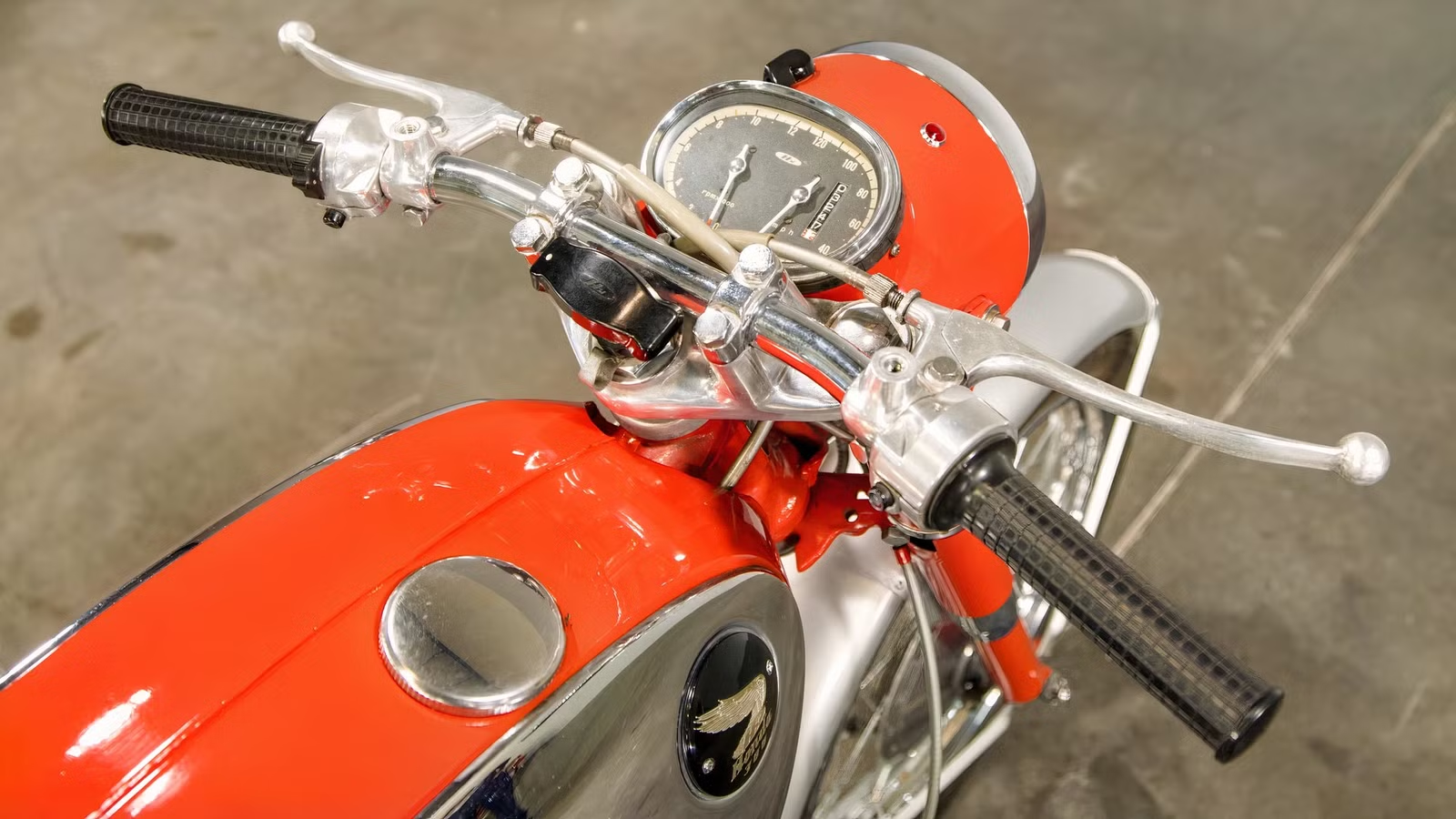
Some motorcycles earn their place in history with huge engines, racing trophies, or wild styling. One compact parallel-twin offered highway speed, sharp handling, electric starting, and everyday dependability at a time when serious motorcycling still demanded muscle, tools, and patience. And that made it a legend decades before modern bikes perfected the recipe.
Motorcycling Once Demanded More Than Most People Were Willing To Give

American motorcycling entered the 1960s with a hard-edged image. Harley-Davidson represented the domestic establishment, while Triumph, BSA, Norton, and other British brands carried much of the sporting prestige. Their large twins looked fast even while standing still, but they also looked heavy, loud, and slightly annoyed. To many people outside the motorcycle world, riders belonged to a separate tribe with its own clothes, habits, and roadside repair rituals.
Those machines asked a lot from their owners. Starting procedures could involve fuel taps, choke levers, ignition settings, and one firm kick delivered with the confidence of someone trying to open a stuck basement door. Regular maintenance came with the deal – riders learned to adjust points, set valves, tune carburetors, tighten chains, and trace electrical problems through nests of wire. Many enthusiasts enjoyed that relationship, but new riders often did not.
Smaller motorcycles solved part of the problem. They cost less, weighed less, and felt less threatening. Honda had already found American buyers for friendly machines that made two-wheeled travel seem clean and approachable. Yet many riders still viewed small motorcycles as basic transportation or temporary steps toward something larger. The market needed a missing middle – a bike light enough for a new rider, quick enough for an experienced one, and refined enough to use every day.

A Small Japanese Twin Began Embarrassing Bigger Motorcycles

The answer came from a 305cc Honda that looked modest on paper and much less modest from the saddle. Its displacement sounded more like an area code than a warning. Yet the engine could spin beyond 9,000 rpm, giving the little twin a character far removed from the slower, heavier thump of many traditional road bikes. It did not try to copy the relaxed pull of a large British or American twin. Instead, it used revs, light weight, and precise engineering to produce its speed.
Honda built the machine around an air-cooled, single-overhead-cam parallel-twin. It used a 180-degree crankshaft, two carburetors, alloy construction, and extensive roller and ball bearings. The engine sat inside a tubular chassis rather than the pressed-steel frame associated with many earlier Hondas. The manufacturer fitted a telescopic fork, twin rear shocks, low handlebars, and large finned drum brakes. Riders even had several mounting positions for the footpegs. An electric starter handled normal departures, while a kick lever provided backup.
The experience mattered more than the specification sheet. The little Honda felt eager – its engine grew stronger as the tachometer climbed, and its compact size made the available speed feel vivid. The rider could push through a series of corners without wrestling a large fuel tank and a heavy crankshaft.
The 1966 Honda CB77 Super Hawk Changed Everything

That motorcycle was the Honda CB77 Super Hawk, and the 1966 version represented a mature example of a model that had already spent several years reshaping expectations. Honda began selling the CB77 in the United States in 1961, and the company called it the Super Hawk 305 in that market.
Its 305cc parallel-twin drove the rear wheel through a four-speed transmission and chain final drive. Both electric and kick-starting came with the motorcycle, giving owners convenience without removing the mechanical backup. The engine also formed part of the chassis structure. Instead of surrounding it with a full cradle, Honda used the engine and transmission unit to help carry loads between major sections of the frame. That arrangement saved weight, improved access, and left the polished alloy engine on display.
The design produced a motorcycle that felt more advanced than its size suggested. A period Super Hawk could not outmuscle every 500cc or 650cc twin. Yet the Honda could pressure larger machines by carrying less weight, revving harder, stopping well, and handling with unusual accuracy. It attacked the old displacement hierarchy from the side, and a rider no longer needed the largest engine in the parking lot to enjoy the road home.

Honda originally positioned the CB77 as its largest-displacement motorcycle, but that description applied when the model entered the lineup, not throughout 1966. The American market still wanted the torque and status of larger machines, and the manufacturer responded with the 450cc CB450 in 1965 and later with the four-cylinder CB750. Before them, the Super Hawk proved that advanced Japanese engineering could attract performance riders.
The Super Hawk also changed what refinement meant. Earlier riders often accepted leaks, vibration, and frequent adjustment as signs of character. The Honda offered another view – character could come from a rising tachometer needle, a clean shift, and the way a motorcycle held its line through a bend. Period tests found not a single drop of oil outside the engine, which was remarkable for that era. The machine leaked so little through its breather that the rear chain, which the breather was meant to mist with oil, began to run dry. The testers had to lubricate it by hand. Honda had created a maintenance problem by building an engine that refused to make enough mess.
The Machine Behind America’s Most Philosophical Road Trip

In the summer of 1968, Robert M. Pirsig rode his 1966 Super Hawk on a 5,700-mile journey with his 11-year-old son, Chris. They traveled from Minnesota to California and back, crossing long highways, mountain roads, small towns, and stretches of country that exposed both rider and machine. The trip helped inspire Zen and the Art of Motorcycle Maintenance, the 1974 book that combined travel, memory, philosophy, and the practical care of machinery. Pirsig’s widow, Wendy K. Pirsig, later donated the Honda to the Smithsonian’s National Museum of American History with his riding jacket, maps, tools, manuscripts, and other items.
The Super Hawk suited that journey almost perfectly. It had enough performance to cover long distances, yet it remained compact enough to manage on narrow roads and at slow speeds. Its exposed mechanical parts allowed Pirsig to inspect, adjust, and understand the machine as he traveled. Fuel entered through visible carburetors, cables connected the rider’s hands to mechanical parts, and the drive chain required attention. Yet it was all easy to understand on the go.

At the same time, the Honda offered more dependability than many older motorcycles. That difference gave Pirsig a useful middle ground. The Super Hawk demanded involvement, but it did not require endless combat. Its owner could maintain it because the design encouraged understanding, not because another breakdown had ruined the afternoon. In the book, the narrator contrasts his willingness to work on an older Honda with the attitude of traveling companions who prefer to leave their BMW to professional mechanics. The comparison opens a much larger question – whether people should understand the technology they use or accept it as a sealed service provided by somebody else.
Pirsig’s search for “Quality” makes the motorcycle more than a literary prop. He explores the space between rational thought and emotional experience, refusing to treat them as enemies. The Super Hawk occupies the same space – engineers can describe its bore, stroke, frame geometry, bearing surfaces, and ignition timing. Riders describe the clean rush above 6,000 rpm, the confidence of a well-taken corner, and the satisfaction of an adjustment made correctly. Both views matter.

Maintenance provides the bridge between those two views. A careless owner can turn a good motorcycle into a poor one. A thoughtful rider, on the other hand, can preserve the quality already present in the design. Adjusting a valve or cleaning a contact point may appear purely mechanical, but the work requires patience, judgment, and respect for small details. The Super Hawk rewarded that care without making suffering a condition of ownership. It asked its rider to participate while providing enough confidence to plan a 5,700-mile trip. That balance made it the right motorcycle for a story about technology, values, and the quality of a person’s engagement with the world.
The Forgotten Twin That Still Defines The Motorcycles We Ride

The Super Hawk became obscure partly because Honda kept improving its own idea. The CB450 brought more displacement and a double-overhead-cam cylinder head. The CB750 arrived in 1969 with four cylinders, greater power, and a front disc brake. Those motorcycles created bigger headlines and clearer turning points. Later Japanese middleweights added five- and six-speed transmissions, electronic ignition, liquid cooling, fuel injection, and anti-lock brakes. The CB77 disappeared inside that progress.
First-generation Super Hawk owners experienced something new – a small motorcycle that did not feel disposable. It could introduce a rider to motorcycling without becoming boring after the first season. It could commute during the week, chase corners on Sunday, and carry luggage when the map suggested a longer trip. Later generations inherited that formula without learning where it began.

That explains why the CB77 can look ordinary to modern eyes, but its ideas became the norm. Electric starting no longer seems luxurious, a leak-free engine no longer earns shocked praise, and Japanese motorcycles no longer need to prove that careful engineering and strong performance can share the same garage. The Super Hawk helped create that reality, then watched newer motorcycles take the applause. Its influence lives in every approachable middleweight that welcomes a new rider without insulting an experienced one.
Source: Honda, Cycle World

Related posts
Latest Post


No Comments