
The Forgotten Hemi Car That Collectors Can’t Stop Chasing
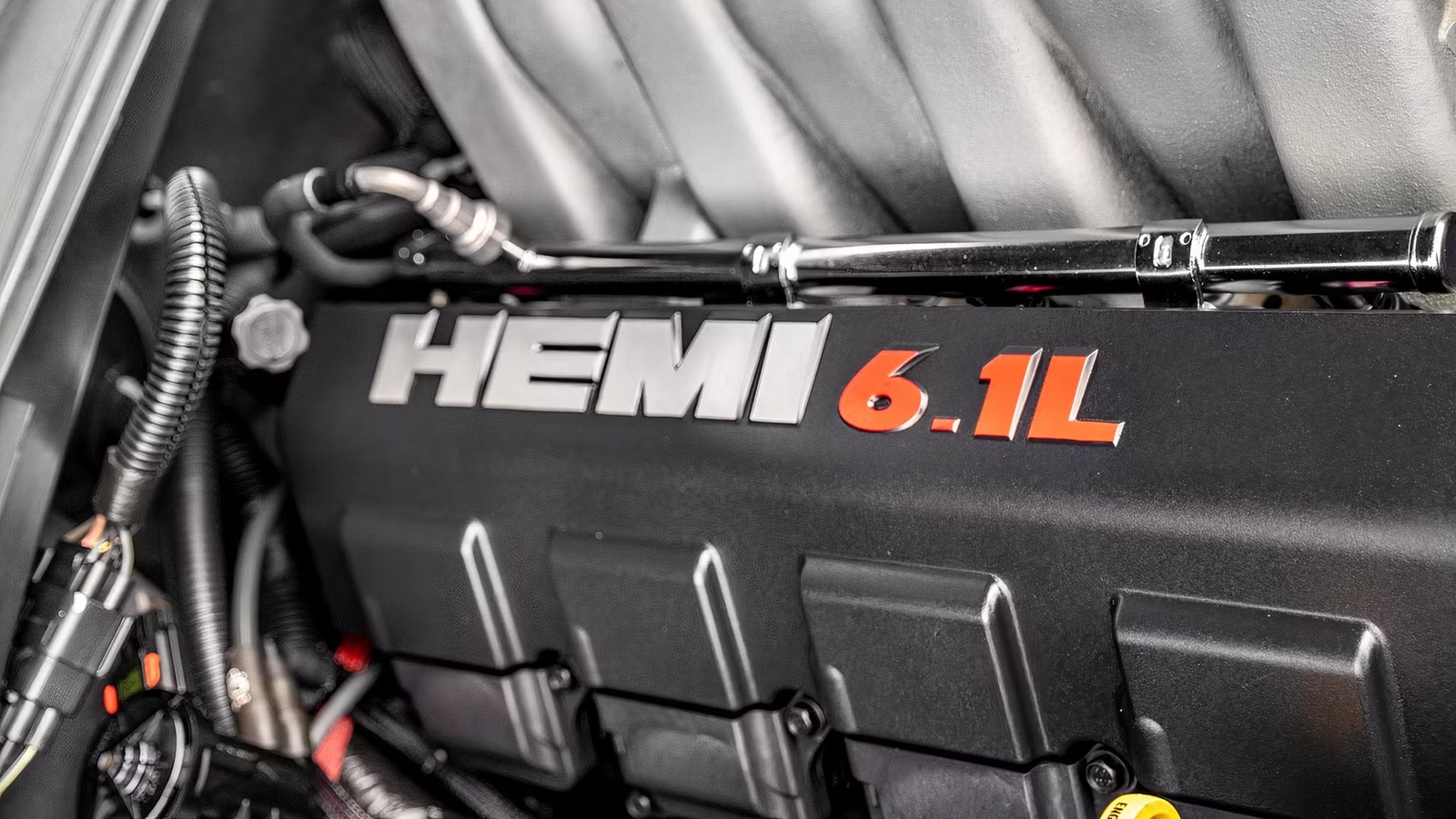
Iconic muscle cars with iconic engines aren’t generally forgotten. Muscle Cars are meant to get attention, and that means that anything of interest is normally big news. But there is one particular muscle machine that has a hard-hitting Hemi under the hood and an outrageous style, but it has managed to fly under the radar of many car fans. But true collectors haven’t slept on its significance, with good examples being snapped up and prices quickly rising.
The Hemi Is The Stuff Of Muscle Car Legend

The word “Hemi” in muscle car circles roughly translates to “the most badass muscle car on the block.” OK, that’s not strictly true (it actually means “half” in Greek), but that’s what these monster mills have come to symbolize. The cylinder heads have a hemispherical combustion chamber, which allows the spark plugs to be placed directly over the center of the chamber, decreasing the distance the burn needs to travel, making the combustion process more efficient, and increasing power.
The Belgium Pipe Company had actually invented the design in the early part of the 1900s, then, through FIAT trying the technology, and Chrysler utilizing it during the war, the latter American firm launched the cast-iron, 331ci “FirePower” engine (rated at 180 hp) in 1951. It was a revelation, but it wasn’t until the 426 Hemi arrived in 1964, AKA The Elephant Engine, that the mill’s fearsome reputation was cemented in history.
Hemi-Engined Machines Are Amongst The Most Revered Muscle Cars

The Hemi went on to find a home in some of the muscle cars of the time, from the 1970 Dodge ChargerR/T to the Plymouth Super Bird, Plymouth GTX, and Dodge Challenger R/T Convertible of the same era. You may have noticed a trend with all the aforementioned models: they are all stone-cold classics that most people would love to have in their garage, often with sky-high prices to match. But what if we told you there is an achingly cool, fairly rare, and unique Hemi model that a lot of people have forgotten about?
The Dodge Magnum SRT8 Is A Forgotten Hemi Muscle Wagon

The collapse of the first muscle car golden era at the start of the ’70s had long-lasting effects. Having endured the fairly pointless Malaise Era models, anyone wanting a muscle car in the ’80s or ’90s was faced with slim pickings. By this point, the game seemed to have moved on, and fast JDM models were taking over as affordable street fighting rockets. But it wasn’t over for the muscle car. The S197 fifth-generation Ford Mustang and the sixth-generation LX Dodge Charger of the mid 2000s ushered in a new interest in muscle cars with looks that were a nod to the Swinging Sixties.
On a roll, Dodge decided to mine another bit of muscle car history — that of the muscle wagon, a forgotten culture of grocery getters with drag strip spec engines. The Dodge Magnum, which used a Charger platform and arrived in 2005, could be bought with a 190 hp 2.7-liter six-cylinder, but the engineers over at Street and Racing Technology (SRT) decided that it would work a lot better with a 6.1-liter Hemi V8. The giant Magnum SRT8 was born and went on sale in 2006, competing as a cut-price alternative to the AMG wagons of the time.
The Magnum SRT8 Is A Pure Muscle Grocery Getter

The Magnum SRT8 is fitted with the third gen Hemi engine. Displacement was enlarged from 5.7 to 6.1 liters by boring out the diameter of the cylinders in the HEMI by 3.5 millimeters, and the compression ratio was also increased to 10.3:1 from 9.6:1. The mill in the SRT8 produces 420 hp and 425 lb-ft of torque, not bad for a wagon you might use to go to the supermarket in.
The SRT engineers fitted new higher-flow cylinder heads, a specially designed intake manifold, hollow-stem valves, a reinforced block, and exhaust headers with individual tubes encased in a stainless steel shell. The redline was raised to 6400 rpm. To keep the Magnum SRT on the road, SRT beefed up the spring rates and suspension bushings, and fitted chunkier anti-sway bars. The ride height is one-half inch lower, and Brembo brakes provide stopping power at every corner. The Hemi is linked to a five-speed auto sourced from Mercedes.

The SRT8 is huge, coming in at nearly 202 inches long, and 75.7 inches wide, with a 120-inch wheelbase. Cargo space is up to a very useful 72 square feet. But that doesn’t mean it won’t shift like a muscle car. This family wagon will hit 60 mph in 5.1 seconds, 100 mph in 12.1 seconds, and keep going until 169 mph. The quarter mile was 13.5 seconds. All round, there wasn’t much this $37,995 wagon couldn’t do, from trips to the hardware store to evenings at the drag strip.
The Magnum SRT8 Was initially Overlooked

Even though the Magnum SRT8 offered great value compared to the big-powered German load-luggers of the time, it was incredibly short-lived. The hot rod station wagon was only sold between 2006 and 2008, and, according to Hagerty, fewer than 4000 were produced. There were various factors at play that probably caused the SRT8 to be canceled too early. This was the time that illustrious carmakers such as Pontiac were being killed off for good, as the US firms struggled in the face of a global economic crash.
The rise of fast and capable SUVs was also making wagons redundant for a lot of buyers, and, well, muscle wagons have always been a niche, and they probably still were. Perhaps if the Magnum SRT8 had arrived five years earlier it would have been a bigger hit. But that didn’t mean it was a failure. So unique is the Magnum SRT8 in a world of hybrids, SUVs, and EVs, that it has become an unexpected smash on the used market in 2026.
Collectors Are Now Going Crazy For The Magnum SRT8

Interest in the Magnum SRT8 has been so strong recently that Hagerty placed the car on its 2025 Bull Market List: 11 Hot Rides on the Rise Right Now. This is essentially the expert resource’s annual rundown of cars most likely to go up in value. Hagerty said that the Magnum was worth $32,600 (excellent condition) in 2025, a rise of a whopping 39.3% since 2019, with good condition prices at $21,600. In 2026, according to Hagerty’s Valuation Tools, a good condition SRT8 will set you back $22,700. This shows a rise of more than a thousand bucks in a single year. A quick look on Bringatrailer.com confirms these prices, with lower mileage examples going for more, naturally.
It’s not hard to see why the Dodge Magnum SRT8 is so sought after today, and likely to continue. While the so-called second golden age of the muscle car in the 2000s and 2010s seems like recent memory, the speed at which the automotive landscape is changing makes it also appear long in the past. The Magnum SRT8 may just be the most unique and useful example of that era.
Sources: Hagerty, Dodge

Related posts




Latest Post


No Comments