
The Cruiser That Quietly Matches Harley Touring Comfort
There’s no denying that Harley-Davidson has spent decades perfecting long-distance cruiser comfort. However, buying into that experience has also created a perception that if you want floorboards, wind protection, relaxed ergonomics, and effortless highway manners, you have to buy a Harley — and inevitably pay a premium. Many rival cruisers either chase the V-twin soundtrack or strip away touring essentials to keep prices low. The result is a market where genuine comfort often feels exclusive.
Harley Basically Invented The Cruiser Comfort Checklist

Ask any long-time rider what “touring comfort” means on a cruiser, and the description usually traces back to Harley-Davidson, whether the rider has ever owned one or not. The Heritage Classic is as fair a yardstick as any: floorboards that let your feet shift position over a long day, a windscreen that blocks chest-level wind instead of just looking the part, a seat shaped for hours in the saddle rather than a showroom photo, and a riding position that doesn’t ask your wrists to do any real work.
None of it is flashy on a spec sheet. All of it adds up on a 400-mile day, which is exactly when most cruisers start showing their compromises. Most rivals pick a lane instead of chasing that whole list. A stripped-down, standard-style cruiser will nail the relaxed riding position and skip wind protection entirely, betting you’ll throw on a jacket and deal with it.

A performance-first V-twin will throw horsepower and attitude at the problem instead, leaving comfort as an accessories-catalog afterthought you pay for separately, one part at a time, long after the sale. Very few bikes outside Milwaukee try to check every box Harley checks. Fewer still manage it without simply copying the formula outright — same silhouette, same forward-flung riding position, same big twin under a slightly different tank badge.

The BMW R 18 Classic Quietly Matches Harley’s Touring Comfort
At $18,395, It Costs Less Than A Heritage Classic — Without Cutting The Comfort Kit

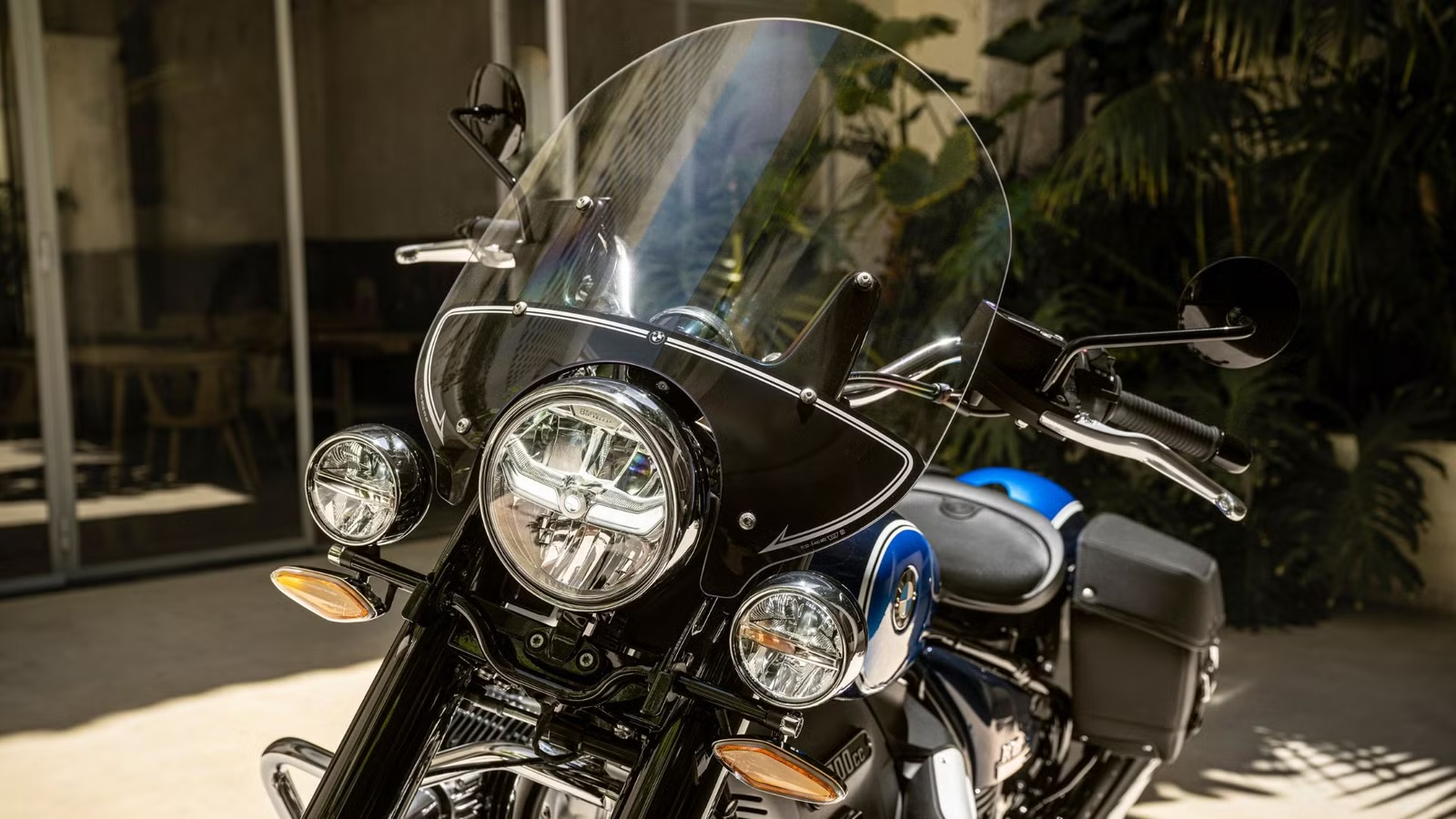
Enter the BMW R 18 Classic — a bike that doesn’t try to out-shout a Harley or out-tech a Gold Wing. It’s a direct, respectful homage to the heavyweight cruisers of the mid-20th century, built around the biggest boxer engine BMW has ever produced, and it happens to check nearly every item on Harley’s own comfort list. In the U.S., the R 18 Classic is offered at a base price of $18,395 — that’s before the $895 destination charge — and it lands just below the Harley-Davidson Heritage Classic’s $19,999 sticker, the closest thing Harley has to a direct rival for this bike.
However, the price isn’t really the story here. What matters is that BMW didn’t cut the comfort kit to hit that number. The R 18 Classic isn’t an aggressive sport-tourer chasing lean angles, and it isn’t a touchscreen-laden tech flagship, either. It’s a bike built to be ridden the way a Harley owner already rides — relaxed, upright, windshield up, saddlebags packed — just wearing a Bavarian badge instead of a Milwaukee one.
Windscreen, Saddlebags, And A 19-Inch Wheel: How The R 18 Classic Ships Ready For The Road

The price comparison is easy enough to make — but the harder question is whether the R 18 Classic actually delivers those comfort features in the real world, or whether they’re showroom promises that fall apart at mile 300. Strip away the badge and the spec sheet, and the R 18 Classic’s touring kit reads like a checklist written specifically to answer Harley’s.
A tall, quick-release windscreen ships standard and pulls off in a few minutes if you want the stripped-down look for a Saturday blast, then goes back on before a Monday commute. Structured, leather-look saddlebags — double-buckle, roughly 15.5 liters each — come bolted on from the factory, not bolted on from a catalog three months after purchase once the honeymoon period wears off and the rider realizes how little the stock bike actually carries.
A wide, 19-inch front wheel, up from the 16-incher on earlier model years, keeps the bike planted and predictable at highway speed instead of darty, the way heavy cruisers can feel on a smaller front hoop, especially loaded down two-up. None of this needs an accessory run to the dealership after the fact. It’s the bike you’d actually want for a weekend away, straight off the showroom floor, gear already sorted.
Mid-Mounted Floorboards, Not Forward Controls

Where the R 18 Classic quietly diverges from Harley is foot position, and it’s worth understanding why rather than just noting it. The boxer engine’s cylinder heads jut out wide on both sides, which physically limits how far forward BMW could mount the standard floorboards — those cylinders are simply in the way.
Therefore, instead of the stretched-out, legs-forward stance you get on a Harley bagger, the R 18 Classic tucks your feet more underneath you, closer to a mid-mounted position. Traditional cruiser riders sometimes report this as a flaw on paper, since it breaks from the classic silhouette, but in practice, it tends to work in the rider’s favor.
The “Big Boxer” 1,802cc Has Loads Of Low-End Muscle

BMW calls it the Big Boxer for a reason. At1,802cc, it’s the largest enginethe company has ever bolted into a motorcycle — air-and-oil-cooled, with two massive cylinders splayed out horizontally instead of stacked in a V. Peak output is a modest 91 horsepower, and that’s kind of the point: this engine was never built to chase a dyno number. What it delivers instead is 120 pound-feet of torque starting from just 3,000 rpm, the same low-rev, easy-pull character that makes a Harley V-twin feel unhurried at highway speed.
BMW’s Shaft Drive Means No Chain Or Belt Inspections — Ever

BMW could have hidden the shaft drive behind plastic covers, but instead it proudly leaves the nickel-plated open driveshaft on display. It’s both a styling statement and a nod to the legendary BMW R5 that inspired the motorcycle’s design.
The practical benefits extend beyond appearance. Shaft drives are renowned for their durability and smooth power delivery, eliminating the periodic maintenance associated with chain-driven motorcycles while offering a clean, maintenance-light alternative for riders who spend weeks on the road.
Combined with the R 18 Classic’s substantial weight, long wheelbase, and well-damped chassis, the drivetrain is meant to contribute to a calm, planted feel at highway speeds. Harley-Davidson’s belt-drive system has long been appreciated for its quiet operation and minimal maintenance, but BMW’s shaft-drive solution takes convenience another step further. Over thousands of touring miles, the absence of belt inspections or chain servicing becomes one less thing demanding your attention, allowing riders to focus on the road rather than routine upkeep.
The Tech That Makes An 800-Pound Bike Manageable
Rain, Roll, And Rock Modes Keep The Ride Predictable Without Cluttering The Dashboard

The R 18 Classic comes standard with three riding modes — Rain, Roll, and Rock — each adjusting throttle response for the conditions and the mood of the day, alongside Automatic Stability Control and Dynamic Engine Brake Control, which BMW calls MSR, smoothing out abrupt engine braking when the throttle snaps shut.
Reverse Assist is available as an option, and it’s a genuinely useful one on an 800-plus-pound motorcycle when backing out of a parking spot on the slightest incline. A USB-C charging port, added in the latest update, keeps a phone or GPS topped off without an aftermarket mount.
That said, there’s no touchscreen dominating the dash, and no drive-mode menu to scroll through mid-ride. The electronics work quietly in the background, which is exactly the point — they add a safety net without disturbing the analog, kick-back-and-ride character the whole bike is going for. Hill Start Control, another optional extra, does the same quiet job at a stoplight on a steep grade, holding the bike steady for a beat, so the rider isn’t juggling clutch, throttle, and brake all at once with a passenger on the back.
Every Design Choice Traces Back To The 1936 BMW R5 — And That’s Exactly What Makes It Not A Harley Clone

The R 18 Classic’s silhouette isn’t an accident. As mentioned earlier, the double-cradle steel frame, the teardrop-shaped fuel tank, and that fully exposed driveshaft all trace back to the 1936 BMW R5, a bike BMW’s designers studied closely when sketching the modern Big Boxer platform. Optional hand-applied pinstriping and chrome trim pieces lean further into that heritage rather than away from it.
It would have been easy for BMW to build a cruiser that copied Harley’s silhouette and called it a rival. Instead, the R 18 Classic leans hard into ninety years of its own boxer history, and it’s precisely that refusal to imitate that makes the comfort comparison compelling. This isn’t a clone chasing Harley’s comfort by accident. It’s a genuinely different engineering approach arriving at the same relaxed, long-haul-ready result.
Source: BMW Motorrad

Related posts


Latest Post


No Comments