
The Most Violent Street Cobra Ever Built Was A Paperwork Salvage Job
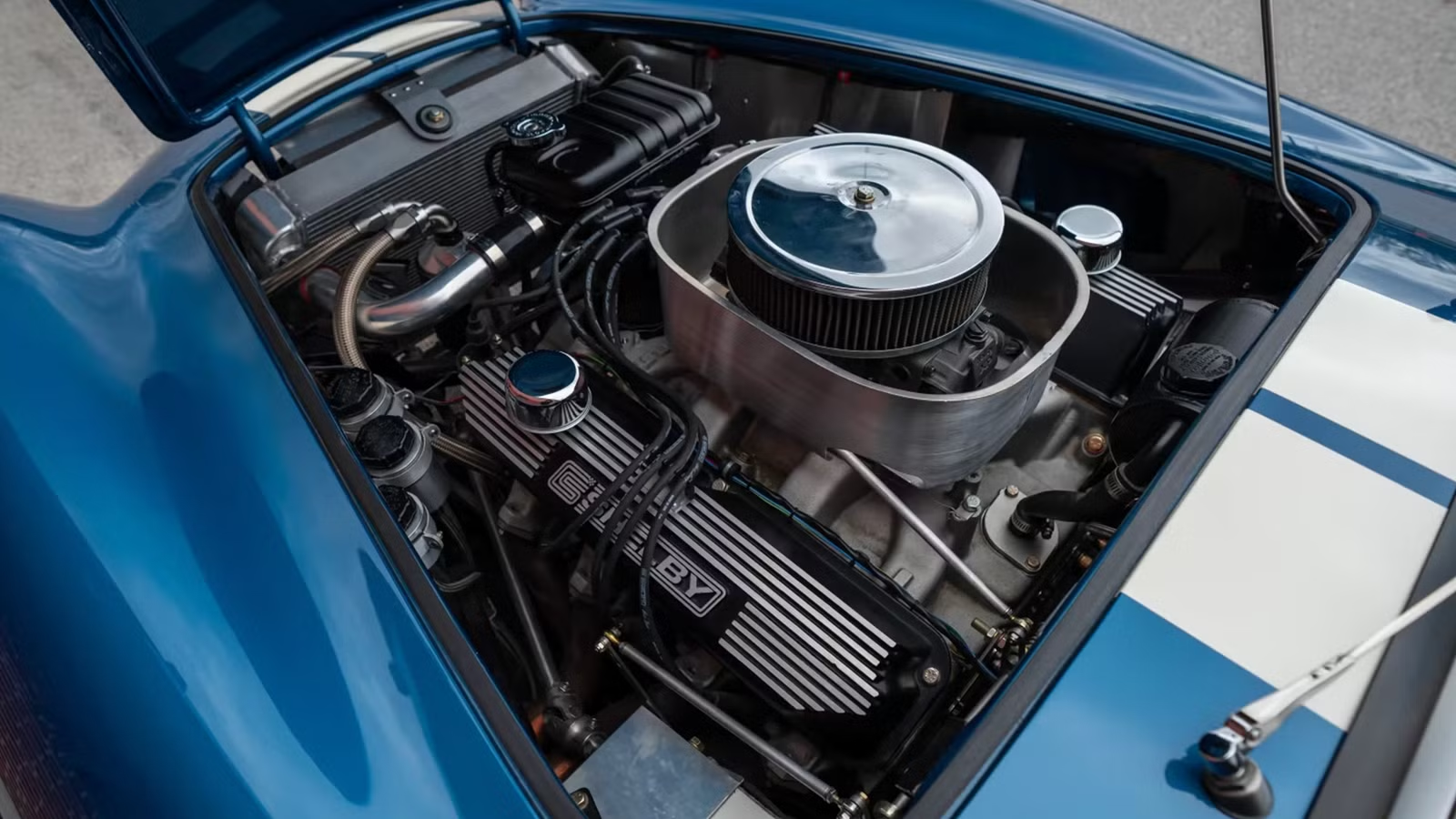
When you think of the world’s most uncompromised sports cars, the kind that border on lethal, the Shelby Cobra 427 has to be in the conversation. Born from the bones of a dainty British sports car and featuring brutal American muscle under the hood, the combination has rightfully held a place in history as one of the most violent cars to ever enter production. That’s the appeal, and why values today are so high.

Its most violent version of all, though, is one that was never meant to exist. In fact, it only came about because of motorsport regulations clamping down on Shelby.
The Original Shelby Cobra 427 Was Meant To Go Racing
While the original Shelby Cobra 427, introduced in 1965, was designed to be a road car, racing was always on the model’s radar. With the original Cobra 260 and 289 having hit their limits, the company set about crafting an almost completely fresh chassis with coil spring suspension on all four corners, wider arches to accommodate thick tires, and enough engine bay space to house the huge 7.0-liter Ford V8.

Alongside the road-legal version of the Shelby Cobra 427, the company built a special Competition version that was designed for FIA International GT racing. Compared to the road car, these cars had some pretty significant changes for every competitive advantage possible.

For a start, the interior was stripped back to bare aluminum, and instead of a full windscreen, they featured a very small aeroscreen placed in front of the driver. Its chrome bumpers were stripped away, and magnesium wheels were brought in to cut unsprung weight.
Other racing hardware included the gigantic roll hoop behind the driver, a larger fuel tank and a retuned engine. In road car trim, the 7.0-liter V8 produced 425 horsepower as standard, while the Competition had around 485 hp, though this varied depending on its use case.
But It Was Almost Banned By The FIA

A year before the Shelby Cobra 427 debuted, the motorsport world’s global governing body, the FIA, had tightened its homologation rules for international GT racing. From then on, it required that manufacturers build 100 road-going examples of any car it wanted to enter into its sanctioned events.
That was the intention for the Shelby Cobra 427, but it hit a roadblock when its homologation came about around Spring 1965. It’s thought that just 53 examples of the car had been produced, falling very short of the FIA’s requirement. At the same time, the Ferrari 250 LM also fell foul.
It meant that the FIA refused to homologate the 427 for the 1965 racing season. While it could still be raced in North America in SCCA events, it left Shelby with a reported 31 unsold examples of the Competition that had presumably been earmarked for buyers looking to compete in FIA events.
It Led To The Most Violent Road Legal Cobra Ever Built

Rather than letting those cars go to waste, Shelby quickly came up with a solution to give them a new lease of life. The result? The incredible, violent and now highly sought-after Shelby Cobra 427 S/C. The ultimate Cobra.
For these Semi-Competition-branded cars, it was effectively a Competition with the bare minimum added to make them road legal. Extra lighting was fitted, a muffler came for the huge side exit exhaust system, and it got a full windscreen. The interior was upholstered, too, and that was about all the changes.

It retained the gigantic rear roll hoop, 15-inch magnesium wheels and race-spec fuel tank. The 7.0-liter Ford V8 wasn’t detuned to a more road-friendly spec, either; in fact, the S/C produced 485 hp — more than the Competition’s 425 hp — with 480 lb-ft of torque.
While those figures may not be the most fascinating today, the Shelby Cobra was a far cry from modern cars. This was long before traction control, stability control, and ABS. It had no power steering, and all of its power was sent to the rear wheels. Combined with its short wheelbase and a curb weight of around 2,500 pounds with fluids and a driver, it makes for a real handful.
Why It Was (And Sort-Of Wasn’t) Worth It

While the Shelby Cobra 427 was eventually homologated for FIA racing the following year, Shelby itself never had a significant presence in racing the car itself. It never got the first-hand benefit that came with success on the track.
Yet, the S/C did find itself with some notable results in the hands of privateer owners. Its most significant result was at the Illford 500, at England’s Brands Hatch in 1966. With Bob Bondurant and David Piper sharing driving duties in chassis CSX3006, they took victory against a field of cars that included Ford GT40s and Jaguar E-Types in torrential rain conditions, marking the only win for a Cobra 427 in an FIA race.
SCCA racing also saw plenty of S/C success, although that would be about the extent of it. Rather, the legend of the Shelby Cobra 427 S/C was formed from its incredible and daunting performance levels as a road car.
How Much Is A Shelby Cobra 427 S/C Worth Today?

With only 31 documented as being produced, any original example of the Shelby Cobra 427 S/C is going to command a huge figure when they come up for sale. According to Hagerty at the time of writing, a Concours-example can fetch as much as $3,000,000, with even the worst-kept originals going for around $1,700,000. It’s thought almost all, if not all, of the original cars do still exist, though, owing to their immense value from new and to date.
If you want a budget option, you could always look to a Shelby Cobra 260, which fetches between $698,000 and $1,100,000. Talk about a bargain.
Looking at those figures, it’s really no surprise that a whole industry exists just for producing replica versions of the Shelby Cobra, is it? Only one firm in the world currently holds an official license to reproduce the Cobra, though, and that’s California-based Superformance. You are still looking at $100,000 for one, though.
It Indirectly Led To One Of America’s Wildest Sports Cars Ever

No road car has, or truly ever could, quite hit the same extreme levels as the Shelby Cobra 427 S/C or even other versions of the Anglo-American sports car, truthfully. Not even Shelby’s own incredible Mustang-based creations in the years since. However, one has arguably come a lot closer than anything else, and that’s the original Dodge Viper.
It is a well-worn tale, but one worth retelling in case you have somehow not heard it. In the late 1980s, Chrysler president Bob Lutz wanted the company to create a spiritual successor to the Shelby Cobra: a halo American sports car that could put the country’s unique automotive culture back on the global stage.
The plan was simple. Big engine, rear-wheel drive, two doors and absolutely nothing unnecessary. Carroll Shelby was even brought in to consult on the project, lending to its status as an honorary sequel to the legendary Cobra.

You know the result. A gigantic V10 engine that was partly developed by Lamborghini, one of the most aggressive chassis ever seen on a sports car and virtually no driver assistance. If there was ever to be a new Cobra, this truly was it. You could even replicate burning your calf on the side exhaust of the original, thanks to the Dodge’s side-exit pipes.
Shelby would also play another key role in the history of the Dodge Viper. While the concept car was shown in 1989, it wouldn’t be until 1991 that the production-spec car was revealed. Its first outing beyond a podium at a show came at the Indy 500, when Carroll Shelby took the wheel with the Viper serving as the race’s official pace car. About as close to a full-circle moment as you could get.
Sources: Shelby American, Ford, Hagerty

Related posts
Latest Post


No Comments