The Full-Size SUV With A 39.1-Percent Chance Of Hitting 250,000 Miles
13 minutes reading
Thursday, 6 Aug 2026 16:00 0 4 autotech
Full-size SUVs have always been about going big, whether that means carrying a family, towing serious weight, or eating miles on long road trips. In today’s market, where vehicles are getting more expensive and increasingly complicated, the real winners are the ones that keep doing their job long after the odometer starts to show silly numbers. A reputation for reliability isn’t built through marketing; it comes from years of proof out on the roads and in the backcountry.
While plenty of SUVs promise durability, only a select few have the engineering, build quality, and proven track record to reach truly impressive mileage numbers. Hitting 250,000 miles is no small achievement, and the models that do it consistently have become legends. This Toyota SUV is one of them, and it has one of the best chances of any SUV on the market of hitting those numbers.
Building An SUV To Last Takes More Than A Big Engine
Front 3/4 shot of 2007 Toyota Land Cruiser 100 Series parkedBring A Trailer
A big V8 and a tough-looking body are great starting points, but building an SUV that can survive decades takes a lot more than simply throwing in a large engine. The real secret behind them is usually the boring stuff: strong components, proven designs, and engineers who aren’t afraid to leave a good thing alone. Toyota is one of the most bulletproof brands out there, and near the top of its unkillable vehicles list is the legendary 4Runner.
It was never designed to win drag races or impress people with the latest tech. Instead, Toyota focused on creating a dependable machine that handles daily driving, rough trails, and years of punishment with minimal drama.
Profile action shot of 2007 Toyota 4Runner driving on roadToyota
The 4Runner’s formula is simple but effective: a rugged body-on-frame platform, a naturally aspirated engine with a long history of reliability, and mechanical parts that have been tested in some of the harshest conditions on the planet.
The 4Runner is a not-so-subtle reminder that durability often comes from restraint. The SUVs that tend to reach huge mileage figures are usually not the ones with the most complicated features; they’re the ones built with enough strength and simplicity to keep going.
Why Mechanical Simplicity Still Matters More Than Ever
Front 3/4 shot of 2011 Chevrolet Suburban parked on roadBring A Trailer
Some SUVs earn their reputation by adding more tech; others earn it by simply refusing to break down. That was the formula for most SUVs for decades in the U.S., and it is the formula that is behind the massive number of older SUVs, like the GMT800 and GMT900-gen Chevy Suburban, still on the road. Both of these generations were built from the late 1990s through to the early 2010s, and gained a reputation for durability thanks to their proven small-block V8 engines and dependable transmission options.
You get body-on-frame construction, naturally aspirated engines with hefty displacement, overbuilt components, and torquey outputs that arrive low in the range. Today, they don’t look hugely impressive in terms of tech and features, but they do impress in terms of being workhorses. They can haul families, tow trailers, and clock up serious mileage with simple maintenance.
Close-up shot of 2005 Chevrolet Suburban engine bay showing Gen III Vortec 5300 V8Bring A Trailer
The 5.3-liter Gen III Vortec 5300 V8 found under the hood of the GMT800 Suburbans has an iron block, is free of cylinder deactivation tech, features a pushrod cam-in-block build and hydraulic lifters, and runs a low compression ratio of around 9.5:1. Well-looked-after examples are more than capable of hitting 200,000 miles of towing and hitting the highway.
The Latest Technology Doesn’t Always Deliver The Longest Lifespan
Shot of 2026 Land Rover Defender OCTA Black interior showing the dashboardLand Rover
Shot of 2012 Toyota Land Cruiser interior showing front cabinToyota
There’s no denying that added tech in the modern SUV market can make day-to-day life a lot easier. We all enjoy power liftgates, hybrid rigs that reduce fuel consumption, big screens with easy access to everything at a touch, and electronic off-road features that make hitting the trails as easy as driving down the road. However, this tech has its downside: it is not always that reliable.
According to the 2026 U.S. Vehicle Dependability Study, tech problems, most notably phone connectivity, are driving up problems per 100 vehicles (PP100). The study says that of the top five industry problems, four of them are linked to phone connectivity. Tech is now determining how reliable a vehicle is perceived to be, while both PHEVs and EVs experience more problems, on average, than gas-powered vehicles. When tech plays up, it is very easy to look back at older SUVs and wonder why marques ever changed the formula.
The Toyota Sequoia Earned Its Place At The Top
Front 3/4 action shot of 2017 Toyota Sequoia driving on roadToyota
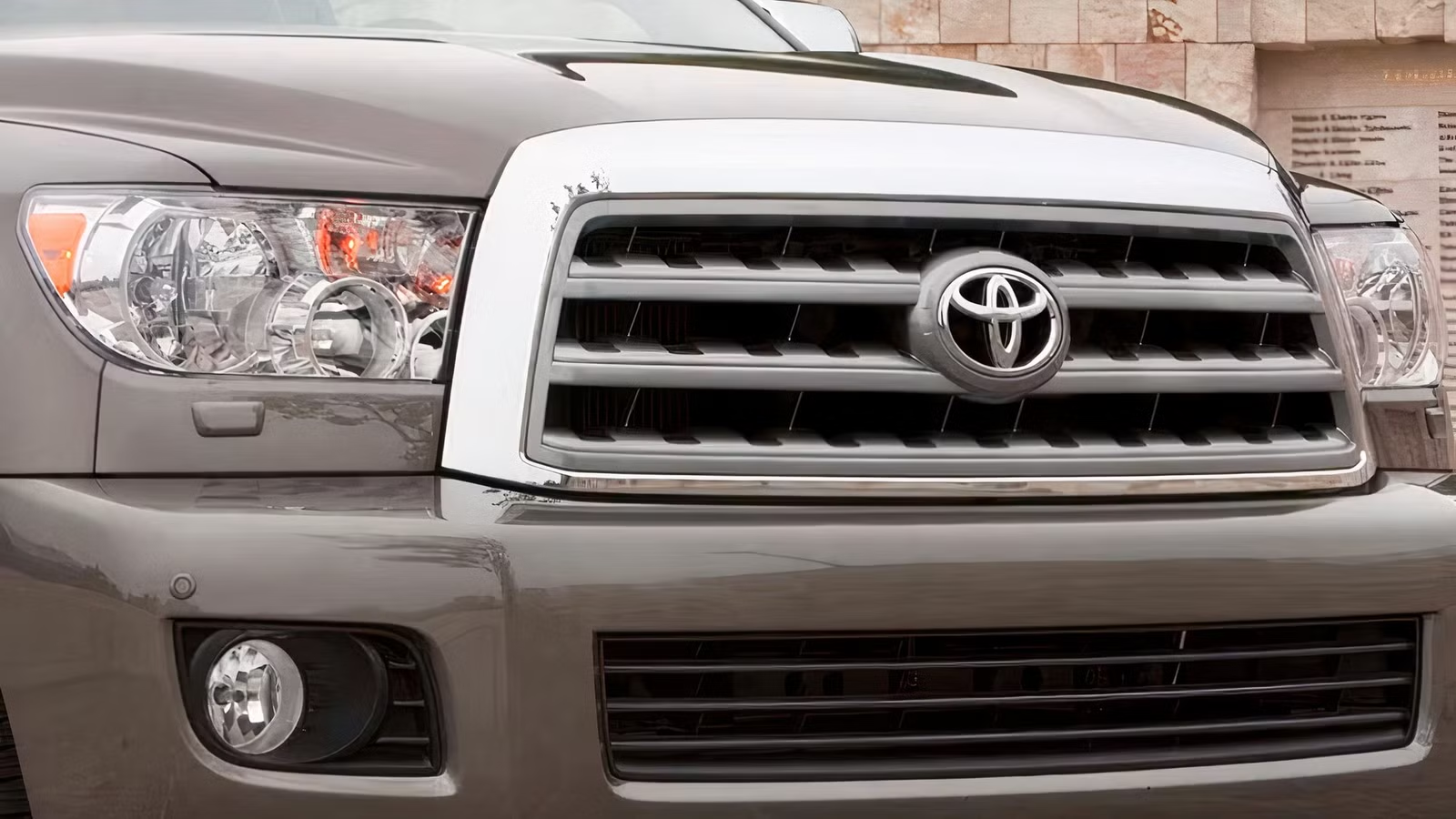
Before tech truly took hold of one of Toyota’s most rugged full-size SUVs, models like the second-gen Toyota Sequoia (2008–2022) epitomized how long-lived and tough an SUV could be. Today, that legacy of longevity has carried over, and institutions like iSeeCars still see it as one of the SUVs with the highest estimated lifespan.
According to iSeeCars, the Sequoia has an average estimated lifespan of 191,207 miles. They also say that the Sequoia has a 39.1 percent chance of hitting 250,000 miles, making it 8.1 times more likely than the average vehicle to do so. The model below it in the rankings is the 4Runner, which has an estimated lifespan of 197,282 miles, but has a lower 32.9 percent chance of hitting 250,000 miles.
Its Naturally Aspirated V8 And Proven Drivetrain Made All The Difference
Close-up shot of 2017 Toyota Sequoia engine bay showing 5.7-liter naturally aspirated V8Toyota
The second-generation Toyota Sequoia arrived at the perfect time if you were looking for a full-size SUV built for the long haul. While many brands were already moving toward smaller turbo engines and more complicated systems, Toyota stuck with a much simpler approach. Under the hood of some of the most reliable Sequoia model years, like the 2017 Sequoia, is the naturally aspirated 5.7-liter 3UR-FE V8, one of Toyota’s most unkillable engines.
Good for 381 horsepower and 401 pound-feet of torque, the 3UR-FE packs a decent amount of muscle, but its real strength is how it makes that power. Unlike a lot of modern SUVs, the 3UR-FE relies on no forced induction; that means no turbos creating extreme temperatures, no complicated boost systems, and no need to squeeze maximum output from every liter.
Rear 3/4 shot of 2015 Toyota Sequoia parked on streetToyota
Instead, you get a strong design that consists of DOHC, hefty displacement, conservative tuning, an aluminum block, and chain-driven timing. With regular maintenance, a 3UR-FE V8 under the hood of a Tundra has hit over a million miles, so they are definitely built for the long run.
Just as importantly, the transmission in the Sequoia plays a big role. Early second-gen Sequoias are equipped with Toyota’s A750 five-speed automatic, while later models use the AB60 six-speed auto. Neither transmission is revolutionary, but they are built to handle the Sequoia’s weight (up to 6,045 pounds) and its impressive 7,400-pound tow rating, thanks to hydraulic automatic technology instead of DCTs, robust gearsets, strong internals, and torque converters that allow for smooth power delivery.
The Sequoia’s Old-School Engineering Is Exactly What We Miss Today
Profile action shot of 2017 Toyota Sequoia driving on roadToyota
This kind of thinking wasn’t limited to the engine; the whole build is relatively simple compared to modern SUVs and the newer generation of the Sequoia. Unlike modern unibody crossovers, the second-gen Sequoia uses a proper body-on-frame layout, meaning it can handle towing loads better, shrug off rough terrain, and deliver the long-term toughness needed to survive hundreds of thousands of miles.
The suspension follows the same philosophy. A double-wishbone front setup helps keep it relatively comfortable and controlled on the road, while the rear suspension is designed to handle heavy loads without falling apart under constant strain. Add in Toyota’s proven four-wheel-drive system and heavy-duty components, and the Sequoia becomes less like a disposable family ferry and more like a piece of real heavy-duty equipment.
What Sets It Apart From Modern Full-Size SUVs
Front 3/4 action shot of 2017 Toyota Sequoia driving on roadToyota
This straightforward build is what a lot of modern SUVs have moved away from. Today’s SUVs are certainly smarter, faster, and packed with tech, but the Sequoia was built around the simple idea of making it strong first, and everything else coming second.
Compared to the Sequoia’s closest full-size SUV rivals, none of them come close when it comes to chances of reaching 250,000 miles. iSeeCars says that the Suburban has an 11.8 percent chance; the GMC Yukon XL, a nine percent chance; the GMC Yukon, 7.8 percent; the Tahoe, 7.7 percent; the Escalade ESV, a 6.8 percent chance; and the Armada, a 5.8 percent chance.
Front 3/4 action shot of a 2020 Toyota Sequoia TRD Pro traversing some overgrown terrainToyota
Toyota-grade dependability is one thing, but the Sequoia also outdoes a lot of its full-size rivals in terms of maintenance costs. Edmunds estimates that for the last model year of the second generation (2022), it will cost you between $78,793 and $92,409 to own over five years. This includes high-end five-year maintenance costs of $8,918, $2,817 in repairs, and $28,487 for gas.
Something like the 2022 Suburban will cost you up to $11,986 and $3,111 in maintenance and repairs; for a 2026 GMC Yukon, a minimum overall cost of $88,589; and for an Escalade, a minimum five-year cost estimate of $121,193.
It Avoids The Complexity That Holds Many Rivals Back
Profile shot of 2017 Toyota Sequoia parkedToyota
Not only do 2026 full-size SUVs get more in the way of electronic systems keeping the engine doing what it should be doing and adaptive systems that can be costly to repair, but they also get the thing that most of us look for in a new SUV: lots of tech inside and outside the cabin.
Models like the 2026 BMW X7 are equipped with a 14.9-inch infotainment screen and a 12.3-inch digital cluster that forms the BMW Curved Display. The new 4Runner is equipped with electronic Sway Bar Disconnect on the outside and a 14-inch touchscreen on the inside, and the 2026 Land Rover Range Rover gets active noise cancellation, electronic air suspension, dual 11.4-inch rear-seat infotainment screens, digital LED headlights, and a 13.1-inch curved glass Pivi Pro floating display with haptic feedback.
Shot of 2026 Land Rover Range Rover Autobiography interior showing front cabinLand Rover
It is all very impressive and is why a lot of us choose certain full-size SUVs today, but that is an awful amount to go wrong, even in the supposedly more reliable models we have today.
Inside the final model year of the second-gen Sequoia: a seven- or eight-inch touchscreen, smartphone integration, tri-zone climate control, a power liftgate, and available adaptive suspension for the highest trim (the Platinum). In earlier models, you get nowhere near this level of tech.
Even The New Sequoia Still Has Everything To Prove
Low-angle front 3/4 shot of 2026 Toyota Sequoia parked off-roadToyota
Low-angle profile shot of 2017 Toyota Sequoia profile parkedToyota
The latest generation of the Sequoia is a sign of how much the full-size SUV market has changed. When the third-gen arrived for 2023, Toyota traded the old-school 3UR-FE V8 for its i-FORCE MAX hybrid powertrain: a 3.4-liter twin-turbo V6 paired with an electric motor and a 10-speed automatic transmission. The result is a serious jump in performance, with 437 horsepower and a huge 583 pound-feet of near-instant torque on tap, making the previous V8 look almost modest.
It is also far more fuel-efficient; FuelEconomy.gov says that the 2022 V8-equipped Sequoia can achieve between 14 and 15 combined mpg, which amounts to $4,000 to $4,300 a year for gas. The 2026 Sequoia: between 20 and 22 combined mpg, costing a more sensible $2,750 to $3,700 a year for gas. It also brings touchscreen sizes up to 14 inches, digital displays, and Adaptive Variable Suspension (AVS) and Load-Leveling Rear Height Control Air Suspension optional on far more trims.
Shot of 2026 Toyota Sequoia Interior showing front cabinToyota
In other words, the new Sequoia offers everything we look for in a modern SUV. However, so far, it hasn’t proven itself to be bulletproof. There have already been some concerns from loyal Sequoia owners about the engine change, while an NHTSA recall for the transmission failing to disengage when placed in neutral also hasn’t helped the reception of this very different Sequoia.
The new-gen Sequoia also lacks the iconic roll-down rear window, and a high starting price of around $66,000 has put some buyers off. Many have been quick to point out that the turbos, hybrid system, and more electrical assistance all-around could be a problem in a few years or deep in the woods. So, while the Sequoia nameplate lives on, the latest iterations are still waiting to prove whether they can build on the legacy the older generations established.
The Toyota Sequoia Remains The Benchmark For Usability And Dependability
Front shot of 2017 Toyota Sequoia parkedToyota
The Sequoia’s biggest achievement is that it never needed to reinvent what a full-size SUV should be. It provides the space, capability, and comfort expected from a three-row SUV without feeling as though it was designed around a short ownership cycle. The 2022 model has a maximum cargo capacity of 120.1 cubic feet, and the 2026 model gets 86.9 cubic feet. That is a massive reduction, but the basics are still there.
Today, the second-gen Sequoia still makes sense as the go-to SUV to carry the family across the country or haul equipment, despite its aging tech, while the new Sequoia still makes sense as a modern iteration of the legend. The 2026 model is still rated 80 out of 100 for reliability on J.D. Power, after all.
Shot of 2017 Toyota Sequoia interior showing front cabinToyota
Both the final V8 Sequoias and the new model are in an interesting position against the likes of the Tahoe, Yukon, Expedition, and Wagoneer. The market has now moved on from pure utilitarianism, and the Sequoia’s rivals have become a lot more premium, powerful, and more focused on delivering near-luxury-car feels. It’s not a bad thing, but it has changed what we get from models that were once for the long run.
The Sequoia’s appeal has always been that it feels like something built to be used rather than replaced. This is also apparent in its long-term appeal beyond reliability. CarEdge says that the Sequoia only depreciates by 37 percent over five years, and by 63 percent over 10 years, while used prices can sometimes still exceed these estimates.
Shot of 2017 Toyota Sequoia interior showing front seatsToyota
Shot of 2017 Toyota Sequoia interior showing rear seatsToyota
Average used prices for a 2016 Sequoia are between $20,600 and $26,900; between $24,600 and $29,100 for the 2017 model; between $27,200 and $33,600 for the 2018 model; between $32,400 and $36,800 for the 2019 model; between $37,500 and $43,800 for the 2020 model; between $36,500 and $48,200 for the 2021 model; and between $37,100 and $52,400 for the final model year of the second generation.
The MSRP for a 2026 Sequoia ranges between $65,725 and $86,135. The outlay for one is a significant commitment, but thanks to everything that makes the Sequoia relevant year-on-year, even when mileage starts to climb and the excitement of a new purchase fades, it proves itself to be the kind of SUV built for a lifetime. It has become the benchmark because it represents something becoming rarer: a full-size SUV that feels like a long-term investment rather than a temporary upgrade.
Base Trim Engine
5.7L V8 Gas
Base Trim Transmission
6-Speed Automatic
Base Trim Drivetrain
Rear-Wheel Drive
Base Trim Horsepower
381 hp
Base Trim Torque
401 lb-ft @ 3600 rpm
Fuel Economy
13/17 MPG
Make
Toyota
Model
Sequoia
Segment
Full-Size SUV
Infotainment & Features
8 /10
Sources: Toyota, iSeeCars, RepairPal, J.D. Power, Kelley Blue Book, and CarEdge.








No Comments