
The Ultra-Rare Chevrolet Muscle Car Collectors Still Hunt For
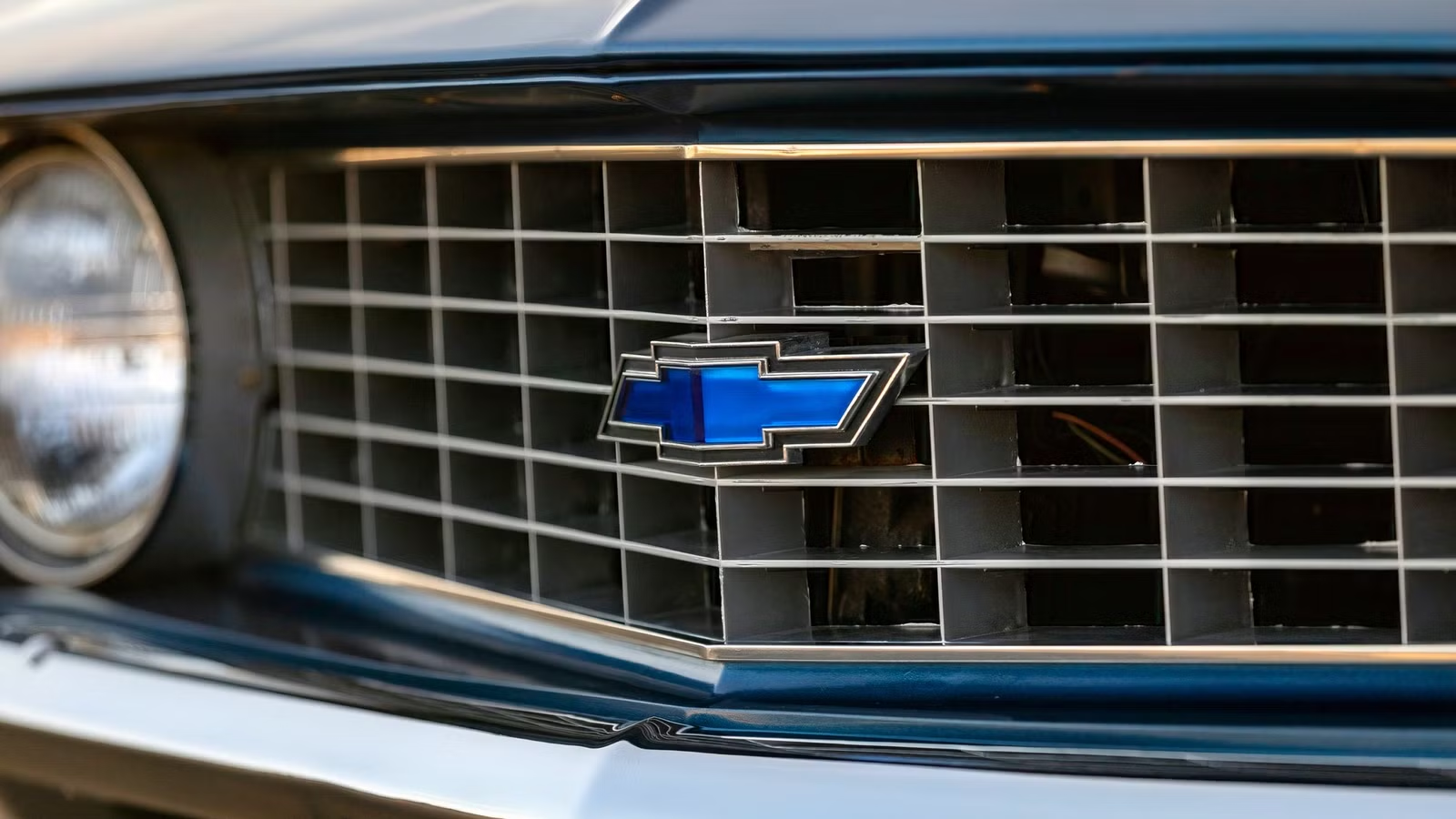
The golden age of American muscle cars is remembered fondly by gearheads in the States and beyond. Many desirable classics we obsess over today originate from that period, and a few of the coolest and rarest among them can make any serious collector weak at the knees. In hindsight, the sort of performance you could get access to for just a few months’ wages was utterly insane, while the horsepower wars between GM, Ford and Chrysler ensured buyers had plenty of great options to choose from. Legends like the Hemi ‘Cuda or Chevy’s coveted Chevelle SS 454 LS6 will nowadays command six, perhaps even seven figures at auction, which sometimes translates to more than 100 times their initial MSRPs.
General Motors Had Some Weird Rules Back In The Day

Blue Oval and Chrysler had no problem with the idea of pushing limits when times were good, but GM was more like the cautious adult telling everyone to settle down and behave. On the one hand, its divisions were banned from racing since 1963, partly due to the company being under investigation for monopolistic practices and antitrust concerns at the time. You see, GM’s share of the U.S. automotive market was over 50% back then, which drew a whole load of unwanted attention from the Department of Justice. To avoid giving the federal government a reason to seriously consider breaking the auto giant up into smaller entities, General Motors decided to keep a lower profile by withdrawing completely from motorsport.
Then there was the whole ordeal regarding capped engine displacements, part of GM’s broader effort to distance itself from a high-performance brand identity. Compact and mid-size cars were to receive powerplants no bigger than 330 cubic inches, but this rule ironically ended up backfiring in spectacular fashion. Unwilling to accept the limitation, some brands started looking for loopholes they could exploit, and it didn’t take long for Pontiac under John DeLorean to find one. Because GM’s rule didn’t specify anything about optional packages, they took the unassuming Tempest LeMans and gave it the W62 option package, thus spawning the legendary 389-cube GTO.
By the time the bigwigs caught wind of this, thousands of dealer orders had already been placed and there was no way for the project to be canceled without facing serious backlash. Ultimately, GM had to let it slide and the GTO became a standalone model in 1966, while the displacement cap was raised to 400 cubic inches.

DeLorean Wasn’t The Only One To Defy GM’s Policy

The Pontiac GTO may have been the best-known case of someone finding a way around GM’s displacement cap rule, but it was far from an isolated occurrence. As it turned out, offering bigger engines as optional packages wasn’t the only way to circumvent the displacement cap, because there was also the Central Office Production Order (or COPO) system used by Chevrolet at the time. And since 400 cubes were still not enough, a dealer named Fred Gibb decided to take full advantage of it in order to give Americans one of the most remarkable muscle cars they would ever see. Now, COPO was normally intended for fleet vehicles like taxis or police cars, but Gibb had other plans at the tail end of the 1960s.
Chevrolet Camaro ZL1: Because Rules Are There To Be Broken

As a Chevy dealer, Fred Gibb had the brilliant idea of using the COPO program as a way of chasing superior performance, and the fruit of his labor was an absolute marvel. Enter the fabled Camaro ZL1 from 1969, one of the rarest, craziest and most sought-after muscle cars released during the glory days. COPO allowed Gibb to order Camaros specified with Chevrolet’s all-aluminum, 427-cubic-inch V8 codenamed ZL1, a light but brutally powerful mill originally designed for the Can-Am road racing series. It featured forged internals, 12:1 compression, and a Holley four-barrel carb, while its peak power output was rated at 430 horsepower and 450 lb-ft of torque.
Many argue those figures are conservative, though, and the engine is widely believed to have made north of 500 hp in reality. One could have it paired with a three-speed automatic or four-speed manual transmission, the latter providing either close or wide gear ratios. A limited-slip differential was part of the drivetrain componentry, too, while engine temperatures were held in check by a heavy-duty cooling system. In terms of real-world performance, the ZL1-powered COPO Camaro could accelerate from zero to 60 mph in just 5.3 seconds, but this could drop into the four-second range with a race tune and some slicks. Its quarter-mile time sat at 13.16 ticks of the stopwatch with street tires and standard tuning, whereas stickier rubber and race prepping brought that down to 11.64 seconds.

Those numbers were extraordinary for 1969, confidently placing the ZL1 among the fastest muscle cars of its era. But it wasn’t just about that race-derived engine, because the car also featured a thoroughly upgraded chassis to handle its raw power. The suspension was beefed up to keep the Chevy nice and planted, while a considerable reduction in overall weight came as a result of that sweet, all-aluminum V8 mill. It is said to have shaved roughly 160 pounds off the car’s mass, which aided stopping performance despite the brakes being only marginally better than those found on regular Camaros (and extremely rudimentary by today’s standards).
From a visual standpoint, there wasn’t anything that would immediately give away the ZL1’s wild side, making it a true sleeper without any SS badging or racing stripes. This only added to its charm, because you could essentially get something that looked like a standard Camaro but was actually a street-legal drag racer. However, to say pricing was steep would be a gross understatement, as the COPO Camaro ZL1 came with a sticker price of around $7,200. For comparison, a contemporary 383-cube Plymouth Road Runner would only cost about three thousand dollars, while the much pricier Ford Mustang Boss 429 still sat below $5,000 and Chevy’s very own Camaro SS 396 was in the region of $3,500. Clearly, not many buyers had twice that amount to spend on the ZL1.
With Only 69 Units Sold, The Camaro ZL1 Is A True Unicorn

Given how expensive the ZL1 was — the engine itself costing more than the base car at over four grand — only 69 copies ever found their way onto public roads. That, along with its blistering performance and intriguing backstory, makes it one of the most desirable classic muscle cars you can get your hands on today. These cars rarely hit the auction block, though, so finding one won’t be easy even if you have deep pockets. Speaking of which, the current price for a well-kept Camaro ZL1 can easily cross into seven-digit territory, which doesn’t come as a surprise given its rarity and credentials.
The highest recorded sale took place via Mecum in May, when the second ZL1 ever made commanded $1.43 million. It’s not hard to see why so many enthusiasts regard this legendary unicorn as a blue-chip investment, because market values regularly exceed the million-dollar mark when ZL1s change hands. The model occupies a very unique place in American muscle car history, one that collectors will happily pay a massive premium for in our day and age. You don’t normally get such a compelling combination of scarcity, performance credentials, and historical significance in a single model, yet the Camaro ZL1 delivers all three in abundance.
Sources: Chevrolet, Classic.com, Mecum

Related posts





Latest Post


No Comments