
The Long-Distance Tourer That Beats Harley-Davidson On Price And Features
Few motorcycles have shaped a segment as completely as Harley-Davidson’s touring lineup. These throne-like machines give riders the choice of soaking in the scenery or hiding behind a massive fairing that shrugs off wind and weather with equal indifference. They deliver serious wind protection, characterful engines, deep feature sets, and a heavy dose of heritage — that hard-to-quantify sense of belonging to something larger than yourself. Predictably, all of that comes at a significant price.

But what if heritage and brotherhood aren’t your priorities? What if you simply want a quiet, refined touring machine that eats miles with minimal drama and doesn’t drain your bank account in the process? Better still, what if that alternative could match or even surpass the American icon’s feature set? For riders asking those questions, the answer has been sitting in Honda’s lineup for decades — and it makes a genuinely compelling case.
The Honda Gold Wing Tour Beats Harley In Two Key Areas
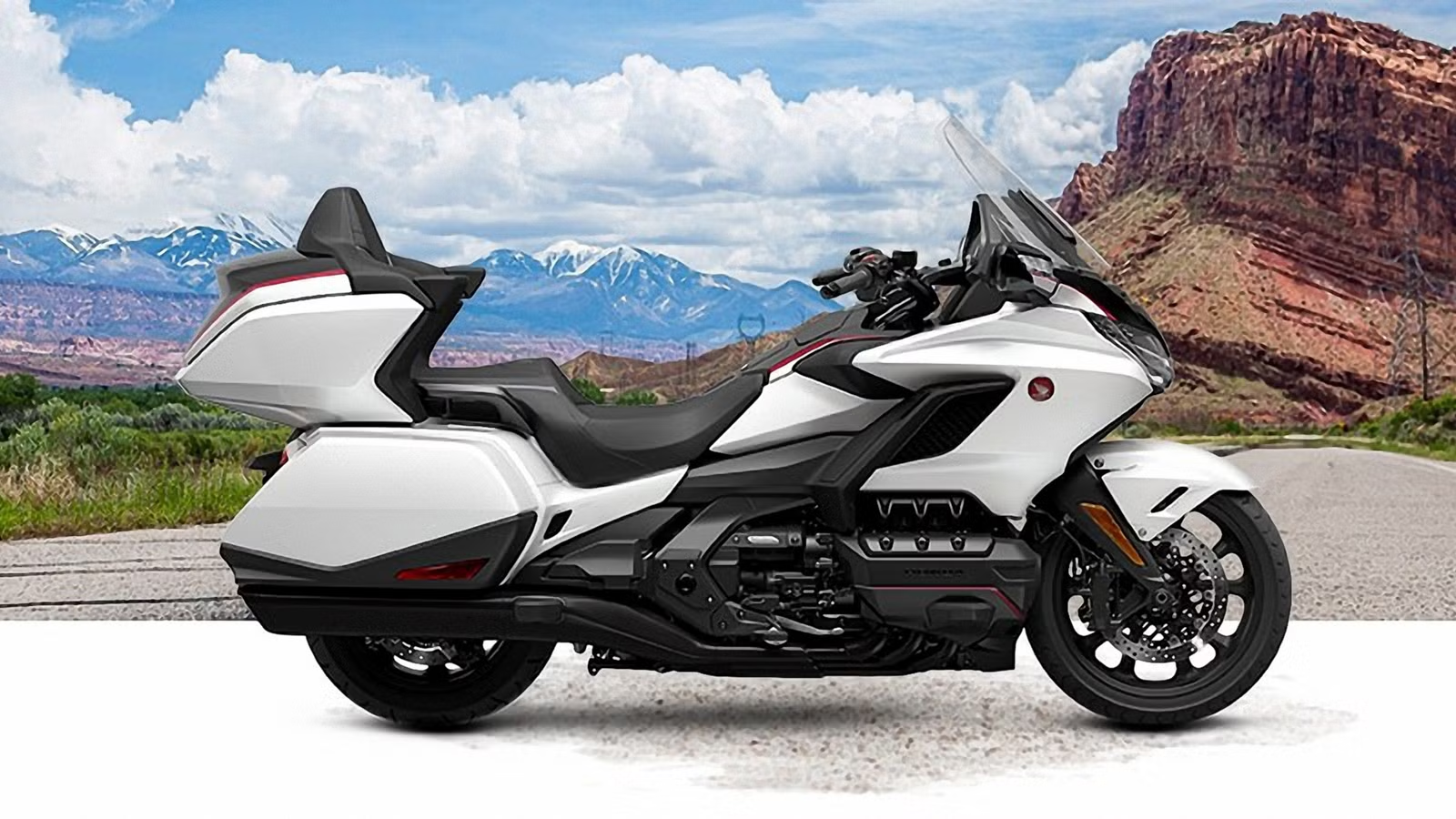
The Gold Wing is an icon of the touring world, and it has gone from strength to strength over the half-century it has been on sale. The last major update arrived in 2018, when sweeping changes made it a more accessible motorcycle for a broader range of riders while preserving everything that made it beloved in the first place. With so many standard features, unbeatable refinement, and a handful of genuine world firsts, the Gold Wing Tour makes a strong case as the long-distance tourer that beats Harley on both price and features. The Gold Wing Tour starts at $29,500 plus $775 destination fees.


One should note that the price quoted above is the base price. There is no real difference in the core feature set across variants, but you can add the seven-speed dual-clutch transmission for a modest premium, or step up to the automatic paired with an airbag. The airbag option is not available with the manual gearbox.
Honda Gold Wing Tour Highlights
- World’s only horizontally opposed flat-six engine in a motorcycle
- World’s only motorcycle with a seven-speed dual-clutch automatic
- World’s only airbag-equipped motorcycle
Honda Gold Wing Engine: Six Appeal

|
Engine |
Horsepower |
Torque |
|---|---|---|
|
1,833cc Six-Cylinder |
124.7 HP |
125.3 LB-FT |
The Gold Wing shares a rare distinction with the BMW K 1600 series as one of only two motorcycles currently available with a six-cylinder engine. Honda’s powerplant stands alone, however, as the only flat-six configuration in production motorcycles today. This engine produces 125 horsepower and 125 pound-feet of torque. It features upgraded cylinder heads with four valves per cylinder, while Honda’s Unicam SOHC technology keeps those heads compact and the overall engine width to a minimum. The latest iteration sheds 13 pounds compared to the previous generation — or 8 pounds in DCT form.

Transmission options include a six-speed manual that retains an electric reverse motor for parking-lot maneuvers, or — for an additional premium — the world’s only seven-speed dual-clutch automatic transmission offered in a motorcycle. The DCT version adds a creep mode that walks the bike forward or backward at low speeds. Honda engineers configured the gearbox output shaft to rotate opposite the engine crankshaft, effectively canceling the rocking motion inherent to longitudinal engine layouts. Power reaches the rear wheel via shaft drive. Electronic sophistication comes courtesy of a six-axis IMU and ride-by-wire throttle, enabling multiple ride modes, traction control, cruise control, and hill-hold assist.
Honda Gold Wing Tour Chassis: Unique All Around

The Gold Wing uses a die-cast aluminum twin-beam frame, and it has seen some significant engineering changes over the years. The front suspension was redesigned around a double-wishbone setup — similar in concept to BMW’s Duolever system — which increases stability under hard braking by maintaining a more consistent rake angle. It also allowed Honda’s engineers to move the engine further forward in the chassis, since the front wheel now travels vertically rather than tracing the rearward arc of a conventional fork. The result is improved weight distribution, and positioning the rider further forward enhances the overall sense of control.

The rear suspension consists of a Pro-Link monoshock on a single-sided swingarm. Preload is electrically adjustable across four modes accessible through the display menus, and damping is electronically controlled as well. The brakes feature 320 mm dual discs at the front, each gripped by a six-piston caliper. At the rear, a 316 mm disc is paired with a three-piston floating caliper. Honda’s C-ABS system distributes braking force according to the demands of each situation.
Honda Gold Wing Tour Features: Everything You Need

The Gold Wing may carry a price that undercuts the full-dress Harley tourers, but it doesn’t cut corners on equipment. The standard feature list is extensive. Heated grips come as standard, and both the rider and pillion seats are heated as well. The trunk — which doubles as the pillion backrest — is large enough to swallow two full-face helmets. The saddlebags open at the push of a button and lock or unlock remotely via the key fob. Other notable standard items include passenger armrests, passenger audio controls, an upgraded audio system, a tall windscreen, and wide rider footpegs.

Honda Gold Wing Tour Notable Features
- Optional airbag
- Wireless Apple CarPlay, Android Auto
- Adjustable windscreen with memory
- BASF-developed paint
- Tire pressure monitoring
- A button that allows you to open your garage door

Related posts



Latest Post


No Comments