
Why The Ninja 650 Might Be The Most Beginner-Friendly Midweight Sports Bike Ever Made
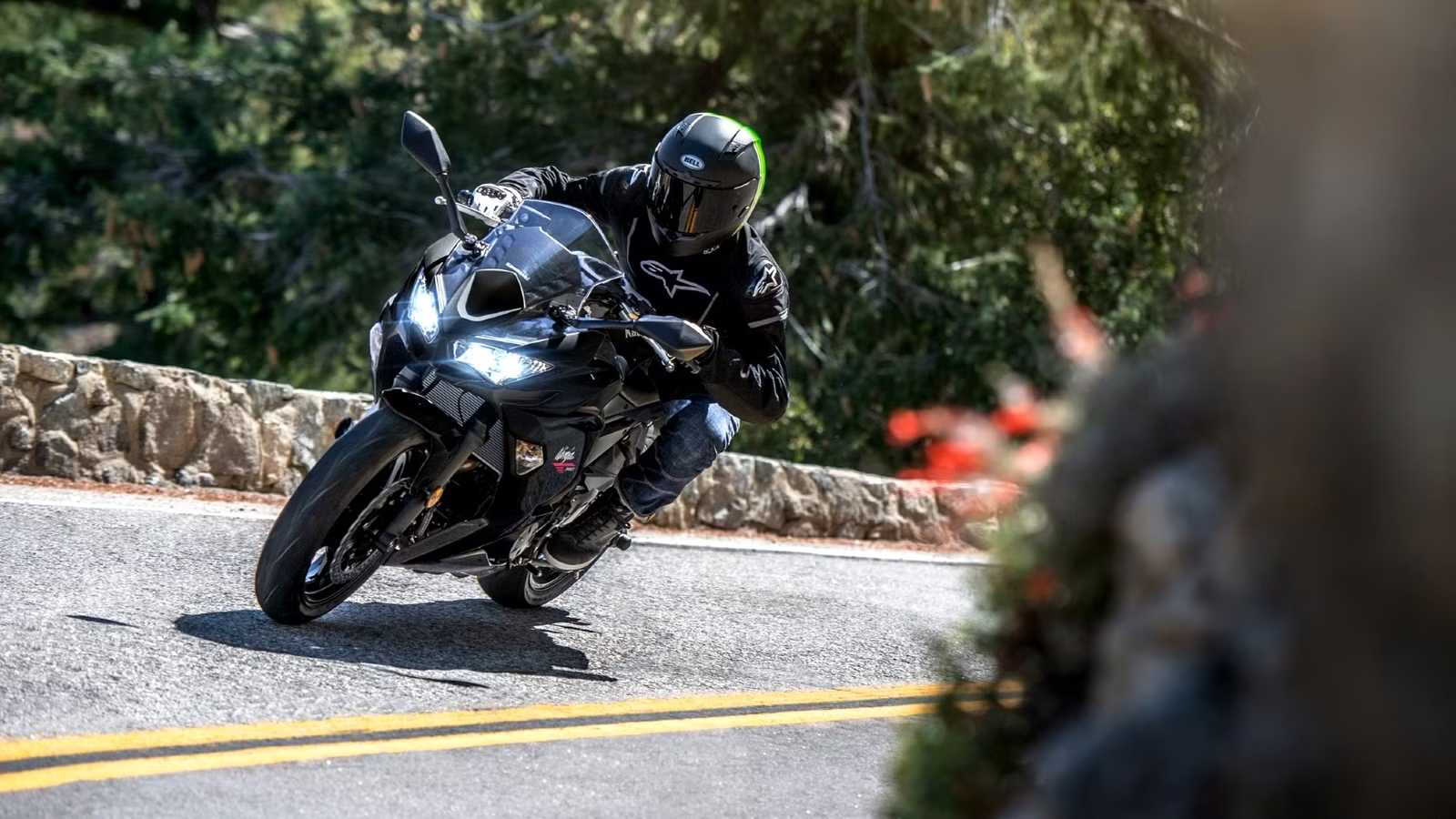
Imagine you’re a beginner sports bike enthusiast looking for your first purchase. Ideally, you’d want to start with a 250-400cc machine like a Kawasaki Ninja 300 and CFMoto 300SS. But the argument changes if you have some experience in the past and have handled a sports bike before.

That, along with the absence of license restrictions in the US, opens you to two choices: starting off with a 400-500cc premium beginner bike or picking a beginner-friendly middleweight machine in the 650cc ballpark. And if it’s the latter you like, then Kawasaki’s mid-capacity Ninja makes a solid case for itself in 2026. Much of that is down to its overall balance rather than chasing extremes in any aspect.
What Makes A Sports Bike Friendly For Beginners
Traditionally, sports bikes have never been beginner-friendly. They’ve always taken inspiration from race bikes. That birthed the “race on Sunday, sell on Monday” approach. Aggressive ergonomics, powerful engines with peaky performance, short service intervals, and high-end parts were all part of the experience, which makes them unsuitable for beginners. Handling these aggressive machines on a day-to-day basis is a challenge in itself, too, courtesy of a car-like turning radius, heat in your nether regions, and high saddles.


So for a sports bike to be beginner-friendly, it needs to take an entirely different approach. The clip-on bars need to be tall enough for regular riding without too much weight on the wrists, while the saddle should be roomy and its height needs to be low enough to plant both feet properly. These things also mean the footpegs can’t be too high or rearward.

Then, we have the engine characteristic. Smooth power with usable torque is necessary, with a focus on tractability. After all, no beginner has the skill to manage a sudden surge of power and chase 13,000 RPMs on a regular basis. Last but not least, the entire package needs to be proven, reliable, and easy on the pocket, loaded with parts that keep going with basic maintenance. Keeping all that in mind, there is really only one bike in the midweight segment that ticks these boxes.
The New Affordable Kawasaki Ninja That First-Timer Riders Shouldn’t Ignore
For under $5,000, this Ninja gets you almost 40 horsepower and proven underpinnings
The Kawasaki Ninja 650 Is As Friendly As Middleweight Sports Bikes Come

On paper, the Ninja 650 is not winning any spec sheet wars in this uber-competitive middleweight segment. The Yamaha YZF-R7 and Suzuki GSX-8R have more power and features, while the Aprilia RS 660 is simply in a different league, component-wise. Then, there’s the CFMoto 675SS and Triumph Daytona 660, both of which have a unique inline-triple powerhouse. But where the Ninja excels is in its overall balance and credibility.
Neither of these bikes matches the balance of all of the above-mentioned things better than the Ninja 650. For instance, the Yamaha YZF-R7 matches the Ninja 650’s reliability and ease of livability record. But it is considerably more committed and has more electronic failure points in 2026, post the recent update. Meanwhile, the GSX-8R, RS 660, Daytona 660, and 675SS all have considerably newer engines and more expensive parts to replace.

Speaking of expenses, the Ninja has a lip-smacking price as well. It starts from $7,599 in 2026, which is considerably cheaper (by about $2,000) than all of its rivals. In fact, this is closer to premium entry-level bikes like the Aprilia RS 457, Honda CBR500R, and Benelli Tornado than it is to the middleweights. To make matters sweeter, you can find MY25 examples for $7,399 and save around $500 over that, thanks to ongoing offers. ABS is an optional extra, though, which takes the price to $8,199.
There Is No Shortage Of Friendly Elements On The Ninja 650

What do you get for the money, you ask? Well, there’s plenty, and all of it focuses on being friendly for the masses (including beginners). You should also know that the Ninja 650 kick-started the “usable” middleweight segment in a way upon its debut, and it was so good already that Kawasaki hasn’t really overhauled things since then. There have been small improvements throughout, though, which make the current version a rather polished product. Let’s dive into the nitty-gritty.
A Traditional Parallel-Twin Engine Brings The Firepower

While the world explores parallel-twins with 270-degree cranks, Kawasaki keeps things simple. The 650 has a 649cc parallel-twin engine (also seen on the Versys 650), with a traditional firing order for a smooth power delivery throughout the revs. Having experienced the engine, we can confirm that it is linear and poised without being intimidating.
That’s a big plus for new riders, considering the power output isn’t exactly low. You get 67 horsepower and 48.5 pound-feet—both respectable numbers by new-age middleweight standards (the R7 has 72 hp and 49 lb-ft). All that power reaches the wheel via a six-speed transmission, and if you’re easy on the gas, you will eke out around 55 miles per gallon.
The Kawasaki Motorcycle That Punches Above Its Price Point
This Kawasaki naked bike delivers over 120 horsepower for under $10k, outperforming rivals that cost considerably more
Trellis Chassis With A Suspension That Just Works

The mill sits inside a trellis chassis, paired with a curved double-sided swingarm. This suspends on telescopic forks and a preload-adjustable monoshock for suspension duties. Sure, telescopic forks seem criminal in 2026, but they are more friendly and easier to fix than USDs when a beginner busts the fork seals. Joining hands with this is a set of 17-inch alloy wheels, where the front houses two 300 mm rotors with two-piston calipers and the rear has a 220 mm disc with a two-piston caliper. Oh, and unlike other middleweights, this has a slimmer 160-section rear tire (cheaper to replace).
A Low Saddle Height And Simple Features Round Things Off
Bumping up the friendliness is the rider’s triangle. The saddle height is quite low by sports bike standards (31.1 inches), the clip-on handlebars are tall (positioned above the triple-tree), and the pegs are low with a mid-set position. However, this is heavier than the competition, weighing 425.6 pounds (423 without ABS) fully fueled. Having both feet planted will certainly help deal with that.

When aboard, you’re greeted by a TFT instrument cluster. This is the old 4.3-inch unit, similar to the ZX-6R rather than the new display we see on the Z900. Although a little basic, it gets smartphone connectivity via the Rideology app and two display modes (dark and bright). As for rider aids, traction control and slipper clutch are the only inclusions. We feel that’s enough for a motorcycle with under 70 horsepower.
Source: Kawasaki

Related posts



Latest Post


No Comments