
The Most Reliable Harley-Davidson V-Twin Ever Built
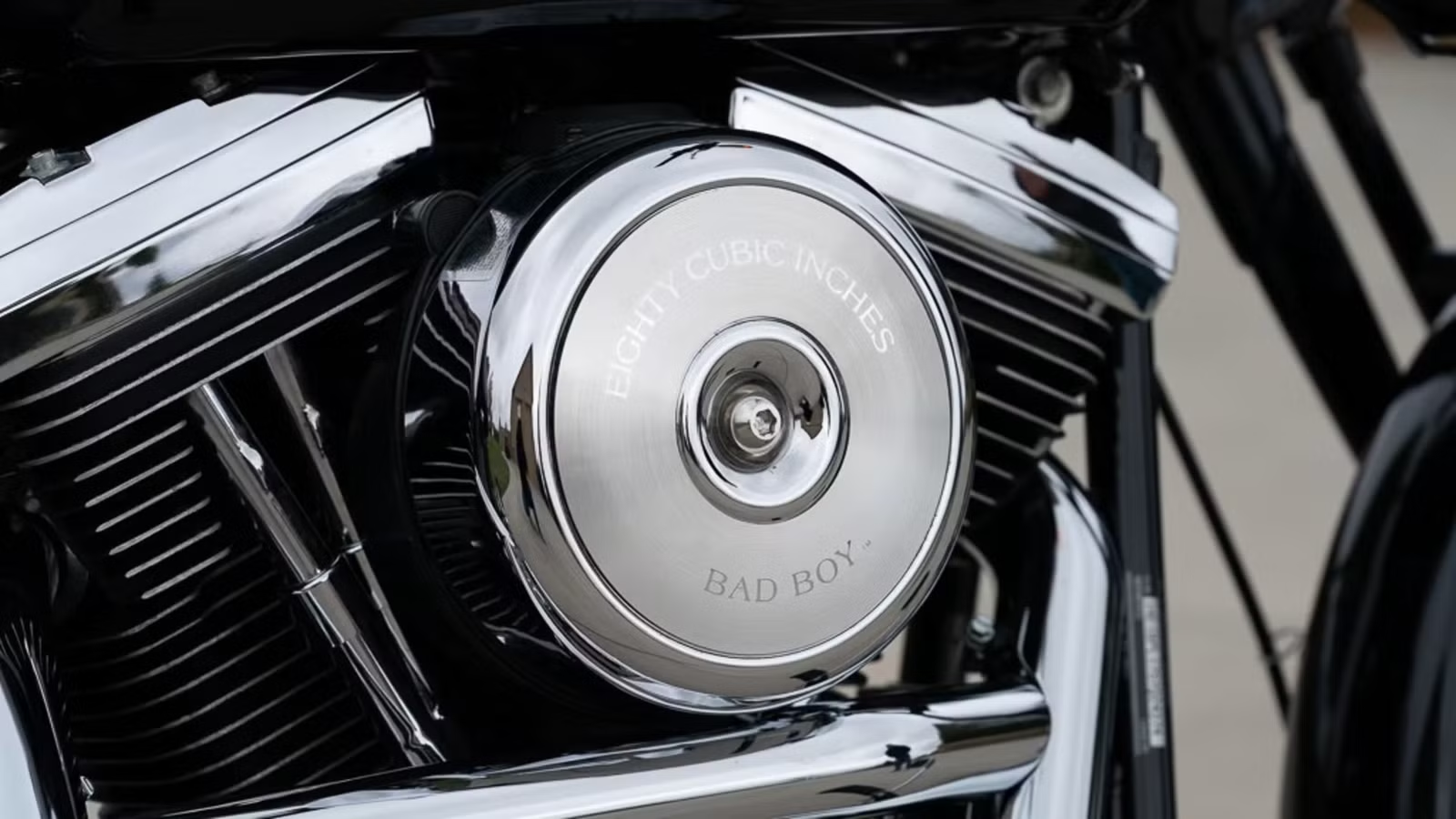
Harley-Davidson has built more than a few V-twin engines with reputations for going the distance. The modern Milwaukee-Eight has quickly earned riders’ trust, while the Twin Cam and Evolution continue to inspire fierce loyalty decades after their introductions. Each has a legitimate claim in the reliability conversation, but one stands apart for reasons that go beyond engineering alone. To understand why, it’s worth looking at what each engine got right and what ultimately separates the winner from the rest.
The Milwaukee-Eight Has Earned Riders’ Trust

If this debate were based only on modern engineering, the Milwaukee-Eight would have a strong claim to the title. Introduced for the 2017 model year, it marked Harley-Davidson’s biggest Big Twin redesign in nearly two decades, delivering smoother performance, better cooling, and fewer vibrations than the Twin Cam it replaced.

The improvements weren’t just about increasing power. Harley also focused on creating an engine that felt more comfortable and confidence-inspiring for everyday riding. A four-valve cylinder head improved efficiency, while refinements to the engine’s design reduced vibration without sacrificing the unmistakable feel of a Harley V-twin. The result was an engine that made long days in the saddle noticeably easier without feeling disconnected from the brand’s traditional character.
Real-World Reliability Matches The Design

Just as importantly, the Milwaukee-Eight has earned a reputation for reliability. Thousands of owners have logged impressive mileage with little more than routine maintenance, and the platform has proven itself in everything from daily commuters to cross-country touring motorcycles. That’s an impressive accomplishment for an engine that also produces noticeably more power than the Twin Cam before it.


For riders buying a new Harley-Davidson, it’s easy to see why so many choose the Milwaukee-Eight today. It delivers the refinement many riders wanted without losing the character that has always defined a Harley V-twin. It may even become the answer to this question one day. For now, the Milwaukee-Eight is missing one thing no amount of engineering can accelerate: decades of real-world proof. To find the engine that built Harley-Davidson’s reputation for long-term durability, you have to look a little further back.
The Twin Cam Proved More Durable Than Many Expected

When Harley-Davidson introduced the Twin Cam for the 1999 model year, it had big shoes to fill. Replacing the well-regarded Evolution was never going to be easy, but the new engine brought meaningful improvements in power, torque, and refinement while quickly earning a loyal following of its own.

Over the years, the Twin Cam found its way into everything from Dynas and Softails to Electra Glides and Road Kings. Owners appreciated its stronger performance and relaxed highway manners, and many examples have accumulated well into six-figure mileage with nothing more than scheduled service. Whether crossing states or commuting every day, the Twin Cam built its reputation the same way every dependable engine does: by quietly accumulating miles year after year.
One Weak Spot Changed The Conversation

For all its strengths, the Twin Cam never completely escaped one well-known issue: the early cam chain tensioners. On 1999–2006 models, the spring-loaded tensioner shoes could wear faster than expected, and if left unchecked, they had the potential to cause expensive engine damage. Harley later introduced hydraulic tensioners that greatly improved durability, and many earlier bikes have since been upgraded, but the issue remains part of the engine’s legacy.

That single weakness is what keeps the Twin Cam from taking the top spot. Without it, there’s a strong argument that Harley’s second-generation Big Twin could have become the company’s undisputed reliability champion. Instead, the title still belongs to an engine that earned its reputation with fewer caveats. Long before the Twin Cam arrived, Harley had already built a V-twin that owners trusted to rack up hundreds of thousands of miles with remarkably few known trouble spots.
The Evolution Set Harley-Davidson’s Reliability Standard

By the time the Evolution arrived for the 1984 model year, Harley-Davidson had something to prove. Earlier V-twins had earned devoted followings, but they had also developed a reputation for oil leaks, frequent maintenance, and inconsistent reliability. The Evolution 1340 Big Twin didn’t just replace the Shovelhead; it transformed how riders viewed Harley-Davidson reliability. The Evolution Sportster engine also built an impressive reputation for durability, but the Evolution 1340 is the engine that redefined reliability for Harley-Davidson’s Big Twin lineup.

Unlike the engines before it, the Evolution was designed to solve many of the durability complaints riders had simply accepted as part of owning a Harley. Aluminum cylinders and heads improved heat dissipation, hydraulic lifters reduced routine maintenance, and the straightforward design avoided the kind of chronic weak points that plagued some earlier V-twins. It wasn’t the most powerful V-twin Harley had ever built, but emphasizing durability over chasing bigger horsepower numbers became one of its greatest strengths. Owners found they could ride farther, wrench less, and trust the engine to keep delivering mile after mile.
Decades Of Proof Make The Difference

Plenty of Harley engines have earned loyal fans. The Evolution earned something even more valuable: time. Four decades after its debut, countless examples have surpassed 100,000 miles, with many reaching 200,000 miles or more while requiring little beyond routine maintenance and timely repairs. That kind of longevity isn’t built on marketing claims or a few standout examples; it’s backed by millions of miles accumulated by everyday riders.

The Milwaukee-Eight may eventually earn the same distinction, and a well-maintained Twin Cam can be an exceptionally dependable engine in its own right. However, the Evolution stands apart because it transformed Harley-Davidson’s reputation while proving its durability over decades of real-world use. That’s why, when the conversation turns to the most reliable Harley-Davidson V-twin ever built, the Evolution still sets the standard. But earning a legendary reputation is only half the equation. Whether an Evolution-powered Harley is still a smart motorcycle to buy decades later is a different question entirely.
Why Evolution-Powered Harleys Still Make Sense Today

The Evolution’s reputation wasn’t left behind when production ended. One reason Evo-powered Harleys remain so desirable is that they occupy a unique place in Harley-Davidson history. They’re modern enough to live with comfortably, yet simple enough that many owners still do much of their own maintenance. That balance has become increasingly rare as motorcycles have added more electronics, sensors, and rider-assistance technology.

Replacement parts remain widely available, aftermarket support is extensive, and the engine’s straightforward design means many routine maintenance jobs can be handled without specialized tools or advanced mechanical experience. Those qualities have helped keep Evolution-powered Softails, Dynas, and Touring models built throughout the late 1980s and 1990s popular on the used market. For riders who value proven reliability over the latest technology, that’s a compelling combination.
Buy The Motorcycle, Not Just The Engine

Of course, no motorcycle is reliable simply because of the engine bolted into its frame. The newest Evolution-powered Harleys are now more than 25 years old, so overall condition matters just as much as the V-twin itself. A neglected bike with poor maintenance records, worn suspension, or aging electrical components can quickly erase the advantages of an otherwise dependable engine. A thick folder of maintenance receipts is often worth more than a spotless chrome cover. Regular oil changes, charging system repairs, and evidence that the motorcycle has been ridden and cared for consistently usually tell you far more about its future reliability than an unusually low odometer reading.

That long-term record is why the Evolution still earns the nod as Harley-Davidson’s most reliable V-twin. The Milwaukee-Eight has already established itself as one of Harley-Davidson’s most capable engines. Whether it eventually surpasses the Evolution will depend less on engineering than on how it performs over the next several decades. Until then, the Evolution remains the benchmark every Harley-Davidson V-twin is measured against.
Source: Harley-Davidson

Related posts
Latest Post


No Comments