
The 1967 Shelby Convertible That A Theft Accidentally Saved From The Crusher
A rare car usually involves an exclusive plan and a price tag designed to keep ordinary buyers outside the velvet rope. This one, though, became exclusive because nearly everything around it went sideways, including the production schedule and Ford’s patience.

Then came a hurried makeover and a disappearance so odd that even Carroll Shelby treated the official explanation like an inside joke. By the time the dust settled, an intended first-of-many had become the sole survivor of a canceled branch of the Shelby Mustang family.
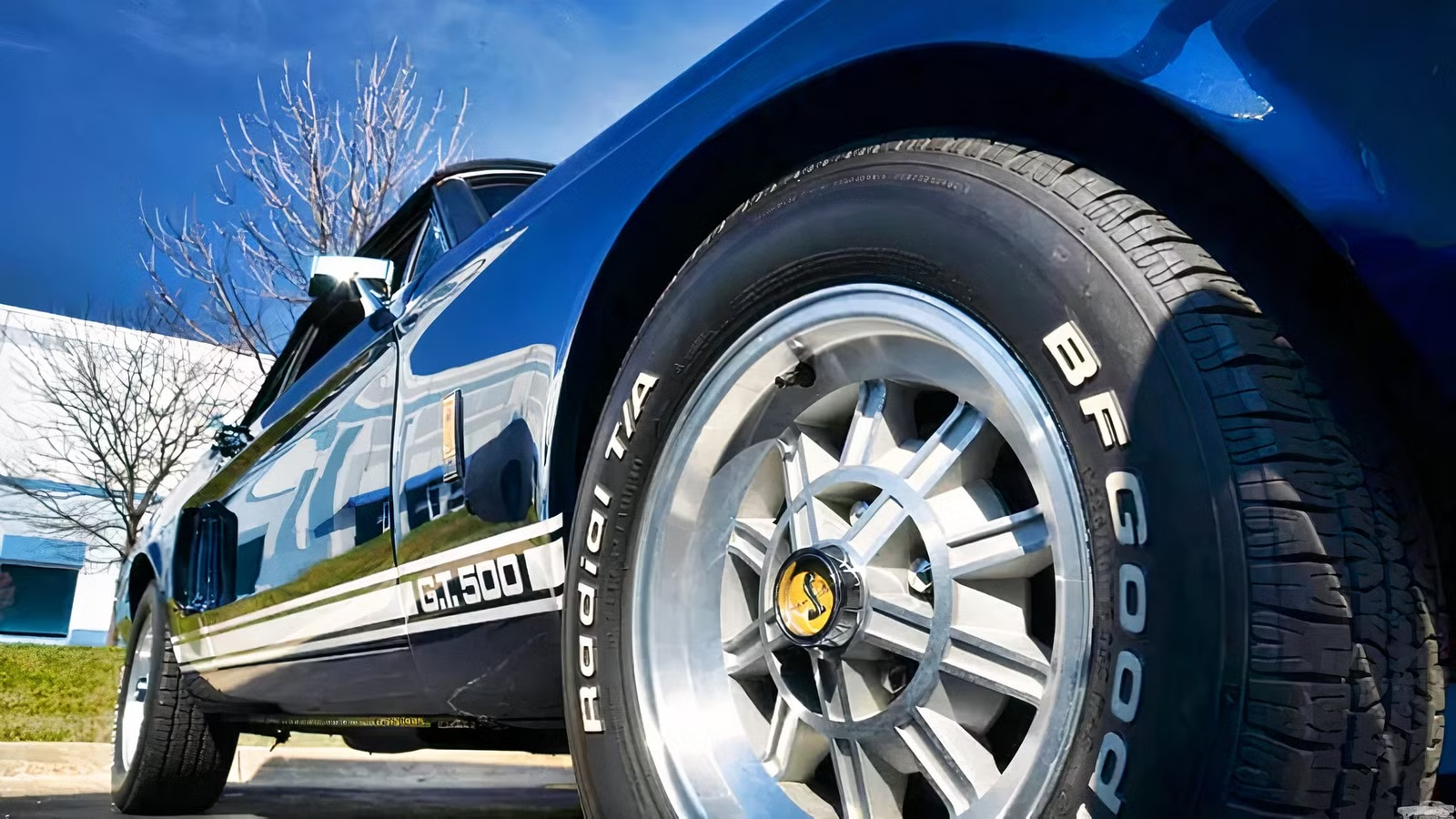
Original images of the 1967 Shelby convertible are rather hard to source, so we’ve used photos of a 1967 Mustang convertible restored to Shelby GT500 specification in 2007 for representation only.
Shelby’s 1967 Ambition Outran Its Assembly Line

Shelby American had kept its Mustang formula relatively focused in 1965 and 1966, building the GT350 around the fastback body. Success made expansion look tempting. For 1967, internal ordering records pointed toward six Mustang-based Shelby models, created by combining small-block and big-block power with fastback, coupe, and convertible bodies. The coupe and convertible were intended to join as midyear offerings.
That plan looked a touch more improbable once the company’s finances were placed under a harsher light. Shelby’s Mustang program had lost $311,000 in 1965 while building about 500 cars. The next year brought roughly 2,300 sales and a $310,000 profit, but Hertz had absorbed close to half of that production. Take away the rental-car order and the sudden business miracle starts looking a little less miraculous.
Ford was already deeply involved in keeping the program moving, and its tolerance had limits. Shelby American’s small Los Angeles operation had been arranged around a far simpler GT350 workload. Asking it to handle two engines and additional body styles meant greater complexity at the exact moment the company needed clean execution. Carroll Shelby was rolling the dice, and the table was beginning to wobble.
Production Trouble Killed The Convertible Before Launch

The first major snag arrived with the 1967 Shelby’s fiberglass. The parts developed for the new nose and hood didn’t properly fit production Mustangs coming from Ford’s San Jose plant. Whatever the reason behind the mismatch, finished cars couldn’t leave Los Angeles on schedule while Shelby employees spent days making bodywork fit one car at a time.
As a result, Mustangs started backing up. Orders changed, deadlines slipped, and the paperwork showed Ford personnel moving into positions that Shelby employees had previously handled. Ford sent Ray Geddes to take over purchasing and installed Fred Goodell as chief engineer. A.O. Smith Plastics in Michigan, already experienced with Corvette fiberglass bodies, was brought in to help clean up the mess.
No Small Issue

It’s worth pointing out that this wasn’t a minor trim issue. The 1967 front-end design created practical headaches that the following year’s parts were meant to address. The revised clamshell arrangement reduced hood lift, while a repositioned scoop and added vents improved airflow around the big-block. Smaller rectangular driving lights also blocked less cooling air than the 6-inch round lamps used earlier.
By spring 1967, the planned midyear convertible had been postponed until the 1968 model year. Ford would terminate Shelby’s Los Angeles production operation at the end of the model run because of production quality and financial strain. In essence, the convertible program failed because it ran out of runway before customers got a chance to say yes.
The 1967 Shelby GT500 Convertible Was Supposed To Have Siblings

The car left behind was Shelby serial 67413C9A00139, built from 1967 Mustang convertible VIN 7R03S133xxx. Shelby American ordered it on August 11, 1966. Ford built it at San Jose on November 21, released it to Shelby on November 25, and Shelby completed it on December 7. Those dates matter because they overturn the old story that this was created solely as a styling concept.
It was an assembly-line production Mustang and the first member of a planned midyear Shelby convertible run. The car originally wore 1967 Shelby styling because the later fiberglass used for 1968 promotional work hadn’t been developed when it was completed. In other words, it wasn’t born wearing a costume from the next model year.
The 1967 Shelby GT500 convertible was also the third big-block Shelby completed, following a fastback and the coupe later known as Little Red. Its production order identified it as a company car and engineering vehicle, and Carroll Shelby reportedly used it as a personal driver. A production pilot living the company-car life sounds almost ordinary, right up until you remember there was never a second one.
Its Hardware Was Even Rarer Than Its Body Style

Under the hood sat Ford’s 428 cubic-inch Police Interceptor V8 with two four-barrel carburetors. The convertible also carried factory air conditioning, power steering, and power front disc brakes. Combining dual-quad induction with factory air in a pony-car convertible was an exceptional arrangement, since even dual-quad 426 Hemi convertibles weren’t available with factory air conditioning.
Its automatic transmission adds another first. The reinforced C6 carried the PCG-R designation and transmission tag number 000001, identifying this car as the first Ford product fitted with that upgraded gearbox. Shelby serial number 00139 may look more interesting on a show placard, but the tiny transmission tag tells an equally important story about where Ford’s big-block driveline development was heading.
Good Enough For The Camera

In March 1967, two sets of hand-laid 1968-style fiberglass pieces arrived in Los Angeles for photographic cars. One set went onto an Acapulco Blue fastback. The other transformed the Candyapple Red convertible with a different hood, front end, taillight panel, and center console. It had gone from canceled production pilot to rolling preview in a matter of months.
The conversion didn’t turn it into a true 1968 production Shelby. Early photographs still show 1967 items such as the instrument cluster and vent windows. Its one-piece fiberglass nose differed from the later three-piece production design, while simulated side reflectors were simply decals. That’s prototype work in the most literal sense: good enough for the camera, provided nobody walked over with a magnifying glass.
Ford Killed The Run But Missed The Car

Soon after the conversion, the Shelby was reported stolen from an apartment-building parking lot while on loan. It was recovered several days later in the Palos Verdes hills with its wheels and several bolt-on parts missing. The people who stripped it had been strangely considerate, reinstalling the lug nuts and disconnecting the radio without cutting its wiring. Even car thieves apparently had restoration standards in 1967.
A June 20 insurance claim sought $506 for repairs to the engineering convertible. The missing parts included the carburetors, air cleaner, radio, steering wheel, and other components. The list closely resembled hardware that would have needed removal during the change from 1967 specification to its 1968 promotional appearance, which is one reason the official story has always carried a whiff of Hollywood.
Slipping Through The Cracks

Carroll Shelby later laughed about the theft account and called it the public version, although he never supplied a replacement explanation. What can be documented is that the car survived a period when Ford commonly destroyed experimental or heavily modified vehicles rather than risk liability. Shelby’s Los Angeles assets returned to Ford in August 1967, and a car altered this extensively could easily have faced the crusher.
Whether the theft directly saved it can’t be proven, but the disruption may have broken the usual disposal chain. The production run vanished, the Los Angeles operation closed, and the only completed 1967 Shelby GT500 convertible slipped through. It became the world’s rarest Shelby Mustang because Ford and Shelby failed to build the others, then somehow failed to kill the one they had.
Sources: 1967shelbyconvertible.com, ThrottleXtreme, Barrett-Jackson, Motorcities

Related posts

Latest Post


No Comments