
Toyota Officially Has The Most Expensive Hot Hatch In America
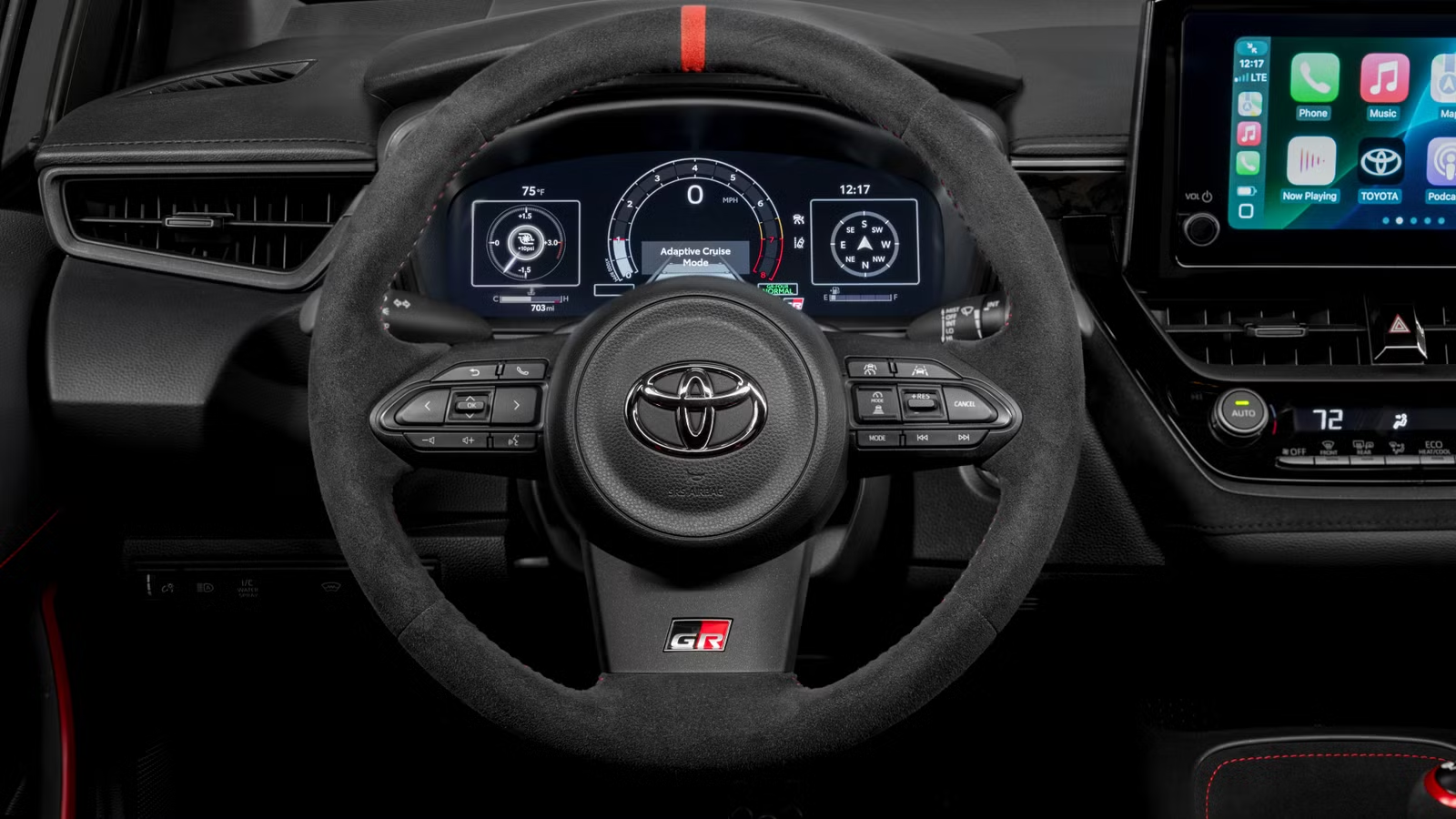
Toyota confirmed the 2026 GRMN Corolla will be built in a run of just 730 units worldwide — and every single one ships without rear seats. That’s not a delete option buried in a configurator. It’s a factory decision, baked into the car’s identity from the ground up, and it reframes the GRMN as something more significant than a hotter trim of the GR Corolla.

The GRMN Corolla isn’t asking to carry your passengers to a track day — it’s asking to be driven there flat-out, then turned loose on circuit. That distinction puts it in rare company: the kind of production-capped, purpose-built machines that JDM culture has been mythologizing for thirty years.
Two Seats, 730 Units, And A Price That Means Business
The GRMN Corolla starts at $64,360 in the U.S. — $65,665 with destination — which is a $23,000 premium over the standard GR Corolla. For that money, Gazoo Racing tuned the suspension specifically around Nürburgring data, fitted a close-ratio manual gearbox, and wrapped the body in carbon fiber panels to claw back weight. The rear seat delete is part of that same engineering logic: every kilogram removed from a car with a relatively modest turbocharged three-cylinder changes the power-to-weight equation in ways that matter on a timed lap.


The 730-unit global production cap is the other number that defines this car. It’s not arbitrary marketing scarcity — it mirrors the production discipline that made the Subaru Impreza 22B and Honda Civic Type R Mugen into collector benchmarks rather than just fast hatchbacks. When a manufacturer caps a run that tightly and removes creature comforts at the factory level, it signals that the engineering team had a specific performance target in mind, not a sales volume.
What Removing The Rear Seats Actually Does To The Car

Weight savings from a rear bench aren’t enormous in isolation — a typical rear seat assembly runs somewhere in the 50 to 120-lb range depending on construction — but the effect compounds. Lower mass means less inertia in direction changes, a marginal improvement in braking distances, and a center-of-gravity shift that tightens transient response. On a car already built around a sport-tuned multilink rear suspension and a torque-vectoring all-wheel-drive system, those margins matter.
More importantly, the two-seat configuration changes how the chassis is calibrated. Engineers don’t have to compromise spring rates, damper tuning, or roll stiffness to account for a fully loaded rear cabin. The GRMN’s suspension can be set up for a driver and one passenger — the conditions under which the car will actually be used — rather than a theoretical four-occupant scenario that will never happen on a circuit. That’s the same philosophy behind the Civic Type R Mugen’s stripped interior and the 22B’s focused two-door architecture: build the car around the use case, not the brochure.
Does The GRMN Corolla Earn The Homologation-Special Label?

The homologation-special tradition has a clear template: limited production run, factory-backed performance modifications, and a configuration that prioritizes lap times over livability. The 22B checked every box. The Mugen Civic Type R checked every box. The question is whether the GRMN Corolla belongs in that conversation or whether it’s a very expensive, very focused track toy that borrows the aesthetic.
The case for it is stronger than it might initially appear. Gazoo Racing — not a third-party tuner — developed the car. The production cap is enforced at the factory, not by dealer allocation. The two-seat layout is a structural decision, not a retrofit. And the Nürburgring development program gives the car a documented performance pedigree rather than a spec-sheet upgrade. What the GRMN lacks is a direct motorsport homologation requirement in the traditional sense — there’s no rally series mandating a street-legal version of this specific configuration. But the modern interpretation of the homologation special has always been broader than that: it’s a manufacturer committing, in hardware, to the idea that some cars exist purely to go fast. By that measure, the GRMN Corolla qualifies.
For gearheads who’ve been watching Toyota’s GR program evolve from the GR86 through the GR Yaris and into the full GR Corolla lineup, the GRMN represents the logical endpoint — a factory-built, production-capped, two-seat track weapon that wears a Corolla badge without apologizing for what it is. Let’s hope Toyota keeps pushing this direction.

Related posts


Latest Post


No Comments