
How Acura’s Coupe Outdrove A BMW 535i In ’92
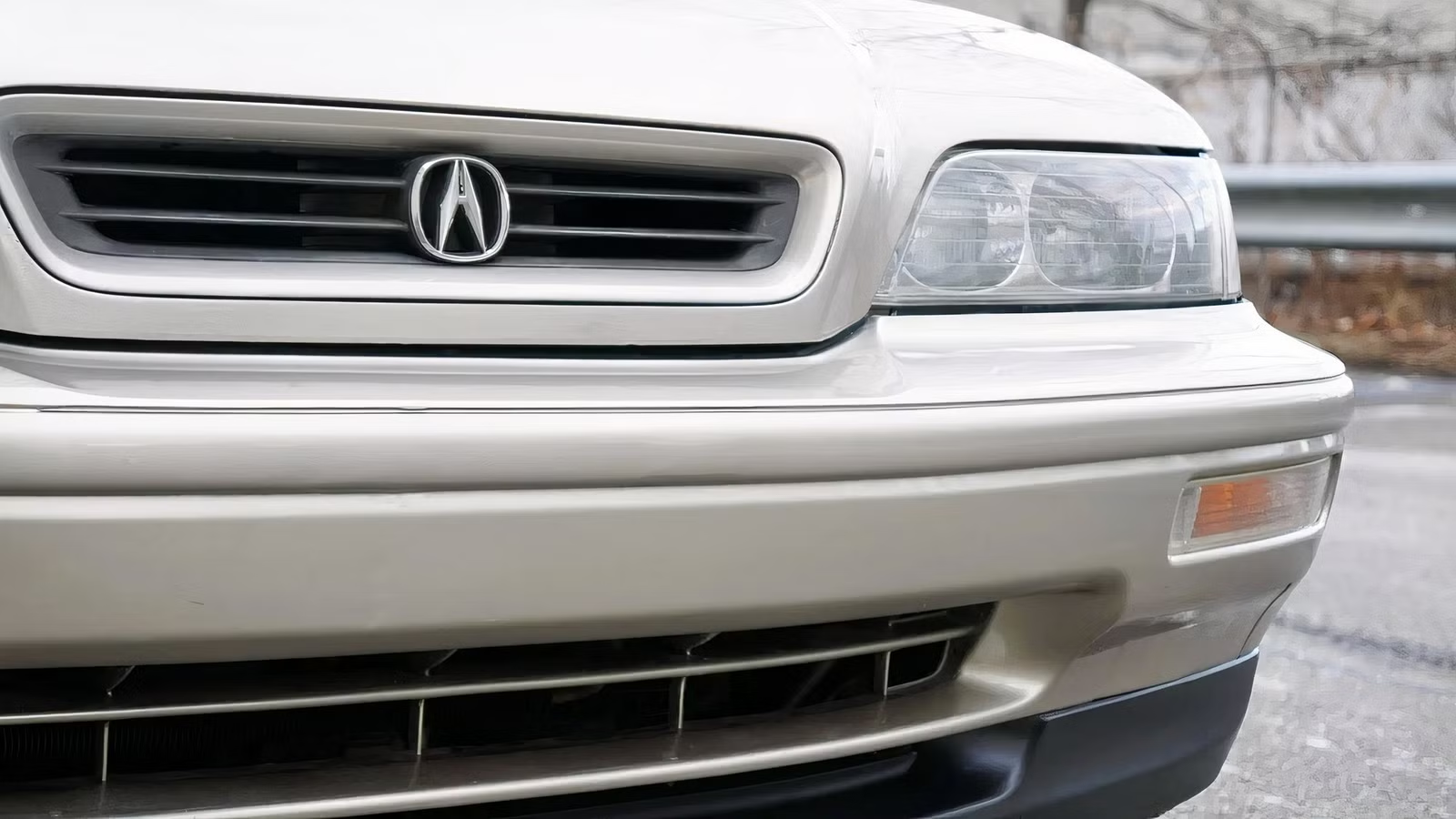
The early 1990s personal luxury coupe market was not built for imports to win. Domestic brands had written the rules and set the benchmarks, and the European competition was operating in its own stratosphere. To land in both conversations at once, something had to be extraordinary. The car that did it went largely unnoticed while it was happening. The comparison that would have settled the whole argument never got run.
The 1990s Personal Luxury Coupe Was A Rigged Game

The story starts in 1990, and the market at the time was not in the best shape. Carmakers were in an arms race to see who would take first place in personal luxury coupes. The competition was fierce, and it looked like there was no way a carmaker outside the domestic circle could come in and take the segment. The ground rules were set by domestic makes, and they favored the home side. There was no space for an imported model in the game.
The main rivals were Cadillac and Lincoln. Cadillac unveiled a redesigned Eldorado for 1992, and Lincoln answered with the Mark VIII the following year as a direct rival. The Mark VIII packed a 4.6-liter DOHC InTech V8 making 280 horsepower. Cadillac came back with the new Northstar V8 mounted transversely, rated at 275 hp in base specification. Power figures were in the same ballpark, and pricing was close enough to matter. Cadillac had the pricing edge because Lincoln asked for roughly five grand more. Imports had no chance.
How The Imports Made Their Way When There Was No Space

While that domestic war was brewing hot, Acura decided to take a piece of it. Honda’s American brand launched the Legend Coupe with a broader vision than most expected, aimed at the European luxury coupes and the American coupes like the Cadillac Coupe de Ville and the Lincoln Mark VII when it arrived in 1991. Period press and media classified it as a domestic-segment competitor rather than a European rival class entry. Half the job was done. But the German benchmark, the Legend, was also aimed at operating on a completely different level. The BMW 535i was the best example of exactly that.

The Inline-Six Engine That Became A Global Legend
From the big screen to the drag strip, this over-engineered masterpiece still rules the tuning world.
Horsepower Per Dollar Had A Different Story To Say

While the domestic fight was settled by V8 muscle and brand loyalty, there was another way to measure the competition, one that the mainstream conversation kept missing. Horsepower per dollar values a car against the power it delivers for what it costs. In Europe, the conventional metric was tax horsepower, a formula-based system that favored smaller engines. In America, the measure was simpler and more direct. What does the engine actually deliver for the price on the sticker.
Here is where it gets interesting. At the time, the BMW 535i had a sticker of around $44,350, climbing to around $45,000 once all charges were factored in. An Acura couped gave it a serious run for its money with a sticker price of $32,000 to $36,000. That is a gap of close to ten thousand dollars on the low end. Period press and media never directly compared the two cars on that basis. The audience had no idea what the numbers looked like when these two cars were measured against each other. One delivered substantially more car per dollar. The other delivered the nameplate.
What Displacement Efficiency Actually Means In A Fair Fight

Putting the BMW and the Acura head to head is comparing two cars built for different purposes. Even in a direct comparison, the BMW had the structural advantage: rear-wheel drive, European dynamics pedigree, and the nameplate. That argument the Acura was never going to win. But Acura took a page straight from the Honda playbook. One approach. Increase the power without increasing the displacement. It worked out. The brand increased valve diameter, reworked the valve timing, and refined the valve lift—all from the same engine. Clever Japanese engineering. And that engineering had a name.
Acura Legend Type II: The Coupe That Had Other Plans

The Acura Legend Type II was presented to the press in 1992 as a 1993 model year car, and the coverage it received was not proportional to what it actually delivered. The Type II was not a separate model. It was a performance designation, a step above the standard Legend Coupe that made 200 hp and already held its own against the 535i on paper. Acura had done something specific with this one, and the result was a car that looked like a luxury coupe from the outside and drove like a focused performance machine underneath.
Acura got serious about the business and the result was the Type II. The distinct engine tune squeezed 230 hp out of the single-overhead-cam V6, with peak power at 6,200 rpm and 206 lb-ft of torque at 5,000 rpm. The engine came paired with a 6-speed manual, aiming to extract the maximum from that tune. A 4-speed electronically controlled automatic was also on offer. The whole package sat on independent double wishbones front and rear, and the car ran a 60/40 front-to-rear weight distribution. Clever Japanese engineering, doing more than the badge on the outside suggested.
Putting It To The Test: The Numbers Against BMW 535i

Here are the numbers, side by side. The BMW M30B35 3.4-liter inline-six made 208 horsepower and 225 lb-ft of torque. The Type II’s single-overhead-cam V6 made 230 horsepower and 206 lb-ft of torque. Acura had more horsepower, BMW had more torque, six cylinders each, both on manual transmissions for the comparison. The Legend Type II ran the quarter mile in approximately 15.6 seconds and hit 60 mph in approximately 7.2 seconds. The BMW ran 16 seconds flat for the quarter mile and 7.2 to 7.6 seconds for 0 to 60. The Acura did better.
The Hand-Built Buick Coupe That Had A Touchscreen In 1988
This hand-built coupe had a touchscreen in 1988, but its biggest problem may have been arriving before buyers knew they wanted one.
The Quarter Mile Comparison The Press Never Actually Did

Acura placed the Legend Type II explicitly against the domestic luxury coupes. That was probably the right commercial call. The V8 muscle cars were the volume conversation and the domestic purchase decision, and the Type II was never going to beat a Cadillac on American street credibility. But by positioning the car that way, Acura guaranteed that the comparison showing the Type II at its best never got made.
Period press and media focused on the domestic competition, and the Type II kept losing that argument. No V8. No muscle car character. No American DNA. Those criticisms circulated, and they were not wrong on their own terms. The Acura was not trying to be that car. The muscle cars took the table, and the Legend Type II’s real story got buried underneath. Its strengths were reliability, refinement, driving pleasure, and the Japanese engineering the brand never set aside. Against a domestic V8 coupe, those were not the metrics the market was scoring on.
Locking Horns Against Each Other, What The Numbers Say

Against the BMW, the story looked completely different. The Type II had 22 more horsepower and came in at a substantially lower sticker price. The BMW had the driving dynamics edge, rear-wheel drive and the linear delivery of the M30 inline-six gave it a character the front-wheel-drive Acura could not match on feel. But the Type II was faster by the numbers, and the value gap was not close. Two perfect rivals who never knew they could lock horns, and the press never ran them as a direct comparison. The audience never got the result. The Acura won.
Why We Think The Early Generation Honda/Acura Legends Are Highly Underrated Classics
Some of Honda’s cars never got the attention or recognition that they deserved, the Legend is one of them.
The Consequences The Legend Had To Face Thanks To The Wrong Test

Neither car lasted long in the era that followed. The Legend nameplate was gone from US showrooms by 1995, within three years of the Type II arriving, with Acura renaming the lineup RL for the 1996 model year. The BMW 535i was replaced by the 530i and 540i, both V8, for the 1994 model year. The comparison that never ran has become the story that defines both of them in the collector market today.
The Collector’s Market Put The Cars In The Wrong Place

The Acura Legend Type II averages around $11,597 on the collector market per Classic.com data. The BMW E34 535i averages around $15,385 on the same market. The gap is partly down to brand recognition, the European performance nameplate carrying weight in collector circles that the Acura does not currently match. But that gap also tells the same story as the comparison the press never ran. The Acura is undervalued relative to what the specs and the head-to-head numbers say. The market has not caught up to what the Legend Type II actually is.
The Type II’s engineering story never got the comparison it deserved. Squeezing every last ounce of performance from the same displacement, doing it for thousands less, beating a purpose-built European performance sedan on the numbers. That story went unseen while it was happening. Acura’s performance lineage fragmented after the Legend. BMW moved on. The E39 followed the E34, and the 5 Series is still a strong name. In the collectors market, the Legend Coupe Type II carries a reputation as the forgotten personal luxury car. If the market catches on to what it actually is, the tables will turn fast.
Sources: Acura, Honda, Classic.com, Bring A Trailer

Related posts

Latest Post


No Comments