
The Suzuki Motorcycle That Ages Better Than Riders Expect
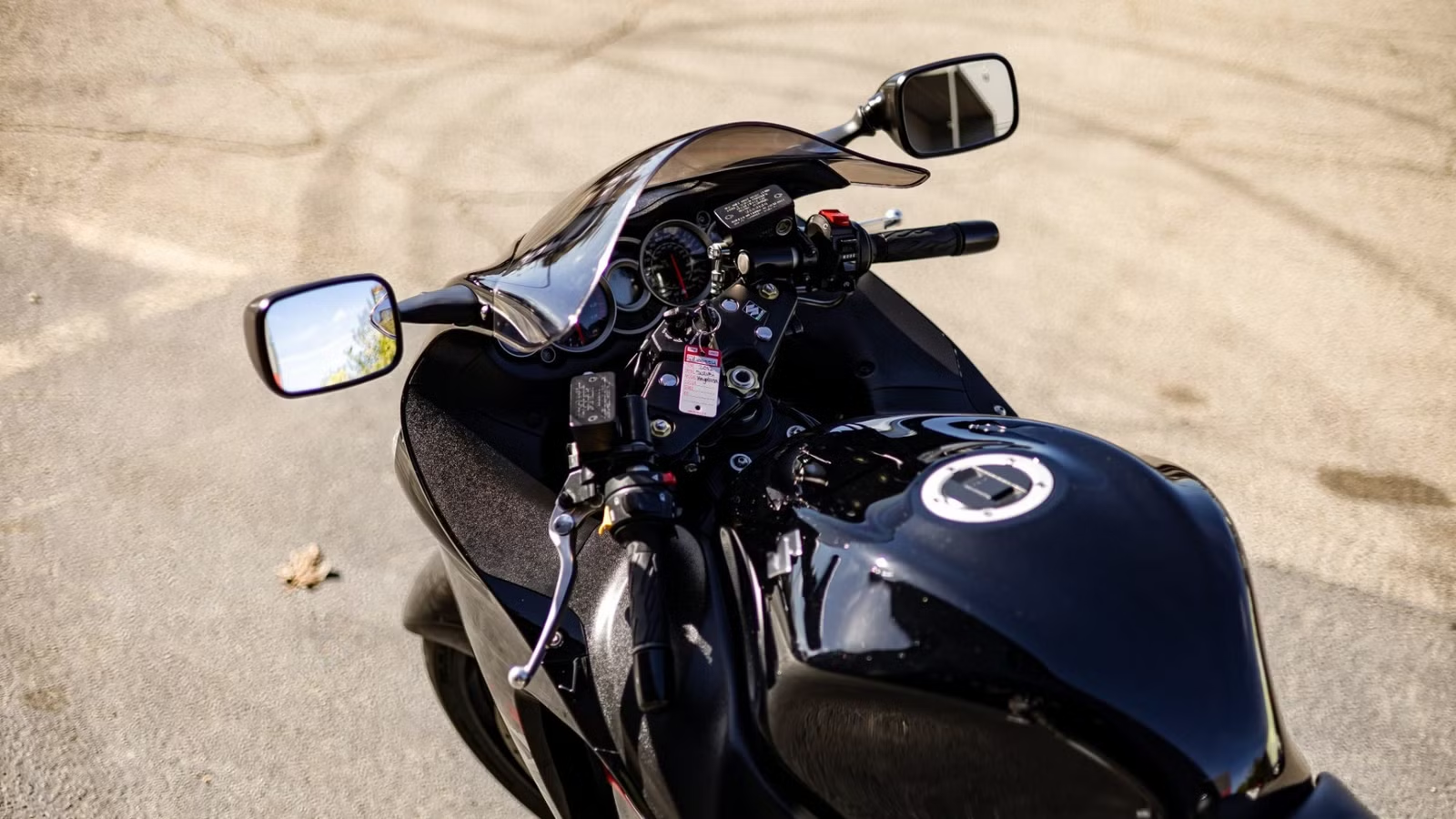
More often than not, Suzuki motorcycles age pretty well. This is thanks to their relatively conservative design, bulletproof reliability, and focus on real-world performance. Excellent examples include the legendary TL1000S, the GSX-R1000 K5, or the still-on-sale GSX-R750, SV750, or V-Strom 650. However, there’s one Suzuki sports bike that stands out for aging better than anyone expected. No, it doesn’t belong to the GSX-R lineup.
Why Most Suzukis Age Well
Suzuki motorcycles tend to age quite well, and that’s thanks to their “if it ain’t broke, don’t fix it” engineering philosophy. Suzuki bikes typically feature over-built engine internals and proven tech that give them bulletproof reliability. And the company does not go for rapid or experimental design updates, so its designs tend to have a timeless appeal while their competitors start showing their age in a couple of years. It’s such things that make Suzuki motorcycles age better than most other motorcycles on the market, and several examples prove this.
There Are Several Suzuki Bikes That Have Stood The Test Of Time

Take the legendary 2005 Suzuki GSX-R1000 K5 superbike. Featuring a long-stroke 999cc inline-four engine that produced 175 horsepower and tipping the scales at just 365 pounds dry, the K5 was the best superbike you could buy back in the day, and even today, it remains a popular choice for those looking for an analog superbike experience. Similarly, there was the 1991 Suzuki TL1000S, featuring a 125 horsepower V-twin and a unique rotary-style shock. The latter earned it the Widowmaker title, yet buyers still pick these up for the easy and torquey riding experience it offers.


Heck, some of Suzuki’s bikes are so timeless that Suzuki has still kept them on sale years after their launch with minimal updates along the way. For example, the SV650, last updated in 2016 to meet Euro-5 norms, the V-Strom 650, last updated in 2017, and the GSX-R750, last updated in 2011. However, there is one Suzuki motorcycle that ages better than any of the bikes mentioned here. It’s a missile on two wheels that often gets overshadowed by its predecessor and successor, yet it is arguably the best of the lot.
The Gen 2 Hayabusa Holds A Special Place In The Lineup

To understand exactly what makes the second-generation Hayabusa so timeless, we have to see it in the context of the generation that came before it, the original Hayabusa, and the one that came after, the current-generation Hayabusa. In a way, the Gen 2 Busa strikes a balance between old-school cool and the new tech-savvy take. Let’s dive in.
The Original 1999 Suzuki Hayabusa

The original Suzuki Hayabusa debuted in 1999, annihilating the competition. Named after the peregrine falcon that hunts blackbirds, it was powered by a 1,293cc inline-four engine making just over 170 horsepower, which gave it a top speed of 194 miles per hour, a 0 to 60 miles per hour time of 2.47 seconds, and a quarter-mile time of just 9.7 seconds. With its bulbous, aerodynamic bodywork and surprisingly comfortable ergonomics for what is among the first hyperbikes, this Hayabusa is an icon in all rights.

It’s no wonder that the original Hayabusa is among the most influential motorcycles ever made. Still, it wasn’t a perfect bike. It was a raw bike with bonkers performance and spongy brakes, and a lack of any rider aids or electronics meant you were at the mercy of your skills and traction. At the same time, while it handled corners gracefully, the fairings and engine covers would scrape the tarmac at full lean, which can be quite scary if you’re not prepared for it.
The Third-Generation Suzuki Hayabusa

We then come to the third-generation Hayabusa, which brings sharp styling and is vastly more sophisticated than the earlier iterations. Reviews suggest that the bike also boasts vastly superior throttle response and a punchier midrange than ever. Staying in line with the status quo, the new Busa is properly modern, featuring launch control, anti-lift, lean-sensitive traction control and ABS, engine braking control, and a bidirectional quickshifter, as well as top-spec Brembo Stylema calipers.

The problem with this generation is the performance. It produces 185 horsepower, which is a significant drop from the Gen 2 Busa. Sure, power figures are not everything, but this is a bike that has always been about top speed and horsepower. For enthusiasts, the Busa has now lost its charm. In a way, what was once the apex predator of sports bikes is now left snacking on quails, mice, and rats… or middleweight sports bikes. Also, it’s expensive, starting at nearly $20k!
The Second-Gen Hayabusa Is The Most Powerful Peregrine Falcon

That’s where the Gen 2 Hayabusa comes in. Introduced in 2008, the second generation built on the original model without major changes to the overall structure. However, it did bring some relatively minor engine updates that resulted in large horsepower increases. For starters, the engine’s stroke was increased by 2mm, raising the displacement from 1,298 cc to 1,340 cc. Even the compression went up from 11.0:1 to 12.5:1, and the cylinder head was more compact and featured lighter titanium valves. The latter were driven by a chain but got a hydraulic tensioner.

The engine also featured lighter pistons with ion-coated rings and shot-peened connecting rods. Fuel injection was handled by GSX-R1000-derived dual injectors, working with smaller 44mm throttle bodies in the Suzuki Dual Throttle Valve (SDTC) system. Suzuki also updated the exhaust system, using a 4-2-1-2 layout with quieter mufflers, a catalytic converter, and an oxygen sensor to meet Euro 3 requirements. Other minor updates included a heavier-duty slipper clutch and slightly lower final drive ratio.
The Result Is 195.7 Horsepower At 9,500 RPM

These minor engine changes resulted in a significant horsepower gain, pushing the power output to 195.7 horsepower at 9,800 RPM and 113.6 pound-feet of torque at 7,200 RPM. That’s significantly more than the older and current-gen Busas, making this the most powerful Hayabusa ever made. And it will stay that way for a long time, as emission norms are only going to choke power figures of big-bore inline-four engines even further. For a bike that’s all about top speed and power figures, the Gen 2 Hayabusa is the clear winner among other Busa generations.
Analog Performance But It’s Not A Widowmaker

Power aside, both the older Gen 1 and newer Gen 3 Hayabusas sit on either end of the analog vs tech-savvy riding experience spectrum. On the other hand, the Gen 3 Busa gets all the electrical nannies that will give even an intermediate rider a false sense of confidence that they know how to handle all that horsepower. For those looking for an analog appeal without the widowmaker-ish tendencies of the original, the second-generation is the right pick, especially those made after 2013.
That’s because post-2013 Hayabusas got ABS, which is arguably the most important rider aid you need when you’re going fast. Remember, you don’t need ABS until that one time you absolutely need it. Meanwhile, the lack of other electronic nannies still keeps the riding experience analog enough to have fun.

This Hayabusa also featured the Suzuki Drive Mode Selector (SDMS). Essentially, SDMS lets you dial down engine performance for city riding and long highway trips, and turn it up to 11 when you want to test your quarter-mile times or attack corners on a mountain road. As a result, the bike won’t feel like it’s wanting to run out from under you when you’re crawling in city traffic.
Better Underpinnings Only Make The Bike Better To Ride

The second-gen bike also featured better underpinnings compared to the original, which still holds up well today. The frame was carried over with the same wheelbase and rake/trail; however, the suspension was overhauled. This bike featured fully adjustable, stiffer Kayaba suspension: a 43mm USD fork with DLC-coated sliders and a monoshock with a strengthened swingarm. These changes should result in better composure on the road, especially when going fast.
The bike also got a steering damper to prevent death wobbles at high speeds. Earlier Gen 2 models got Tokico radial brake calipers, which offered significantly better braking performance than the spongy 6-piston calipers of the original. In 2013, with ABS, the bike was upgraded to Brembo M4.32 calipers for better braking performance. Finally, the bike ran 17-inch wheels with Bridgestone BT-015 radial tires taken directly from the GSX-R1000. Put everything together, and you have an analog hyperbike that should feel stable and more forgiving compared to the original model.
Not As Grotesque As The Original, Not As Sharp As The New One

A similar story follows for the bike’s design. Reportedly, Suzuki conducted some market research across the US and Japan in 2004 to identify which elements of the Hayabusa attracted so many buyers. It found that, while the original Busa’s design was polarizing in the media, customers very much loved the grotesque design. Yoshiura, the designer, also traveled around the US to take inspiration from the custom Busa scene. So, Suzuki designed the Gen 2 Hayabusa to strengthen the bike’s looks while retaining the same flyline and overall structure.
I wanted to create a masculine form that complements a rider’s muscular structure, with hints of developed biceps, forearms, and calves. — Koji Yoshiura, Designer of gen 1 and gen 2 Hayabusa
While the overall shape is very close to the original, the bike’s lines were mostly dictated by wind tunnel tests. As a result, the bike not only offered better wind-shielding and aerodynamic performance, but looked more cohesive compared to the first-generation model. While looks are subjective, we think it looks better than the current-gen Busa, too, as the latter is more angular and sharper, straying from the raw, organic identity of the first two generations.
A Bird Of Prey That Has Aged Well

The original Hayabusa will always be an icon for shattering speed records and putting an end to speed wars, while the newer Hayabusa will continue to woo riders looking for a missile on two wheels with sports tourer-ish comfort. But the Gen 2 Hayabusa will be known for being the most powerful of the three, offering an analog appeal without being outright dangerous and with a design that (while still polarizing) looks better than the older and newer Busas. In our books, the Gen 2 is the ultimate Hayabusa.
Source: Suzuki Cycles

Related posts


Latest Post


No Comments