
The Cold War Two-Stroke That Taught Japan How To Build Motocross Bikes
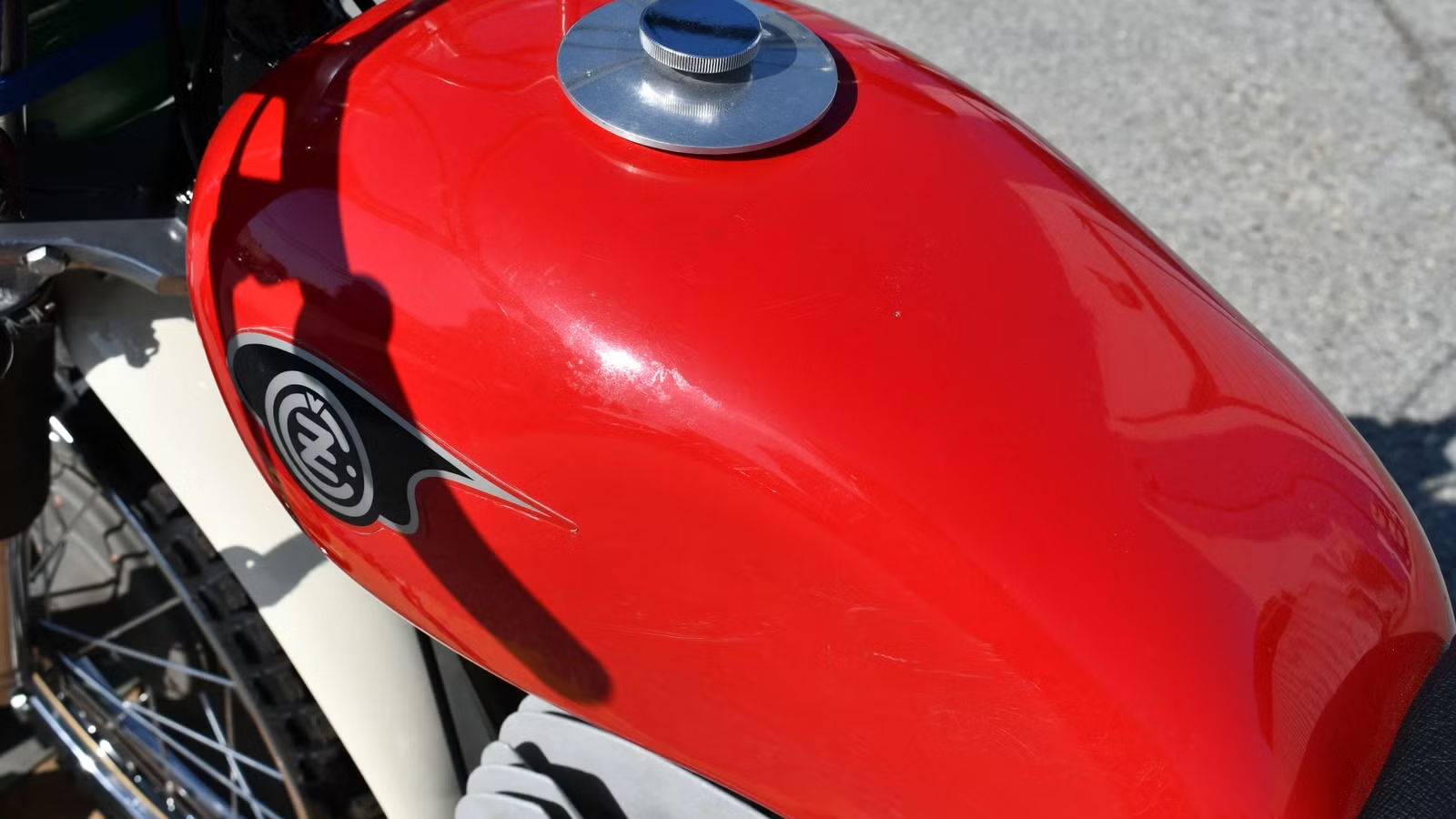
While the Cold War might not have been fought with missiles and guns, there were still many battlegrounds on which both blocs competed. Sports became an intense proving ground for both, with motocross being an unlikely, but incredibly aggressive, arena. And while one Eastern company made a bike that dominated, it was Japan and the West that ultimately won.
Motocross Became Another Front In The Cold War
International sport has always been about more than determining who’s best. When athletes compete with national pride on the line, they often become symbols of their countries as much as competitors. And while sporting rivalries between countries can get heated, the 1960s saw something more — a rivalry between two different global blocs.
Everything became a battleground between the Eastern and Western blocs, as politics, science, and sport in general weren’t just fields in which people practiced, but theaters in which to claim victory. Motorsport became another arena in which countries tried to prove their mettle, and the Eastern bloc found particular success in more accessible disciplines like rallying, speedway, and motocross. And when it came to motocross, no Eastern manufacturer was more involved than Czechoslovakia.
The country, which split into Czechia and Slovakia in 1993, built a reputation for making lightweight, highly-competitive motorcycles that consistently challenged their better-funded Western counterparts. Brands like Jawa and CZ became symbols of ingenuity, as CZ in particular won seven of the 15 editions of the International Six Days Trial (an enduro race which is the oldest off-road motorcycle event on the FIM calendar) since the Cold War started.

Racing Successes Mattered As Much As National Prestige

As the Cold War dragged on from its 1947 beginning into the 1960s, motorcycles became an increasingly important part of the battle for technological and industrial supremacy. Bikes were cheaper than cars, easier to mass-produce, and remained a key mode of transport. Motorcycle racing became a proxy for industrial superiority, as each bloc took to the track to bolster national prestige.
Grand Prix motorcycle racing was arguably the premier battleground of two-wheeled competition during the Cold War. The East fielded brands like East Germany’s MZ and Czechoslovakia’s Jawa and CZ against Japan’s Honda, Suzuki, and Yamaha, along with Italy’s MV Agusta. Motocross was another key arena, and one the Soviet Union was desperate to conquer. That was no more obvious than in the 1974 FIM 250cc World Championship, when Czech rider Jaroslav Falta entered the final round with a chance of winning the title.
In one of the sport’s most controversial races, Falta was repeatedly involved in incidents with Soviet riders that many considered deliberate attempts to stop him winning, and although he crossed the line first, he was given a one-minute penalty for a supposed jump start. The decision dropped him down the order and handed the championship to Soviet rider Guennady Moiseev in one of the Cold War’s most controversial motocross finales, showing just how politically charged international competition had become.

The mid-1960s arguably marked the peak of the East-West motocross rivalry. Western manufacturers like Sweden’s Husqvarna, along with Britain’s BSA, Greeves, and Matchless, had dominated the Motocross World Championship, winning every 500 cc title and all but two of the 250 cc championships through 1962. That began to change in 1963, when CZ finished second and third—the first time an Eastern manufacturer claimed multiple spots on the overall podium. The bike that did it was a factory prototype 250 cc twin-pipe which, one year later, would see CZ stand on the top step for the first time.
The CZ Type 968 Was Years Ahead Of Its Rivals

Released in 1964, the CZ Type 968 wasn’t just a good motocross bike, but a completely different approach to motocross in general. Rather than being a production bike that was adapted for racing, it was a racing bike from the outset.
To begin with, the bike weighed just 214 pounds. That made it incredibly light for the time, especially when compared to competitors like the 240-pound Maico 250 GS. It achieved this by using an air-cooled two-stroke with a single cylinder, having minimal bodywork, a small fuel tank given it only needed to have enough for one 40-minute-plus-one-lap race, and by using magnesium and alloy parts in its construction. This lack of weight proved advantageous on the track, as it gave the bike a stronger power-to-weight ratio and made it far more manageable.
It wasn’t just the bike’s weight that made it a performance powerhouse, though. As the bike wasn’t a production bike turned racer, it didn’t carry any of the production compromises—such as road-readiness or accommodating inexperienced riders—that some of the Japanese bikes did. This sole focus on racing ensured that everything from suspension to engine to tuning was done with the intention of winning — a luxury that competitors didn’t always have.

Then there was the bike’s most recognizable aspect — its twin-exhaust-port cylinder. Unlike most racing innovations, this was done to solve a problem rather than increase power, with that problem being heat. Being air-cooled allowed the bike to stay lighter, but did bring with it the possibility of overheating and warping cylinders, which was a common problem with performance two-strokes. By splitting the exhaust into two smaller ports that merged into separate header pipes before passing around the frame’s front downtube, the heat was spread more evenly across the bike’s single cylinder. Not only did this improve the exhaust flow and the bike’s performance, but the extra heat management also improved the bike’s reliability.
It all made for an incredibly effective motorcycle. It won the 1964 250 cc Motocross World Championship with Belgian Joel Robert on board, taking eight overall event wins from 14 rounds in the process. It did even better in 1965, with Soviet rider Victor Arbekov taking the title from Joel Robert in second, both on the Type 968. But with the Type 968 dominating, it was only a matter of time before other manufacturers—and, more importantly for the Eastern bloc pride the Type 968 was instilling—other countries caught up.
Japanese Manufacturers Paid Attention And Learned From CZ

By the late 1960s, the Type 968’s innovations were becoming more widely adopted. Its two-stroke, single-cylinder, lightweight approach was a reference point that others could draw from in their own manufacturing, and Japan in particular was incorporating what it had learned from the bike.
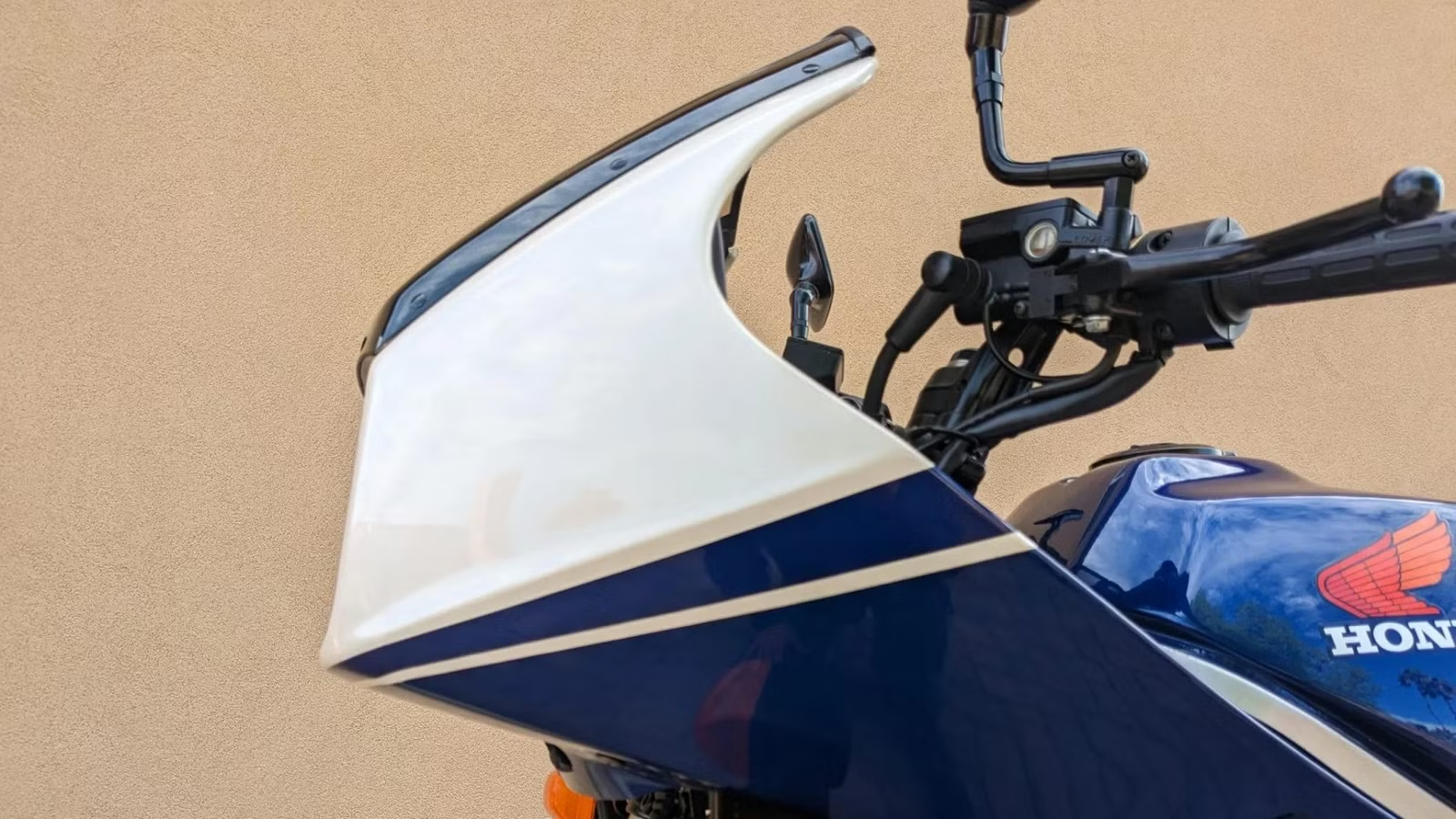
Honda, Yamaha, Suzuki, and Kawasaki were able to take what had made the Type 968 so successful and iterate on it with their larger budgets, quicker development cycles, and more advanced manufacturing techniques. CZ, and the Eastern bloc at large, couldn’t keep up with this increased pace, and while it won more Motocross championships in both the 250 cc and 500 cc categories, it wouldn’t do so again after 1969.
Bikes like Yamaha’s DT-1 and YZ250, Suzuki’s RN250, and the Honda CR250M Elsinore all elaborated on what made the Type 968 so good, ushering in a new era of Japanese (and, by extension, Western bloc) dominance. Eastern bloc bikes wouldn’t secure another title before the end of the Cold War in 1991, while Japanese bikes won the 500 cc class every year from 1975 until 1993, though every 500 cc championship since 1968 belongs to countries that either were, or would have been, in the West.
CZ Changed Motocross Forever, Even If Japan Reaped The Rewards

While the CZ Type 968 might be gone now, along with the country that made it, that doesn’t detract from its legacy. The bike was born in a tumultuous time and given the unenviable task of providing national and international glory, and, despite the odds, it did so. And while the bike itself may not exist anymore, its influence remains. It proved that smart engineering could beat big budgets, and that the Eastern bloc could be dominant on dirt tracks if given the chance. And while Japan may have won the race, it did so by using CZ’s notes.
Sources: CZ, Honda, Suzuki, Yamaha

Related posts


Latest Post


No Comments