
The Motorcycle Built For Riders Who Plan To Keep It Forever
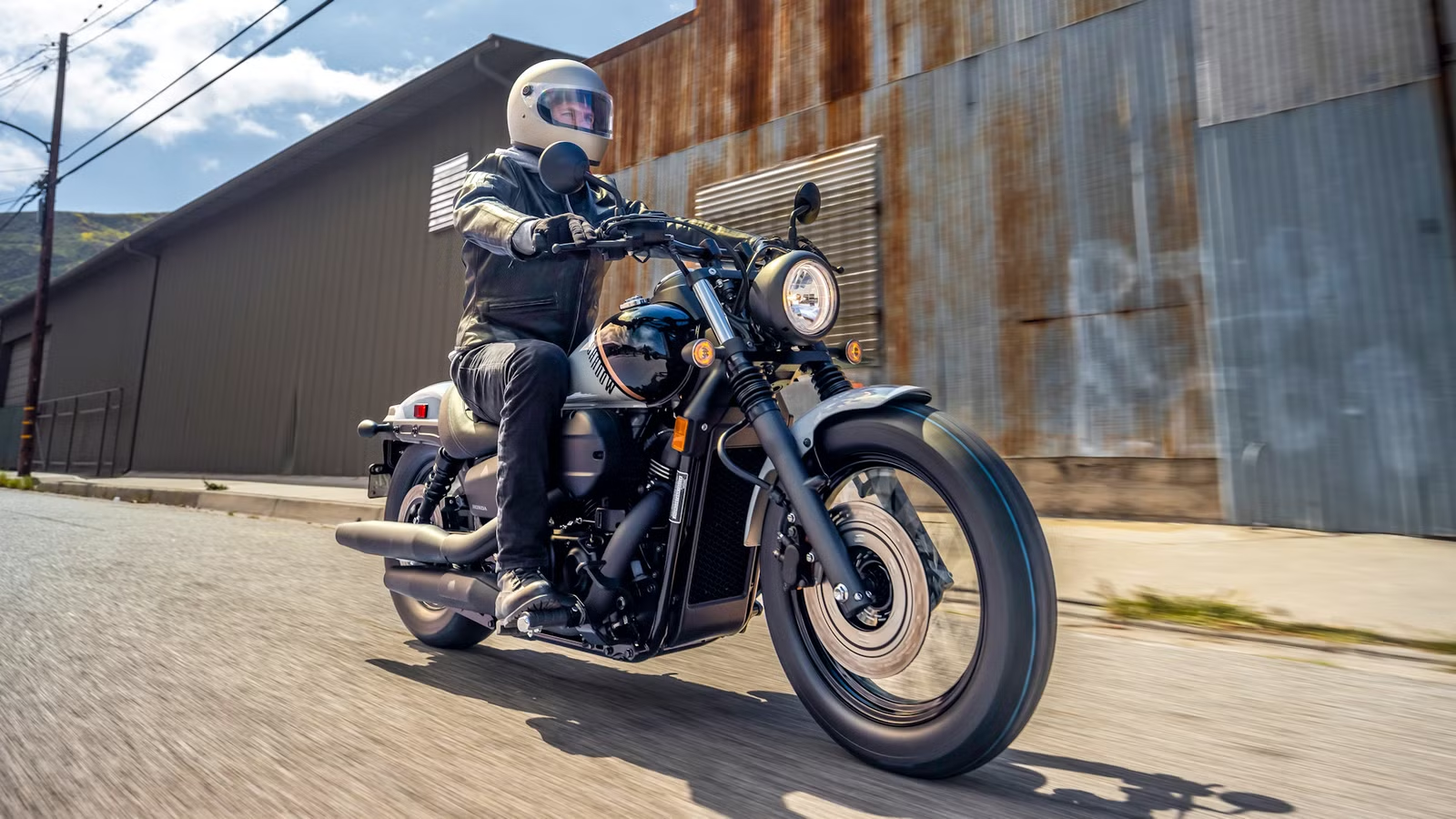
Finding a motorcycle you can genuinely keep for decades — one that won’t nickel-and-dime you into the ground or strand you on a back road — is harder than it sounds. The market is full of contenders, and the best of them span every style of riding, from adventure touring to sport bikes to laid-back cruisers. That breadth is actually good news: whatever kind of riding you love, there’s a machine built to outlast your enthusiasm for it. But if you need a single answer — one motorcycle that covers the widest range of riders and use cases, costs little to own, and has a track record measured in generations — the choice keeps circling back to the same name. It won’t shock anyone who has spent time around Honda.
The Honda Shadow Phantom Is The Motorcycle Built For Riders Who Plan To Keep It Forever

There are many great motorcycles that fit the description when you ask about motorcycles that can be kept forever, but the Shadow is a special one. It can be ridden by beginners; it is that docile. It can make a great second motorcycle for experienced riders. And it is a simple, fun motorcycle for anyone who wants the feel of an American V-twin cruiser without the price tag and maintenance costs of an American one. The Shadow has also been around for a very long time, so parts are plentiful, affordable, and there was never much to go wrong with it in the first place.
Starting Price: $8,699

One of the Shadow’s strongest selling points is its price. Up until recently, there used to be two different variants available, with the retro-styled, chrome-laden Shadow Aero delivering a compelling entry price with optional ABS. The Shadow range now consists solely of the Shadow Phantom, and ABS is standard. It still fits neatly between the Honda cruisers on either side of it, and occupies a sensible gap in the middle of the competition as well. The cruisers that claim to deliver more value haven’t yet proven themselves over time, so there are no real alternatives to the Shadow at this price point.
The Honda Shadow Has One Of The Final Japanese V-Twins


The Shadow’s V-twin was designed to mimic the feel of an American V-twin, and it does that quite well. You’d definitely be surprised to know, then, that it is a short-stroke design. This is paired with a relaxed 9.6:1 compression ratio, which means it tolerates lower-quality fuel without complaint while still putting out 45 horsepower at 5,500 RPM and 48 pound-feet of torque at 3,500 RPM. The layout is a 52-degree V-twin displacing 745 cc, and it features a notably uncommon valve arrangement: two intake valves and one exhaust valve per cylinder.
Despite its age, it has liquid cooling and fuel injection, so it is extremely reliable. A five-speed wide-ratio gearbox handles shifting duties, and there is no fancy technology like an assist-and-slipper clutch. The Shadow uses a driveshaft rather than a chain or belt, making it the most affordable Japanese motorcycle with shaft drive available today.
Honda Shadow Phantom Chassis

Honda chose the traditional route for familiarity and reliability. This is a double downtube frame, and Honda opted for twin rear shock absorbers to preserve a low seat height. The 41 mm front forks wear ‘beercan’ covers that give them the appearance of inverted forks and offer 5.5 inches of travel. The only suspension adjustment available is a five-step preload setting at the rear, which provides 3.5 inches of travel.
Honda uses a 17/15-inch wheel rim combination. These are spoke rims that require tubes for their tires. Disc brakes are fitted at both ends — a 296 mm disc at the front and a 276 mm disc at the rear. An identical two-piston floating caliper is used at both ends, and ABS is standard on the Shadow Phantom. The ABS is not switchable.
Honda Shadow Phantom Dimensions

The Shadow is the epitome of ‘long and low’. It stretches nearly 97 inches from end to end, with a generous 64.5-inch wheelbase. The twin shocks keep the seat at a very accessible 25.6-inch height. The fuel tank is on the smaller side at 3.7 gallons, though the engine’s efficiency helps offset that limitation. Wet weight comes in at 560 pounds.
The Feature List Is Barebones

Prospective Shadow owners don’t queue up to buy one of these because of its feature list. This is a simple, no-nonsense motorcycle that is fun to ride and easy to maintain — the features were never part of the appeal. There is a tank-mounted instrument cluster with an analog speedometer and an LCD display at the bottom for information such as the odometer reading. It is, perhaps surprisingly for Honda Powersports America, available in more than a single color: a gray/black combination that you see in the images, along with a metallic orange option at no extra charge.
The accessories list has a grand total of two items: a passenger seat and footpegs, and a bike cover. This isn’t a concern, because Shadow owners know there is a vast world of aftermarket accessory support out there, with something available for every Shadow owner.
Honda Shadow Phantom Competition

There are quite a few good options available if you intend to put a bike that lasts forever in the garage. Names like the Kawasaki KLR650, Suzuki SV650, Suzuki GSX-R750, and even the BMW R 1300 GS will vie for your attention. However, in the budget/middleweight cruiser segment, there are only a few Japanese options. The obvious choices would have been the Suzuki Boulevard C50 and the Kawasaki Vulcan 900, but they sit a small step beyond the Shadow in terms of specs and price. And that is why we’ll turn to another Japanese stalwart: the Kawasaki Vulcan S.

The Vulcan S couldn’t be more different from the Shadow. It has a 180-degree parallel twin engine, a monoshock for the rear suspension, a trellis frame that uses the engine as a stressed member, and a drivetrain shared with a middleweight sport and naked bike. Where it matches the Shadow, however, is in longevity — it has also proven itself over many years and is impressively reliable. This is the unbreakable Japanese cruiser to choose if you also want something sprightly and confidence-inspiring in the corners.
Honda Shadow Phantom vs. Kawasaki Vulcan S
|
Honda Shadow Phantom |
Kawasaki Vulcan S |
|
|
Price |
$8,699 |
$8,149 |
|
Engine |
52° V-twin |
180°I2 |
|
Displacement |
745 cc |
649 cc |
|
Power |
45 HP @ 5,500 RPM |
61 HP @ 7,500 RPM |
|
Torque |
48 LB-FT @ 3,500 RPM |
46.3 LB-FT @ 6,600 RPM |
|
Final Drive |
Shaft |
Chain |
|
Curb Weight |
560 LBs (wet) |
498.3 LBs (wet) |
Source: Honda Powersports

Related posts


Latest Post


No Comments