Why Buy A New Civic When This Sport Sedan Costs Less?
8 minutes reading
Wednesday, 22 Jul 2026 18:00 0 58 autotech
A new 2026 Honda Civic Si is a genuinely good car. It’s sharp, efficient, and wears Honda’s reputation for reliability like a badge of honor. But at roughly $31,500 to drive off the lot, it’s also a 200-horsepower economy car dressed up in a body kit. For the same money, sometimes less, a well-kept late-2010s German sports sedan puts a 349-horsepower turbocharged V6, all-wheel drive, and a genuine luxury interior in your driveway. This isn’t a knock on the Civic. It’s a reminder that “new” and “best value” aren’t always the same thing.
Thirty thousand dollars has become the default budget line for anyone shopping a sporty daily driver, and the Civic Si sits right at the top of it. Honda prices the 2026 Si at roughly $31,495 including destination, which buys a 200-horsepower turbo-four, a six-speed manual, a helical limited-slip differential, and genuinely excellent chassis tuning. It’s quick enough, efficient at around 27/37 mpg, and it will almost certainly outlast its warranty without drama.
The Math Changes The Moment You Stop Insisting On A Fresh VIN
2026 Honda Civic Si rear 3/4 shotHonda
That same $30,000-ish budget, spent on a three- or four-year-old German sport sedan instead of a brand-new Japanese compact, buys a completely different tier of car. Depreciation is the great equalizer in the enthusiast world: it takes vehicles that once competed with $60,000 stickers and drops them into Civic Si territory within a few years. This Audi, built from 2017 through 2024, is one of the clearest examples of this. It’s not cross-shopped against the Civic by Audi’s marketing department, but it absolutely should be cross-shopped by anyone typing “best car for $30,000” into a search bar. The catch, and it’s a real one, is that buying used means buying someone else’s maintenance history instead of a fresh warranty. That trade-off is worth examining honestly rather than glossing over, because it’s the whole reason this comparison exists in the first place.
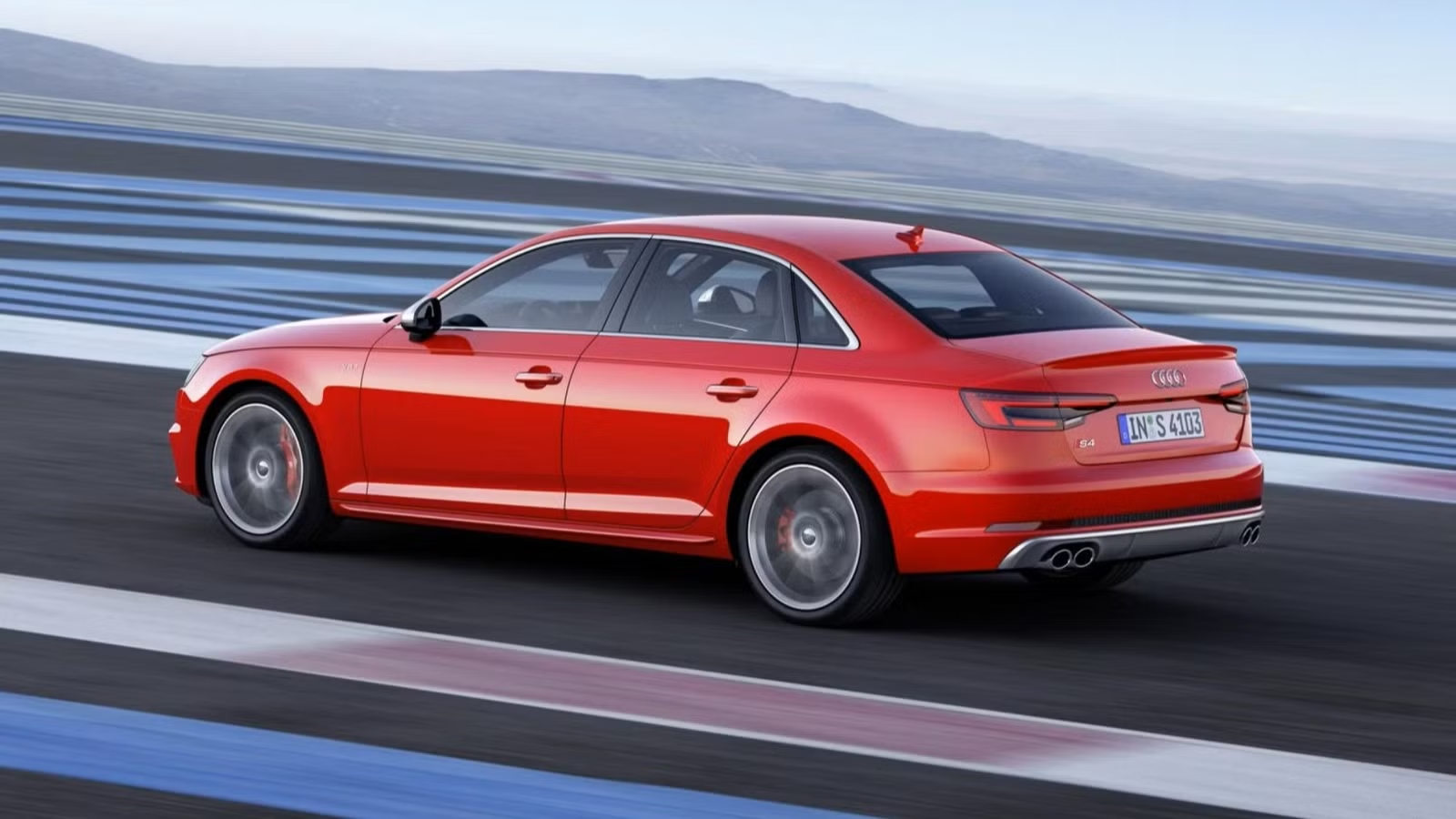
The 2019 B9 Audi S4 Delivers Luxury, Performance, And Everyday Practicality For Civic Money
Used 2019 Audi S4 prices for dealer-sold cars have ranged from around $25,300 for a Premium model up to roughly $29,000 for a loaded Prestige trim, according to Kelley Blue Book, depending on mileage and condition. Edmunds’ appraisal tool pegs 2018 and 2019 S4 values in a similarly wide band, generally landing well south of $30,000 for clean examples with moderate mileage. In practice, that means a buyer can realistically find a Premium Plus or even a well-optioned Prestige-trim B9 S4 for less than the price of a new Civic Si sitting on a dealer lot today.
2020 Audi S4 rear 3/4 shotAudi
What that money buys is not subtle. Where the Civic offers a competent but budget-conscious cabin, the S4’s interior is lifted almost entirely from cars that once stickered in the $55,000-$65,000 range. Virtual cockpit digital instrumentation, Nappa leather, heated and ventilated seats, a Bang & Olufsen sound system, adaptive cruise control, and genuinely quiet cabin insulation were all standard or widely optioned on higher trims. This is a car that was built to compete with the BMW 3 Series M340i and Mercedes-AMG C43, and it still reads that way from the driver’s seat, even years removed from its showroom debut.
Practicality holds up too. The B9 S4 is a proper four-door sedan with a usable trunk, real rear-seat space for adults, and none of the compromises that come with smaller, cheaper cars. It doesn’t ask you to sacrifice comfort or usability to get performance, which is exactly the trade the Civic Si, for all its virtues, still quietly makes.
A Turbocharged V6 And Quattro AWD Make Every Drive Feel Special
Shot of a 2025 Audi S4’s engineAudi
The heart of the B9 S4 is Audi’s EA839 3.0-liter turbocharged V6, a single-scroll turbo unit rated at 349 horsepower and 369 pound-feet of torque in US spec. That’s nearly double the Civic Si’s output from an engine with a completely different character: deep, muscular torque that arrives low in the rev range and stays there, rather than a four-cylinder’s need to be worked to make its case. Paired with a ZF-sourced eight-speed automatic, the S4 will hit 60 mph in the mid-four-second range, a full second and a half or more quicker than the Civic Si’s factory-quoted times.
2019 Audi S4 rear 3/4 shotAudi
Quattro all-wheel drive is the other half of the story, and it’s arguably the more meaningful difference for real-world driving. The Civic Si is a sharp, front-wheel-drive car that rewards a skilled driver on a dry road, but it’s still limited by where it can put its power down. The S4’s quattro system, combined with a standard or optional sport differential on higher trims, allows the car to lay down its torque in wet weather, snow, or simply hard acceleration out of a corner without the front wheels scrambling for grip. It transforms the driving experience from “quick when conditions cooperate” to “quick, full stop.”
None of this makes the Civic a bad car to drive — it isn’t. But the S4 operates in a different performance bracket entirely, with a soundtrack, a mid-corner composure, and a straight-line pull that a 200-horsepower economy car simply cannot replicate, regardless of how well its chassis is tuned.
What To Watch Out For Before Buying A Used Audi S4
2019 Audi S4 front shotAudi
This is where the used-car math has to get honest. The B9 S4’s EA839 V6 has developed a reputation among owners and independent shops for timing chain tensioner wear, sometimes showing up as a ticking or tapping noise from the front of the engine, particularly around the 40,000-60,000-mile mark on early cars. It’s not a universal failure, and Audi addressed some of the underlying components in later production runs, but it’s common enough that any serious buyer should ask for service records specifically addressing the timing chain and tensioners, and budget for an inspection that checks for chain stretch before signing anything.
The ZF 8HP automatic transmission is generally considered one of the more durable units in the segment, but it isn’t maintenance-free the way some Audi literature implies. Despite factory service schedules that once suggested “lifetime” fluid, most independent specialists now recommend a fluid and filter service every 60,000 to 100,000 miles to protect long-term reliability, especially on a car that’s already had one or two owners before you. A seller who can’t produce records of this service, or who insists the car has “never needed anything,” is a seller worth being cautious with.
2019 Audi S4 badgeAudi
Beyond the drivetrain, buyers should budget for routine wear items that come standard with any performance-oriented German sedan: brake pads and rotors that wear faster than a Civic’s, tires that are wider and pricier to replace, and the occasional electronic gremlin common to Audi’s MMI infotainment system. None of these are dealbreakers, but they’re real costs that a Civic buyer largely avoids, and they should factor into any honest comparison between the two cars.
Lower Depreciation Means The S4 Could Be The Smarter Long-Term Buy
Here’s the part that actually tips the scales for a value-minded buyer: a new Civic Si depreciates fastest in exactly the years you’d own it. A car stickering near $31,500 today will lose a meaningful chunk of that value in its first three years on the road, the way virtually every new car does. The buyer who paid full retail eats that loss in full.
The Audi B9 S4 has already absorbed that hit. Its original owner paid the depreciation tax; the used buyer is stepping in after the steepest part of the curve has already played out. A 2019 S4 that stickered north of $55,000 new is now available for roughly half that or less, according to current KBB and Edmunds pricing, which means the car has far less room left to fall in value relative to what a new Honda Civic still has ahead of it. Buy the S4 today, drive it for three or four years, and the dollar amount you lose to depreciation is likely to be smaller in absolute terms than what a new Civic Si buyer loses over the same window, even though the S4 cost about the same or less to acquire in the first place.
Here’s The Real Argument
2019 Audi S4 rear 3/4 shotAudi
It’s not that the Civic Si is a bad car — it remains one of the best-driving, most dependable compact sedans money can buy new. It’s that “new” isn’t a value proposition by itself, and when a turbocharged, all-wheel-drive luxury sport sedan is available for the same money with most of its depreciation already behind it, the smarter buy isn’t automatically the one with delivery mileage on the odometer.













No Comments