
In the past, performance and reliability weren’t always compatible. High-strung, race-bred engines and components didn’t take too kindly to running around town, and doing so was asking for problems. Luckily, times have changed, and even exotic supercars are pretty dependable these days. But one Nissan sports car offers the kind of reliability you would expect from a Honda, but also Porsche 911 Carrera 4 performance and everyday usability that doesn’t leave you needing a chiropractor after a drive around the block. Is this the holy grail of do-it-all motoring?

UPDATE: 2026/06/18 17:01 EST BY MARTIN P. WAINAINA
This article has been updated with additional historical context covering the lineage, evolution, and key milestones that shaped the iconic performance nameplate this car belongs to.
The Porsche 911 Carrera 4 GTS Set The Benchmark Of Supercar Dailys

The Porsche 911 Carrera 4 GTS is the benchmark of usable high-performance machines. This is the 992.2, the eighth-generation of the 911, and pretty much the pinnacle of the Stuttgart brand’s daily super sports car philosophy. The company has fine-tuned its iconic rear-engined sports car to the point where it is both easy to drive and devastatingly fast. It offers great visibility, an 88/100 JD Power score, and bullet-proof residuals.
This is the first-ever production Porsche with an innovative, lightweight T-Hybrid system. It was developed through racing and is linked to a new 3.6-liter six-cylinder boxer engine, with an electrically driven turbocharger and in-transmission electric motor. It’s the kind of spec that delivers a killer blow in any barroom debate. But the same time, the GTS is subdued, with no big wing to attract unwanted attention. If ever there was a daily sleeper supercar, the GTS is it.

Official Giveaway
🔥 Limited Time
Enter The Weekly Giveaway
Win Car Guy Gear
Sign up to our newsletter to enter. Follow on socials for more entries.
New giveaways every 2 weeks
Enter the Giveaway
No purchase necessary. Open to US residents 18+. Full giveaway details on the page.
The GTS Does A Lot Of What The 911 Turbo Does, Just Cheaper

Why not the Turbo? Well, that is almost $100,000 more than the all-wheel-drive GTS Carrera 4. The Turbo costs $270,300, while the GTS comes in at $189,300. While the Turbo has a heady 701 horsepower and can sprint to 60 mph in 2.4 seconds, the GTS’s 532 horses and 2.9 seconds time will probably be enough in the real world.
If you don’t need the showiness of a top-end Turbo model, but also like to have pretty much all the trimmings, it’s hard to argue with the GTS. But what if we told you that there is another sports car that thinks like a Porsche 911 Carrera 4 GTS that you can pick up for a fraction of the cost secondhand? This is a car that matches the Porsche’s performance, and is as reliable as a Honda — what’s not to love?
Here’s How Much A 10-Year-Old Nissan GT-R Costs Today
A used GT-R can be a hefty investment or a bargain supercar, depending on which one you buy.
The Nissan R35 GT-R Is A Big Coupe With Porsche Performance

Between 1969 and 1974, and 1989 and 2002, Nissan’s Skyline GT‑R circled like a mythical beast, gobbling up lap times here, and featuring in the Fast and the Furious there, but the truth is it was illegal in the USA. Yes, the Fast Franchise used some legal loopholes to include the R34, but until 2008 the GT-R was not an official model in the States. Nissan CEO Carlos Ghosn decided to change all that with a global turbocharged all-wheel drive flagship supercar. In December 2007, the R35 GT‑R was unveiled. The 3,840-pound R35 came fitted with a hand-built 3.8-liter twin-turbo V6 belting out 485 horsepower and 434 lb-ft of torque, mated to a 6-speed sequential dual clutch.
The GT-R Can Keep Up With The Carrera 4

|
Engine |
Power |
Torque |
0-60 MPH |
|
|---|---|---|---|---|
|
2008 Nissan GT-R |
3.8-liter twin-turbo V6 |
485 hp |
434 lb-ft |
2.9 seconds |
|
2026 Porsche 911 Carrera 4 GTS |
Turbo/ Hybrid 3.6-liter flat-six |
533 hp |
450 lb-ft |
2.9 seconds |
We say “can” keep up with the Carrera 4, because up until August 2025, the GT-R was amazingly still in production. So it was still being built when the current 992.2 GTS was released. As a side point, the GT-R was launched a couple of years into 997-gen 911 production. That’s how old it is.
Anyway, the dinosaur GT-R, which by 2025 had 565 horsepower and 467 lb-ft of torque, could go head-to-head with the box-fresh Porsche 911 Carrera 4 GTS. Despite being an almost 20-year-old design, the twilight years GT-R could still sprint to 60 mph in 2.9 seconds. That’s exactly the same as the 911 GTS. The Nissan GT-R Premium has a top speed of 196 mph, which actually beats the GTS which tops out at 194 mph.
10 Ridiculously Reliable Porsches On The Used Market
These Porsches have been topping reliability charts over the years and represent some of the best used performance cars to buy in 2025.
Most Performance Cars Don’t Survive This Long

The more we looked at the GT-R, the more one fact stood out: this car really had no business remaining relevant for as long as it did.
Think about what was happening when the R35 launched. The C6 Corvette was still in production. Porsche was building the 997-generation 911. Audi’s first-generation R8 had just arrived. The iPhone was still a novelty. Yet somehow, Nissan continued selling the same basic GT-R formula all the way into 2025. Performance cars usually don’t get that kind of lifespan. Most receive a complete redesign every six to eight years. The GT-R never really got one.
Instead, Nissan kept refining the formula. Power increased from 485 horsepower to 565 horsepower. Suspension tuning improved. The transmission became smoother. Interior quality steadily got better. By the end of production, the GT-R felt far more polished than the car that debuted in 2007. But what’s remarkable is that Nissan managed to accomplish all of this without abandoning the traits that made the GT-R famous in the first place. It remained a twin-turbo, all-wheel-drive performance machine built around relentless grip and devastating acceleration.
Buying A GT-R Vs A Carrera 4 911

The starting price for the GT-R in 2024 was $122,985. It wasn’t exactly the bargain it used to be, but still a lot cheaper than the $189,300 Porsche. When it comes to reliability, KBB.com Consumer Reviews gave the 2024 GT-R 4.3/5 for reliability, putting it on a par with the stout 2024 Honda HR-V which got the same 4.3/5. The 2025 Porsche 911 Carrera 4 GTS KBB.com Consumer Reviews gave 4.2/5 for reliability.
Looking at older GT-Rs, they stack up even better against some Honda models when it comes to reliability. The 2018 GT-R also has a reliability rating of 4.3/5 from KBB, which exceeds the 2018 Honda CR-V. The sensible Honda SUV gets a KBB consumer reliability rating of 4.1/ 5. This shows that even a sports car that accelerates to 60 mph in less than three seconds can be more reliable than an everyday SUV.
`;
}
itemsHtml += `

`;
itemsHtml += `
${price}
${isGreat ? ‘Great price‘ : ”}
${below ? `
${below}
` : ”}
View full listing
${src.title || ”}${src.type !== ‘car_bid’ ? ‘ ‘ + (props.trim || ”) : ”}
`;
if (src.dealername) {
itemsHtml += `
${src.dealername}${props.address ? ‘,’ : ”}
${address}
` : ”}
${distance ? `
${distance}
` : ”}
`;
}
itemsHtml += `
`;
}
if (!itemsHtml) return;
section.innerHTML = “;
initCarousel(section);
})
.catch(function () {});
function initCarousel(section) {
var track = section.querySelector(‘.listing-marketplace-carousel__track’);
var container = section.querySelector(‘.listing-marketplace-carousel__items’);
var cards = section.querySelectorAll(‘.listing-marketplace-carousel__item’);
var leftBtn = section.querySelector(‘#carousel-left’);
var rightBtn = section.querySelector(‘#carousel-right’);
var index = 0;
function cardStep() {
var gap = parseFloat(getComputedStyle(container).gap || 0) || 0;
return cards[0].getBoundingClientRect().width + gap;
}
function maxIndex() {
var visible = Math.max(1, Math.floor(track.clientWidth / cards[0].getBoundingClientRect().width));
return Math.max(0, cards.length – visible);
}
function go() {
index = Math.max(0, Math.min(index, maxIndex()));
track.scrollTo({ left: index * cardStep(), top: 0, behavior: ‘smooth’ });
}
var sendCarouselNav = function () {
if (!window._carouselNavFired && window.websiteSentinel && typeof window.websiteSentinel.sendEvent === ‘function’) {
window._carouselNavFired = true;
window.websiteSentinel.sendEvent(‘Car Marketplace’, ‘listingscarousel_nav’, window.location.href);
}
};
rightBtn.addEventListener(‘click’, function () { index++; go(); sendCarouselNav(); });
leftBtn.addEventListener(‘click’, function () { index–; go(); sendCarouselNav(); });
var scrollNavFired = false;
var scrollNavTimeout;
track.addEventListener(‘scroll’, function () {
if (!scrollNavFired) { scrollNavFired = true; sendCarouselNav(); }
clearTimeout(scrollNavTimeout);
scrollNavTimeout = setTimeout(function () { scrollNavFired = false; }, 1000);
});
window.addEventListener(‘resize’, go);
}
}
if (document.readyState === ‘complete’) {
setTimeout(init, 200);
} else {
window.addEventListener(‘load’, function () { setTimeout(init, 200); });
}
}());
Cost To Own: 2025 Porsche Carrera 4 GTS Vs 2023 Nissan GT-R

|
Category |
Porsche 911 Carrera 4 GTS |
Nissan GT-R Premium |
|---|---|---|
|
MSRP |
$189,300 |
$122,985 |
|
5-Year Cost To Own |
$133,778 |
$82,732 |
|
Maintenance |
$9,748 |
$12,512 |
|
Depreciation |
$61,169 |
$15,964 |
|
Financing |
$27,026 |
$12,738 |
Edmunds puts the total 5-Year ownership costs of a 2024 911 Coupe Carrera 4 GTS at $133,778. That’s the true cost to own, which includes $9,748 in maintenance, $61,169 in depreciation, and $27,026 in financing (based on a 5-year estimate with 15,000 miles driven per year). Unfortunately, there is no 2024 Cost To Own for the GT-R, but Edmunds does have a 2023 tally. The Nissan GT-R Premium costs $82,732, which includes $12,512 in maintenance, $15,964 in depreciation, and $12,738 in financing. It’s worth noting that the GT-R is a much cheaper car to begin with as well.
R35 Weak Points: What Actually Fails on a Bulletproof Legend?

Calling the R35 GT-R bulletproof isn’t far from the truth, but there are a few weak spots buyers should know about. The biggest is the rear-mounted GR6 dual-clutch transaxle. Early examples became infamous for bellhousing rattle, a problem caused by wear within the bellhousing assembly that can eventually lead to more serious drivetrain issues if ignored. Heavily modified cars and those subjected to repeated hard launches are typically the most vulnerable.
Fortunately, the list of recurring problems gets much shorter after that. Some owners have dealt with leaking rear shocks, ABS pump failures, and fluid leaks from gearbox or steering rack seals. What’s notable is what doesn’t regularly fail. The VR38DETT twin-turbo V6 has proven remarkably durable, even in cars making substantially more power than Nissan originally intended. Find a well-maintained example with a documented service history, and the R35 remains one of the safest supercar-level performance buys on the used market.
This Midnight Purple GT-R Is The Most Sought-After JDM Paint Code Ever Made
A 6,000-mile R34 in Midnight Purple is exactly the kind of unicorn the market watches closely.
Why The GT-R Still Feels So Modern Nearly Two Decades Later

On paper, the R35 GT-R’s age should be its biggest weakness. In reality, it’s one of the main reasons the car works so well as an everyday performance machine. Nissan engineered the GT-R from day one to be a technological powerhouse, and that foundation has aged remarkably well.
At the heart of it all is the ATTESA E-TS all-wheel-drive system and the rear-mounted transaxle layout, which give the GT-R exceptional balance and traction in all conditions. Whether you’re dealing with wet roads, highway pulls, or tight corners, the GT-R delivers confidence in a way that many rear-wheel-drive sports cars simply can’t match. This is a big part of why it can still go toe-to-toe with something as advanced as the latest 911 Carrera 4 GTS.

Then there’s the way Nissan continuously refined the platform. Over nearly two decades, the GT-R received constant updates to its suspension tuning, transmission calibration, interior quality, and electronics. By the time the final models rolled out, the GT-R wasn’t just fast—it was polished, predictable, and far easier to live with than its early versions.
Crucially, the GT-R doesn’t feel fragile. Unlike many high-performance machines that demand careful ownership, the hand-built VR38DETT engine has proven it can handle serious mileage when properly maintained. That durability, combined with its everyday usability, is what gives the GT-R its unique appeal: it’s a supercar you can actually use without constantly worrying about it.
In many ways, the GT-R followed the same philosophy that made the Porsche 911 so successful—relentless evolution instead of constant reinvention. The difference is that Nissan did it while keeping costs far more accessible, which is exactly why the GT-R remains one of the most compelling performance bargains on the used market today.
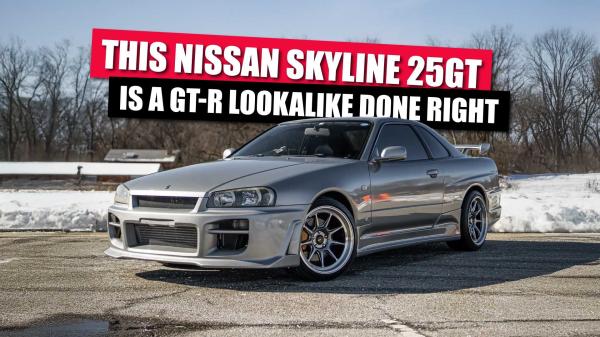
This Nissan Skyline 25GT Is A GT-R Lookalike Done Right
While it is no Godzilla, this Nissan Skyline 25GT has some clean GT-R style bodywork, a turbo RB25DET engine, and plenty of desirable features.
From Skyline To Supercar: The Evolution Of The GT-R

The R35 GT-R may have dropped the “Skyline” name when it debuted in 2007, but it still possessed the DNA of one of Japan’s greatest sports car nameplates. Few nameplates command respect like the Nissan GT-R. What started as a boxy touring sedan decades ago transformed into a twin-turbocharged, all-wheel-drive weapon that regularly eats Italian exotics for breakfast.
- Hakosuka GT-R (PGC10/KPGC10) — 1969–1972
- Kenmeri GT-R (KPGC110) — 1973
- R32 Skyline GT-R (BNR32) — 1989–1994
- R33 Skyline GT-R (BCNR33) — 1995–1998
- R34 Skyline GT-R (BNR34) — 1999–2002
The GT-R story began with the PGC10 Skyline GT-R in 1969. Affectionately nicknamed the “Hakosuka” (Boxy Skyline), this machine dropped a 160-hp 2.0-liter DOHC inline-six borrowed from Nissan’s Prince R380 race car program into a lightweight rear-wheel-drive chassis, creating an absolute weapon. Produced in coupe and sedan body styles, the Hakosuka was a menace on the streets, but the formula also proved formidable on the track. It didn’t just race; it humiliated the competition, racking up 52 domestic touring car victories in Japan and cementing the GT-R badge in motorsport history. While modest by modern standards, the Hakosuka created the GT-R formula: a practical coupe with race-bred engineering and giant-killing performance. Nissan produced exactly 1,945 units of the legendary Hakosuka, which is why collectors pay six figures for pristine examples.
The second-generation KPGC110 Skyline GT-R, nicknamed “Kenmeri” after a popular advertising campaign, arrived at the worst possible time. Boasting a gorgeous fastback silhouette and the same race-bred S20 inline-six as the Hakosuka, the Kenmeri should have been a massive hit, but it arrived just as tightening emissions regulations and shifting market conditions began squeezing the life out of high-performance cars. Nissan pulled the plug after just 197 units, making this the rarest and most elusive production GT-R on the planet. For the next 16 years, the GT-R badge disappeared entirely, turning the Kenmeri into an automotive legend long before enthusiasts could appreciate what it represented. With such rarity, it’s no surprise that the Kenmeri fetches hundreds of thousands of dollars at auctions.

After a long hiatus, Nissan revived the badge with a sledgehammer in 1989: the R32. The R32 brought things that altered tuning culture forever. The legendary RB26DETT twin-turbo inline-six, officially rated at 276 horsepower under Japan’s gentleman’s agreement, provided enough power to threaten European sports cars and was designed to comfortably handle a lot more power than it did while stock. The R32 also introduced the black-magic ATTESA E-TS AWD system and Super-HICAS four-wheel steering, technologies that gave it extraordinary grip and composure. It was so utterly dominant in the Australian Touring Car Championship that local press dubbed it “Godzilla.” Special variants such as the homologation-special NISMO and V-Spec models only enhanced its reputation, while prominent appearances in racing games like Gran Turismo helped introduce an entire generation of enthusiasts to the GT-R legend. Roughly 44,000 examples were produced.

The R33 arrived in 1995 and refined the formula that the R32 had introduced. Although larger and heavier than the R32, it was also significantly more rigid and aerodynamically refined, which helped fix the R32’s infamous snap-oversteer tendencies. The updates worked because the R33 famously recorded a Nürburgring lap time of 7 minutes 59 seconds, making the R33 one of the fastest production cars in the world at the time. Notable versions included the V-Spec, V-Spec N1, and ultra-rare LM Limited, built to commemorate Nissan’s participation at Le Mans. About 16,700 were built.

The R34 took over in 1999 and became the poster car of the nameplate. If one GT-R generation achieved global celebrity status, it was the R34. If you played Gran Turismo or watched Paul Walker behind the wheel of an R34 Skyline in the Fast & Furious franchise, this is the car burned into your retinas. The RB26DETT continued to provide twin-turbo power, while variants such as the V-Spec, V-Spec II, M-Spec, Nür, and the ultra-exclusive NISMO Z-Tune pushed the platform to new heights. The R34 became a pop-culture icon thanks to appearances in the Fast & Furious franchise, Gran Turismo, Need for Speed, and countless video games. With fewer than 12,000 produced, it has become one of the most sought-after Japanese performance cars ever built.
By the time the R35 arrived in 2007, Nissan had spent nearly four decades refining the GT-R formula through successive generations of increasingly advanced performance cars. While the R35 abandoned the Skyline name and replaced the RB26 with an all-new twin-turbo V6, it remained true to the philosophy that defined every GT-R before it: using cutting-edge technology to deliver performance capable of embarrassing far more expensive machinery.
Beyond the R35: Nissan Says The GT-R Will Return

Even though the R35 was an 18-year-old platform, every gearhead was sad to see it go, and for a moment, the future of the GT-R nameplate looked bleak. Thankfully, Nissan CEO Ivan Espinosa recently confirmed that a successor is already in development, putting years of uncertainty to rest. Much of the speculation started with the wild Hyper Force concept Nissan unveiled in 2023. Its aggressive proportions, all-wheel-drive layout, and futuristic performance focus looked suspiciously like a preview of the next Godzilla, leading many to assume the R36 would be fully electric.
That assumption has since been challenged by Nissan itself. Richard Candler, the company’s global product strategy boss, recently stated that current battery technology simply can’t deliver the kind of performance expected from a GT-R, saying that there’s “no way” the next GT-R generation would be battery-powered. That’s notable because Nissan continues to invest heavily in solid-state batteries, which promise lighter weight, faster charging, and greater energy density than today’s lithium-ion packs.

For now, hybrid power appears to be the favored route. While Nissan hasn’t officially confirmed the final powertrain, executives have acknowledged that some level of electrification is inevitable. If that’s the path forward, recent performance cars suggest enthusiasts shouldn’t be worried. The Corvette ZR1X has shown how electric assistance can unlock supercar performance without sacrificing character, potentially giving the next GT-R a formula capable of punching well above its weight once again.
Buying A Secondhand GT-R

The next GT-R will likely be electrified to some extent and will likely be more expensive than the last one. The good thing is that you can pick up a secondhand GT-R for a great price. A base 2009 GT-R costs just $45,600, says Hagerty, a 2010 Nissan GT-R Premium costs $49,500, with a 2016 model coming in at $74,900. If you want to go a bit more hardcore, a 2018 Nissan GT-R Track Edition, with a 565-horsepower unit, will cost $70,100.
|
Model |
Horsepower |
Average Value (2026) |
|---|---|---|
|
2009 Nissan GT-R |
480 hp |
$45,600 |
|
2010 Nissan GT-R Premium |
485 hp |
$49,500 |
|
2016 Nissan GT-R |
545 hp |
$74,900 |
|
2018 Nissan GT-R Track Edition |
565 hp |
$70,100 |
The Nissan GT-R NISMO Edition Commands Much Higher Prices

Nissan introduced the GT‑R NISMO in 2014. This is the fastest Nissan GT‑R ever. With a 7:08.679 lap time, Nissan claimed the volume production car lap record at the Nürburgring Nordschleife. Under the hood, the 3.8-liter V6 VR38DETT engine was treated to know-how that NISMO gained from participating in events such as the Nürburgring 24 hour race, with new high-flow, large diameter turbochargers, used for GT3 racing. Engine output rose to 600 horsepower and 481 lb-ft of torque. A top-end 2018 Nissan GT-R NISMO will set you back $129,000 in 2026.
Ultimately, the Porsche GTS and the Nissan GT-R are both incredible cars. Both have a ton of heritage and legions of loyal fans. The choice will be a personal one, and you have likely already made up your mind which you would take.
Sources: Hagerty.com, Edmunds, FastestLaps, JDPower, Kelly Blue Book, RM Sotheby’s




No Comments