
The 2.2-Liter Four-Cylinder Dodge That Ran With 1980s Ferraris
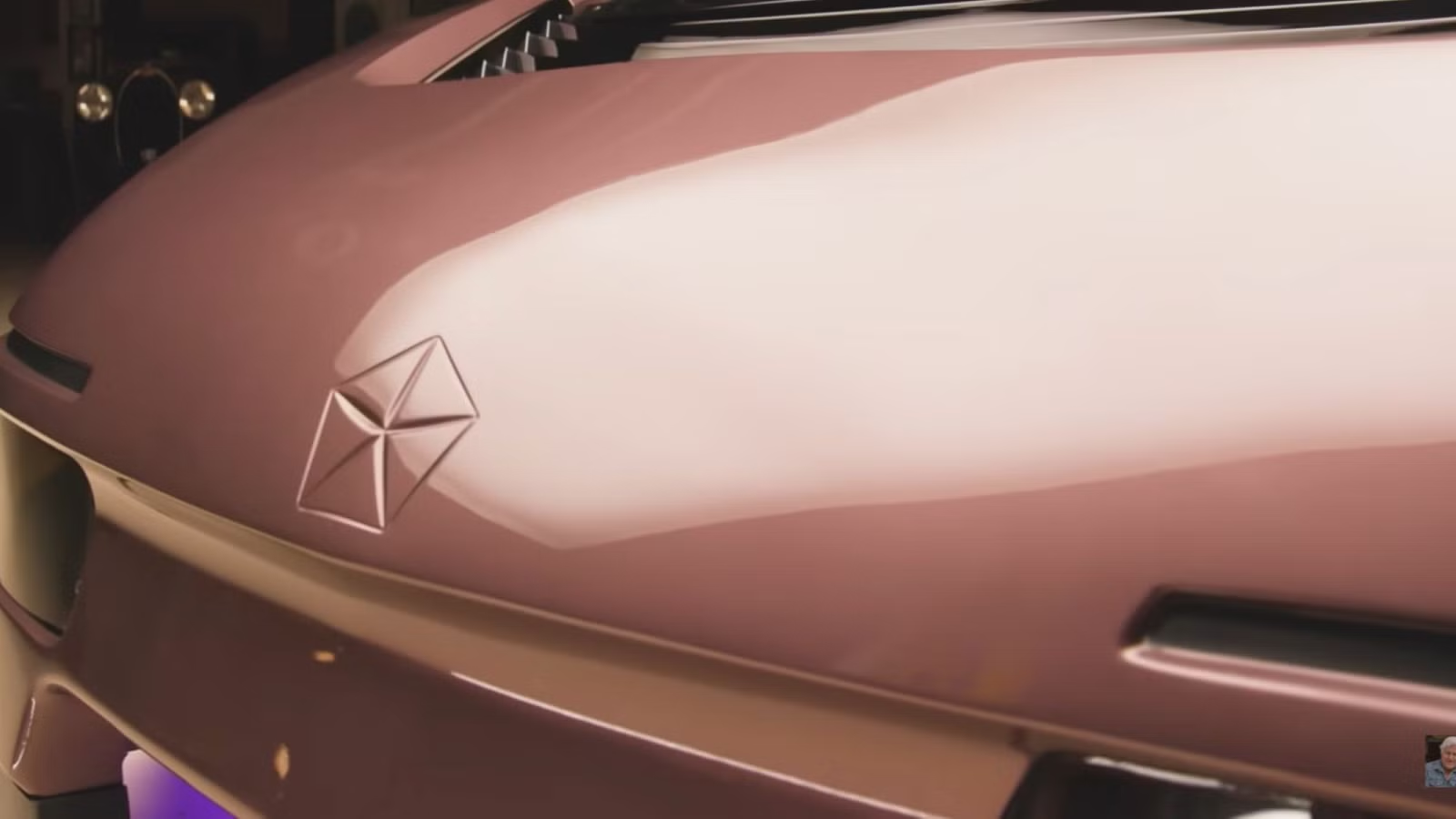
Dodge is a company best associated with muscle cars. Sure, Dodge has deviated to doing economy sedans, and some very decent trucks, but, by and large, it is famed for its two-door coupes. The Challenger, the Charger, the Coronet, the Demon — these are all formidable muscle machines that put Dodge’s name on the map. So what did Dodge do when the muscle car era abruptly ended in the ’70s? It focused on building a Ferrari-beating supercar with a four-cylinder engine out of an economy car, of course. What could possibly go wrong?
Supercars Were Taking Over The World In The ’80s

Blame it on the Countach. Or blame it on the Miura. Or just blame it on Lamborghini. The Sant’Agata Bolognese company invented the supercar in the ’60s with the achingly beautiful Miura P400, and then completed a one-two punch with the Countach of the early ’70s. Suddenly everyone had a poster of a ridiculously impractical Italian supercar on their wall, and come the ’80s, a lot of stockbrokers had one in their garage too. Supercar fever was becoming a pandemic, and quicker than you could say “greed is good”, another twelve-cylinder mid-engined razor blade on wheels would roll out of the factory.
The Ferrari Testarossa Was The Epitome Of Four-Wheeled Testosterone

There were plenty of cars that summed up this supercar Hadean Eon, but one seemed to stand out more than any other. The Ferrari Testarossa of 1984 was designed by Pininfarina and still stops traffic today. The beard trimmer side strakes, the puppy ear rearview mirror, the starring role in Miami Vice — it couldn’t have been more of a statement if it hovered on dry ice. Dodge must have been watching all this supercar madness unfold, because at the same time that the Testarossa was launched, it too decided to roll out a supercar. But with a twist.
Dodge Decided To Swap Muscle For A Supercar


In the ’80s, the muscle car scene wasn’t looking good. The Malaise Era had reduced some illustrious badges to four-pots and a few stickers, and now came an onslaught of affordable cars from Japan. Dodge needed a new direction, and was keen to show what it could do with a turbocharger. So when the chance to design a pace car for the CART PPG Indy Car World Series came up, it went all in.
While other companies had phoned in pace car duties with modified versions of road cars, Dodge created the M4S Turbo Interceptor, a low-slung supercar with an ultra-slippery 0.236 drag coefficient. There was something scarab-esque about the Dodge’s carbon fiber/Kevlar/fiberglass body, with a sinister look that seemed like it was out of Darth Vader’s weekend helmet collection. But the real revelation was under the rear decklid.
The M4S Was Ahead Of Its Time

You wouldn’t find a big V12 sitting in the middle of an M4S. Oh no. Instead, Dodge went with half the cylinders, basing the powerplant on the humble inline-four K-car engine block. But that didn’t mean the car, which was said to have been inspired by the Porsche 962, had an economy model’s power. Driving the rear wheels, the 2.2-liter unit was fitted with two Garrett T25 turbochargers and a Cosworth-tuned DOHC 16-valve cylinder head.
The mill now pumped out 440 hp at 25 psi maximum boost, which was a significant amount for the early ’80s. This kind of boosted downsizing was incredibly forward-thinking. While twelve cylinders, or at least eight, were de rigueur for supercars of the time, exotics of today often rely on twin-turbocharged smaller engines for their power. A case in point being the Ferrari 296 GTB, which makes do with a 2.9-liter V6 and two turbos. Speaking of Ferrari, surely the M4S couldn’t outrun the Prancing Horses of its time?
The Economy-Car Engined M4S Could Run With Ferraris

It sure could. The Dodge could hang with the fastest exotics all day long. According to Ppgpacecars.com, the M4S set its own top speed record at 194.8 mph. It could also reach 60 mph in just 4.1 seconds, and cover the quarter mile in 12.9 seconds. That is pretty quick for today, but in the mid-’80s that was mind-blowing. By comparison, the Testarossa would hit 60 mph in five seconds, according to one independent test, cover the quarter mile in 13.3 seconds, and top out at 176 mph. That wasn’t slow, that was normal for a fast car. The Dodge was simply one step ahead. All Detroit had to do was build it…
A Trip To Hollywood Signaled The End For The Dodge Supercar

But it didn’t. It is widely agreed that the M4S would have been too expensive to put into production and the sales not worth the investment. In the end, it did a good enough job as a concept car getting publicity for the company, to make the reported $1.5 million cost worth it. Also, Dodge wanted to direct attention to the idea of a turbocharged four, as seen in the 1985 Dodge Shelby Charger Turbo, although that only had 146 hp.
But the clearest signal that the M4S wouldn’t be any more than a fancy concept was when the original prototype became a star of the 1986 movie The Wraith, featuring Charlie Sheen. The actual car was used for close-up shots, with six replicas (two driveable, four shells) built for stunts and to be destroyed. While the cheeseball ’80s thriller has become something of a cult classic, it was perhaps a little sad to see the pioneering Dodge be reduced to a movie prop.
Here’s What Happened To The M4S
After returning from Hollywood, the M4S had a more leisurely life as a main attraction at the Walter P. Chrysler museum. When the museum closed in 2016, it is believed to have gone into private hands. One of the movie cars also emerged on Jay Leno’s Garage, introduced by Jeff Dunham. Then, in 2023, as reported by Barnfinds, what appeared to be the original M4S surfaced on eBay with a $290,000 asking price and a Buy It Now price of $499,000. What is interesting is that this car was reportedly based in East Peoria, Illinois. Other videos of Interceptors have emerged, including driving footage with what appears to be Porsche dashboards.
Hagerty discovered that one particular M4S posted on the Facebook page is actually a tribute car, created from an elongated Porsche Boxster, presumably explaining the dashboard. Then, if you visit the website of a company called MWI Supercar, you’ll find that they are manufacturers of “turn-key turbo interceptors”, with engine options from a four-cylinder right up to a V12. Where are they based? East Peoria, Illinois. So, according to MWI Supercar at least, the car did actually make it to the streets, it just took a few years.
Sources: Barnfinds.com; Hagerty.com; Mwisupercar.com

Related posts


Latest Post


No Comments