
Lexus IS 500 Review: BMW Dynamics, Toyota Reliability
Gearheads have been enjoying performance sedans for one reason: they promise to offer the best of both worlds. With brute power and precise handling, they also offer a usable trunk and the practicality of four doors. And one name that surfaces when talking about such sedans is BMW. Enthusiasts praise BMWs for their balanced handling and unbelievable dynamics.

But carmakers have often struggled with producing cars that deliver a thrilling driving experience while also ensuring long-term ownership prospects. The modern performance sedans sure have become technologically advanced, but that comes at a cost. They also demand expensive maintenance and repairs once the warranty expires. But there is hope for sedan lovers: one luxury automaker has blended the driving performance usually associated with BMW with the long-term reliability that Toyota is known for.
What Makes A “BMW-Feeling” Sedan
When a driving enthusiast says “It feels like a BMW,” they are not merely referring to the badge on the hood. They’re talking about cars that prioritize the driver above all else. It’s surprising that very few automakers are following this mantra in today’s competitive market.

Steering is where a true BMW-like driving experience comes from. It is all about genuine feedback through the wheel rather than mere quick responses. A true driver’s car communicates seamlessly with the front wheels, giving the driver confidence through corners and a feeling of being completely in control.
Next is chassis balance. A well-engineered performance sedan does not feel nose-heavy; instead, it feels neutral. It settles predictably under braking, instills confidence when accelerating out of bends, and rotates naturally into a corner. This composure is what sets a BMW-like sedan apart from a regular sedan.
Another key ingredient is rear-wheel drive. Sure, modern all-wheel-drive cars are noticeably more capable, but the purity of sending power only to the rear axle is something enthusiasts still prefer. It not only maintains the balanced handling but also creates a more playful character akin to classic sports sedans.

Horsepower is important; what’s equally important is power delivery. An ideal performance sedan is not all about sudden surges of boost; instead, it is about smooth and predictable acceleration that builds naturally with engine speed. This linear response is what makes for a more rewarding drive and much easier control over the car.
And finally, there is confidence. It does not matter whether you are driving in the mountains or on a highway, a great driver’s car disappears beneath you and makes you feel one with it, encouraging pure driving rather than mere commuting.
These are the very characteristics BMW has built its reputation around. But sadly, many carmakers sacrifice long-term durability in an attempt to replicate those driving dynamics.
Why Most Performance Sedans Fail The Reliability Test

It’s one thing to build a high-performing sedan, and another entirely to build one that still feels solid after 150,000 miles.
Modern performance sedans are not merely engineering showcases. Turbocharged engines use relatively little displacement to produce raw power. Adaptive suspensions handle damping adjustments. And to make the package a practical one, active steering systems, advanced infotainment hardware, and electronic differentials all work together to ensure greater convenience.
The downside is complexity. Compared to naturally aspirated alternatives, turbocharged engines operate under significantly higher thermal and mechanical stress. They eventually wear with age, relying on additional components like turbochargers, intercoolers, high-pressure fuel systems, and extensive cooling hardware. It is not an everyday affair, but relying on these systems introduces more potential failure points as mileage accumulates.

To compound all of that, electronics have become a major ownership consideration. Managing everything from suspension settings to climate functions, these performance sedans now integrate dozens of control modules. This inflates repair prices as diagnosing faults often requires specialized software and expensive replacement components.
This ownership equation is especially experienced in European luxury brands. Their engineering priorities frequently emphasize cutting-edge performance and innovation over mechanical simplicity. It is not a significant concern during the warranty period, but after that, maintenance costs soar.
From labor costs and expensive routine services to very expensive replacement parts, the maintenance costs are steep even for relatively straightforward repairs.
But that doesn’t mean these cars are bad purchases. There are plenty of owners who are more than happy to pay as long as they get those exceptional driving experiences.
But the problem is that many buyers want both. While they want a sedan that feels alive on a winding road, they do not want to face staggering maintenance costs once the warranty expires. And in the current market, very few manufacturers have successfully combined genuine enthusiast dynamics with the kind of durability typically associated with dependable mainstream brands.
The Lexus Formula: Old-School V8, New-School Luxury

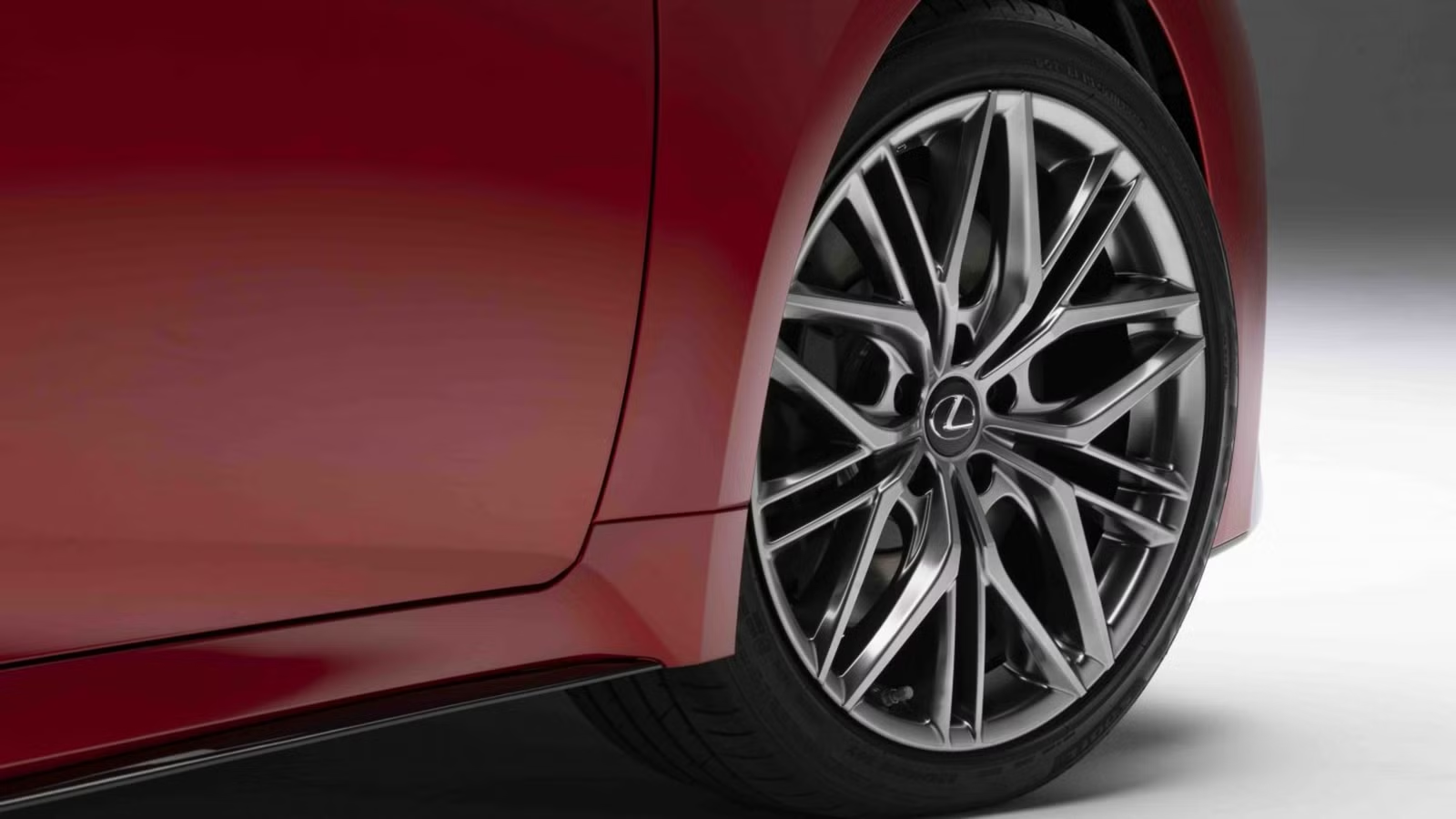
One of the rare exceptions is the Lexus IS 500 F SPORT Performance. In times when automakers chase ever-higher power figures through increasingly complicated turbocharged engines, Lexus stuck with an old-school solution. Under the hood, it packs Toyota’s legendary 5.0-liter naturally aspirated V8, producing 472 hp and delivering power with a smoothness that has become increasingly rare in today’s performance market.
No waiting for boost to build. No artificial soundtrack pumped through the speakers. Just immediate throttle response, a steadily rising wave of acceleration, and one of the best V8 exhaust notes still available in a new luxury sedan.
Fundamentally changing the character of the IS 500 is that engine. It encourages drivers to explore the upper reaches of the rev range. Rather than feeling explosive in short bursts, it delivers smooth inputs, making every acceleration run feel special.
To satiate enthusiasts’ hunger for balanced handling, rear-wheel drive remains standard. The chassis complements the powertrain remarkably well. The steering is direct, and the suspension offers everyday comfort and genuine cornering ability.

It is not made to mimic BMW’s razor-sharp M cars. It does, however, deliver the kind of approachable confidence that makes spirited driving enjoyable without demanding race-driver reflexes.
Over the years, the naturally aspirated V8 has earned an outstanding reputation across multiple Lexus performance models. The engine maintains exceptional durability because there are no turbochargers generating additional heat or pressure. The transmission, too, is similarly proven, relying on a conventional automatic rather than more complicated dual-clutch hardware.
Now comes the part that makes this performance car truly durable: the platform itself. Lexus has refined the underlying architecture over multiple production cycles, ironing out many of the issues that often accompany all-new vehicle launches. Combined with Toyota’s famously conservative engineering philosophy, the result is a performance sedan built with longevity in mind instead of simply chasing headline numbers.
Lexus also consistently ranks near the top of industry reliability studies, reinforcing a reputation that extends well beyond isolated anecdotes. Owners routinely report hundreds of thousands of miles with relatively few major mechanical problems, an achievement that’s increasingly uncommon in the modern luxury segment.
The Sweet Spot Buyer For This Lexus

Before adding this car to your garage, bear in mind that the IS 500 won’t match the latest German rivals for digital displays, customizable ambient lighting, or semi-autonomous driving features. Some interior materials and infotainment elements feel older than what buyers will find in the newest European competitors. Rear-seat space is also tighter than larger executive sedans, making it less practical for families who regularly carry adult passengers.
In pursuit of long-term durability, the car’s performance philosophy may also feel dated. While competitors focus on extracting maximum horsepower from turbocharged six-cylinder engines, Lexus doubles down on naturally aspirated character. That means it sacrifices a bit of outright acceleration and cutting-edge technology in favor of mechanical simplicity and durability.

But for many enthusiasts, that’s exactly the point. The ideal IS 500 buyer is someone who genuinely enjoys driving but doesn’t lease a new car every three years. They plan to own their sedan for a decade or longer. They appreciate responsive steering and rear-wheel-drive balance, but they also value dependable cold starts, predictable maintenance costs, and the confidence to embark on long road trips without worrying about expensive repairs on the way.
The IS 500 stands almost alone in an industry that is moving toward smaller turbocharged engines, electrification, and increasingly software-driven driving experiences. It preserves many of the qualities that made classic BMW sports sedans so beloved while wrapping them in the dependability that has defined Lexus for decades.
The car may not be the newest, fastest, or most technologically advanced performance sedan available today, but it just might be the one that is still putting a smile on its owner’s face 15 years from now.

Related posts





Latest Post


No Comments