
The Ford Engine That Quietly Powered Everything
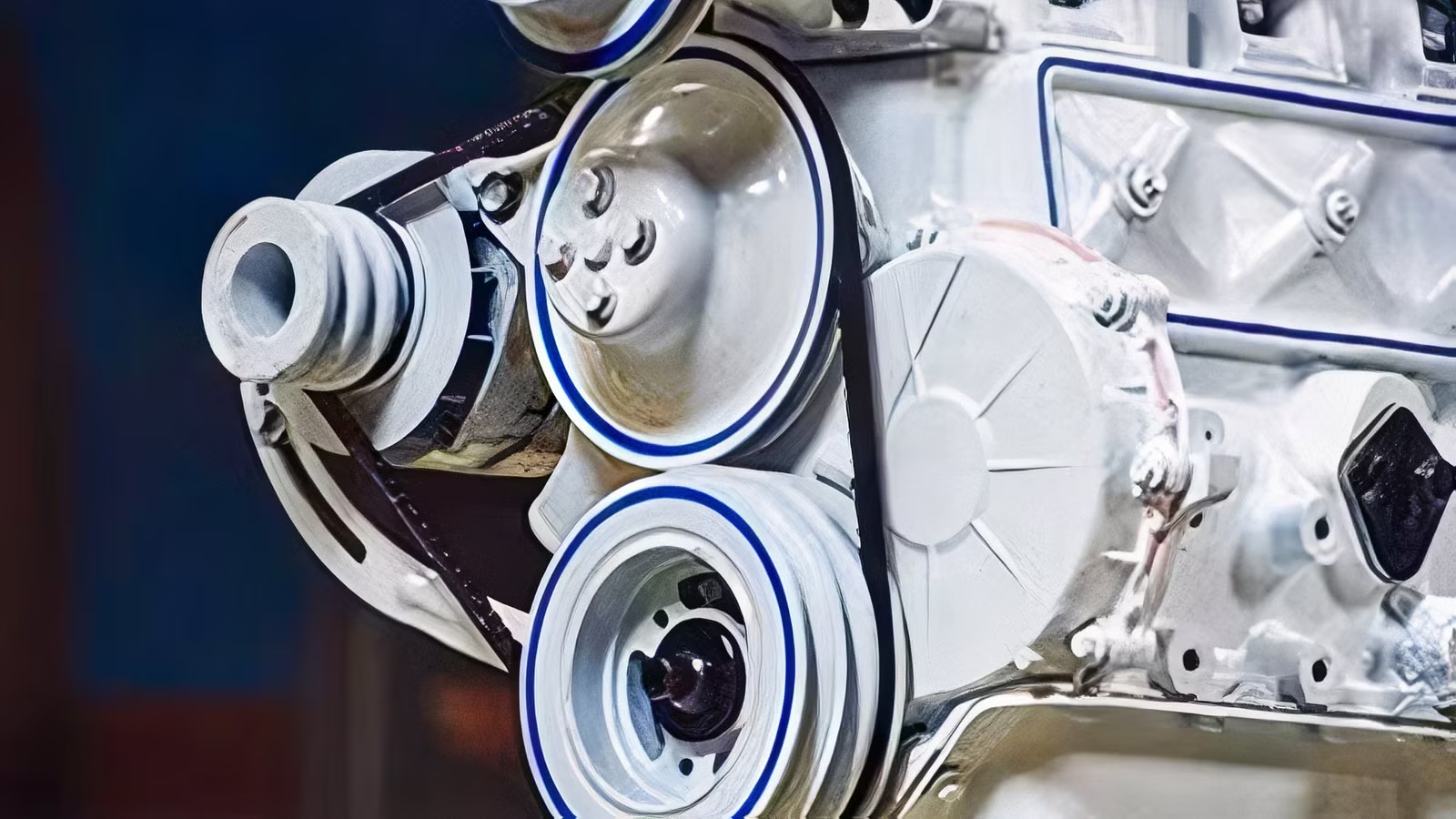
When we look back at automotive history, legends usually earn their reputation through blistering horsepower, high-profile racing wins, or exotic engineering. We celebrate the screaming V8s, the high-revving powerplants, and the engines that defined muscle cars and sports cars. But decades ago, Ford created an engine that became legendary for doing the exact opposite. It wasn’t built for the racetrack, but it became one of Ford’s longest-serving powerplants because of its unyielding reliability, low-end grunt, and near-indestructible design. For over thirty years, this engine didn’t just power cars; it quietly carried the literal weight of an entire era.
Ford Needed An Engine That Could Do More Than Make Power

The mid-1960s marked a massive shift in the American landscape. The post-war economic boom had matured into an era of massive infrastructure expansion, agricultural industrialization, and exponential small-business growth. Suburban neighborhoods were expanding, interstate highways were being built across the country, and commercial transportation was exploding. Suddenly, America didn’t just need passenger cars for the family; it needed a massive fleet of work trucks, delivery vans, and industrial machinery to build the future.
Ford’s legendary V8 engines, like the FE series or the emerging Small Block family, were fantastic for making power. However, fleet operators, construction workers, agricultural workers, and utility companies didn’t care about zero-to-60 times. They cared about pulling power, uptime, and operating costs. If a truck was sitting in a garage with a complex mechanical failure, the business lost money. Ford realized they needed an engine designed from the ground up to handle relentless, heavy-duty cycles day in and day out. They needed a dependable workhorse that could thrive under conditions that would tear a high-performance engine apart.
Existing Engines Had Limits

Prior to this, many light-to-medium-duty trucks relied on smaller-displacement inline-sixes or adapted passenger-car V8s. While these older engines were fine for lighter tasks, the 1960s commercial boom quickly exposed their limits. Increasing payloads meant trucks were constantly hauling heavier concrete blocks, larger loads of lumber, and massive pieces of farm equipment. Towing demands rose drastically as commercial trailers grew larger.

When a regular engine is placed under a continuous, heavy load, it has to run at high RPM to maintain momentum. This high-RPM stress drastically increases component wear, heat buildup, and eventual mechanical failure. Furthermore, early overhead-valve designs often suffered from valvetrain wear or cooling deficiencies when pushed to their absolute limits for hours on end. For severe commercial use, increasing displacement by simply boring out a regular car engine wasn’t going to cut it. Ford needed an entirely different approach: an engine that could make all its power at low RPM.
One Simple Design Quietly Became Ford’s Workhorse

To meet this looming industrial demand, Ford’s engineering team focused entirely on maximizing torque, specifically low-end torque. To achieve this, they chose a classic long-stroke design. Let’s get a little technical here. In engine physics, torque is a function of leverage. By giving the engine a long piston stroke relative to its cylinder bore, the connecting rods push down on the crankshaft with greater mechanical leverage.
This meant the engine could generate its maximum pulling force right off idle, exactly when a heavily loaded dump truck or delivery van needs it most. Because the pistons had to travel a long vertical distance up and down the cylinder walls, the engine was physically incapable of safely revving to high speeds, but it didn’t need to. It was designed to do its best work below 3,000 RPM, operating in a relaxed, low-stress powerband that inherently minimized friction and internal wear.
Designed To Survive Abuse

The secret to this engine’s longevity didn’t lie in complex electronics or space-age materials; it was simply over-engineered. The foundation was a brutally heavy, thick-walled cast-iron cylinder block and cylinder head. The engineers cast the block with extra-thick material to prevent flexing under extreme thermal and physical loads.
To ensure the rotating assembly could survive decades of severe commercial abuse, they implemented several key design choices:
- Seven Main Bearings: While many contemporary engines used four or five main bearings to support the crankshaft, this engine used seven. This virtually eliminated crankshaft flexing, vibration, and structural fatigue.
- Gear-Driven Camshaft: Instead of using a flexible timing chain or rubber timing belt, the engineers opted for a heavy-duty, gear-to-gear timing setup. The crankshaft gear directly turned the camshaft gear. It was loud, heavy, and functionally bulletproof, requiring zero maintenance for the entire lifespan of the engine.
- A Solid Valvetrain: The valvetrain had a straightforward non-adjustable overhead valve design with hydraulic lifters, requiring zero periodic adjustments. Every component was deliberately made oversized and simple, making the engine incredibly easy to maintain.
Ford’s 300 Inline-Six Was Perfect For The Job

In 1965, Ford officially unveiled its 300 cubic-inch (4.9-liter) Inline-Six. For over three decades, from 1965 all the way until it was phased out in 1996, the 300 Inline-Six became the undisputed powerplant for multiple generations of Ford F-Series trucks, Econoline vans, and specialized commercial vehicles.
While consumers could option their trucks with flashy V8 engines that made deep, rumbling exhaust notes and high horsepower, those who bought trucks solely to make a living almost always checked the box for the 300 Inline-Six. It didn’t make a lot of power, as early carbureted engines made a modest 150 to 170 hp. But what you wanted was torque, and this engine made 260 lb-ft of torque at an incredibly low 1,600 RPM. This meant you could drop the clutch on a fully loaded F-250 on a steep incline, and the engine would simply dig in and pull without stalling or sputtering.
It Powered Nearly Every Kind Of Ford Work Vehicle

The sheer versatility of the 300 Inline-Six meant it quickly became a staple of American industry. If you saw a Ford vehicle wearing a company logo, pulling heavy machinery, or serving a local municipality between 1965 and the late 1990s, there was an overwhelmingly high probability that a 300 Six was humming under its hood.
Beyond the iconic Ford pickup trucks, the engine was the standard choice for Ford’s heavy-duty Econoline cargo and passenger vans. But Ford didn’t stop there. Because the engine was so physically robust and thermally stable, they packaged it as an industrial powerplant. It was widely adapted to run on gasoline, liquid propane, or natural gas to power:
- Commercial dump trucks and school buses (F-600 models)
- Industrial water pumps and agricultural irrigation systems
- Massive backup electrical generators
- Airport baggage towing tractors and aircraft tugs
- Heavy-duty wood chippers and construction air compressors
It was an engine that seamlessly transitioned from hauling hay on a small farm to idling for ten hours straight on a grueling New York City construction site.
Its Reliability Became The Stuff Of Legend

Over its 31-year production run, the Ford 300 Inline-Six became legendary with stories of its supernatural durability spread among fleet operators, mechanics, and farmers. It earned a reputation as an engine that simply refused to die, even when subjected to catastrophic levels of neglect. It became common to hear of 300 Sixes passing the 300,000, 400,000, or even 500,000-mile milestones without ever having their cylinder heads removed or their bottom ends rebuilt.
It was an engine that could tolerate being run low on oil, subjected to severe overheating, or fed stale fuel, and it would still start up on the first turn of the key the next morning. Fleet managers calculated their operational bottom lines and realized that while V8s offered more speed, the 300 Six was always more dependable.
Furthermore, because Ford produced millions of these units with virtually identical design, parts were readily available. If an alternator, water pump, or fuel pump did eventually wear out, replacements were cheap and could be found at literally any auto parts store in North America. The large space in the engine bays meant that changing spark plugs, belts, or filters was a ten-minute job, drastically lowering labor costs for businesses.
It Was Around For Three Decades

Very few engine designs in the world have managed to remain in continuous production for over three decades with so few changes to their core architecture. From 1965 through the mid-1980s, the engine relied on simple single- or two-barrel carburetors and traditional distributors. When federal emissions regulations tightened drastically in 1987, many legendary engines were forced into retirement because their designs couldn’t adapt.
But Ford didn’t abandon the 300. Instead, they updated the cylinder head and equipped the engine with a highly efficient Electronic Multi-Port Fuel Injection (EFI) system alongside a split exhaust manifold. The update didn’t ruin the engine; it perfected it. The fuel-injected variant started more easily in freezing weather, ran more smoothly, and pushed torque up to 265 lb-ft, all with the same iron block, gear-driven camshaft, and seven-main-bearing layout since 1965.
It Defined What A Work Truck Engine Should Be

The Ford 300 Inline-Six did much more than move vehicles from point A to point B. It permanently defined the expectations for what a true work truck engine should be. It heavily influenced Ford’s reputation during an explosive era with lots of competition. The absolute trust that contractors, ranchers, and large-scale corporate fleet buyers placed in the 300 Inline-Six built the foundational customer loyalty that made the Ford F-Series the best-selling truck lineup in America. It proved to the working class that Ford understood what they needed: a tool that worked as hard as they did, without complaining, and without breaking the bank.
Its Legacy Lives Far Beyond Production

The last 300 Inline-Six rolled off the production line in 1996, but its story is far from over. Today, the engine enjoys a massive, fiercely loyal enthusiast following that spans generations. Go to any truck restoration forum, off-road meetup, or classic car show, and you will find the 300 Six being celebrated with immense respect. Because the heavy cast-iron block is inherently capable of handling extreme pressures, a passionate group of engine builders retrofit them with turbochargers, custom aluminum intakes, and performance camshafts, turning these old torque-monsters into high-horsepower motors.
They are highly sought after for rugged off-road builds and rock crawlers, where low-speed throttle modulation and bulletproof reliability are the difference between driving home or being stranded in the wilderness. You can still find them today, under the hoods of old 1980s farm trucks, still hauling wood, still pulling trailers, and still starting on the very first crank.
Sources: Ford, Diesel 150 Forum, Ford-Trucks.com, Ford 150 Forum, Dieselarmy.com

Related posts





Latest Post


No Comments