
This Japanese Motorcycle Is The Best Suited Ride For Everyday Riding
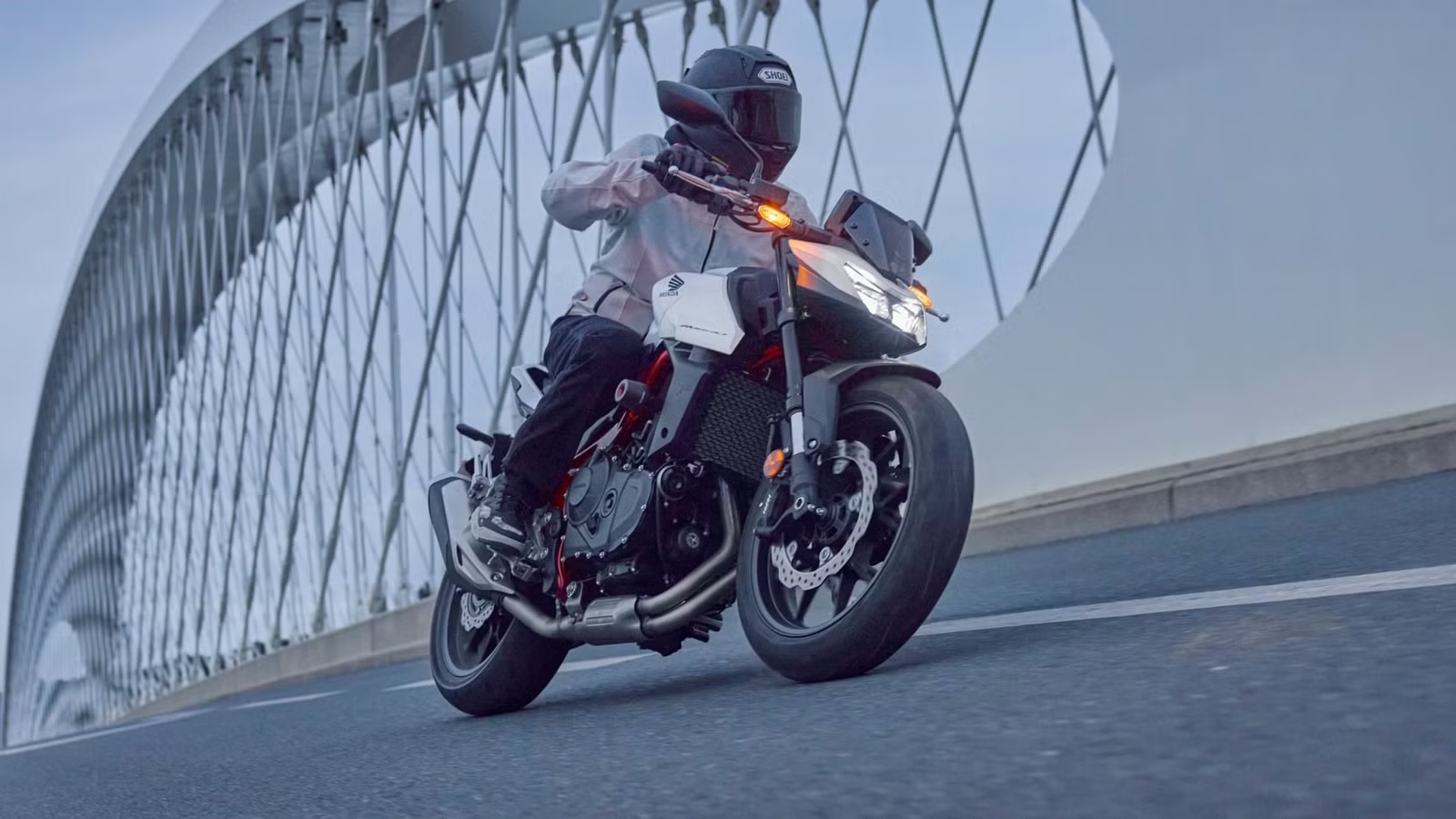
Imagine this. It’s two in the morning, and you’ve just packed up another twelve-hour shift working on an important project. The ride back to the comfort of your home is forty minutes away. And it’s raining. It’s just another day in your busy life, but it could be worse. You’re tired, drained, and standing in the basement parking lot staring at your pride and joy on two wheels. It’s the solace you need, the companion that’ll unwind the tangles of the day, so that you can sleep with a smile and look forward to the next day. It never flinches at your tired inputs, never punishes a lazy line, and it never tires. If you’re after a daily motorcycle that does all of that well, we have a Honda you need to consider.
What The Daily Rider Actually Needs From A Motorcycle

A daily rider is anyone who leans on two wheels for transportation more days than not, riders whose only common thread is the ground they cover and the variety of moods they cover it in. Some ride to a job that starts before sunrise; some find that time well after the city has gone to sleep. None of them gets to pick the weather or their own energy level before swinging a leg over. So it needs a specific set of requirements to be fulfilled.

Reliability, ease of use, comfortable ergonomics and personality; that’s the actual shortlist for a daily bike. Mix Japanese reliability and Ducati-esque ride feel, and you have a winner on your hands. The particular genre of the bike is purely personal preference. It could be a naked, or even a sports bike that can handle the daily grind just as well if it’s the right one. But you’d be better off staying away from a motorcycle that nags for attention every few hundred miles, turning you into a part-time mechanic.

Or even one that punishes a tired or distracted input, with snatchy fueling worsening things, a heavy clutch pull adding more strain, and an unforgiving seating position robbing comfort, all of which wears a rider down faster. Top that with a bike that becomes forgettable past the first few rides, and you’ll be leaving it in the garage at the first excuse, which, for a daily rider, defeats the entire point of owning one.

The Honda CB750 Hornet Delivers On Every Daily Rider Requirement

Honda has had this displacement since the 1970s, when the original CB750 rewrote what a mass-produced motorcycle could do. The modern CB750 Hornet carries that same purpose by being genuinely usable rather than merely fast, as it balances a smooth power delivery alongside good fuel efficiency and renowned Honda reliability. For 2026, Honda folded its E-Clutch tech into the lineup without touching the price, which still starts at $7,999. That alone puts some distance between the Hornet and its competitors, and the engine is the highlight.
A 755cc Parallel-Twin That Demands Less From A Tired Rider

The 755cc liquid-cooled parallel-twin under the tank runs an 87.0mm bore and 63.5mm stroke through a Unicam SOHC head, shared with the XL750 Transalp. Peak output is 91 hp at 9,500 rpm and 55.3 lb-ft at 7,250 rpm, with the oversquare engine thrumming away using a 270-degree crank.

Honda’s Vortex Flow Duct keeps the intake charge response steady between 3,000 and 8,000 rpm, giving it the solid low-mid-range grunt that a daily commuter depends on. The 270-degree firing order also makes for an uneven, V-twin-style pulse, making for an engine character that makes you look forward to the ride back home from work or spending the weekend carving canyons.
Ride Modes And A Chassis That Keep Ticking

Don’t be fooled by the “daily” tag of this middleweight Honda, because it packs an enviable set of electronics from the class above. Five preset ride modes and two fully customizable user settings adjust power delivery, engine braking character, and the Honda Selectable Torque Control threshold. The bike even remembers those settings after the ignition is turned off. So the electronics make even new riders not feel intimidated, and neither does a rainy day force you to reschedule the commute.

The engine and electronics ride on a diamond-type steel frame that weighs 36.6 pounds, 4.2 pounds lighter than the CB650R’s unit. Meanwhile, a 25.0-degree rake with 3.9 inches of trail keeps the steering neutral enough for highway stability yet agile enough for lane filtering. The suspension isn’t fancy, but dependability is what’s more important in daily application. Thus, a Showa 41mm SFF-BP inverted fork handles 4.7 inches of suspension travel up front, and the Pro-Link single shock runs 5.1 inches of travel out back with seven-stage preload adjustment. At 432 pounds wet, the whole package stays light and nimble.
How The E-Clutch Makes Life Easier During Commutes

Honda’s E-Clutch automates the clutch through a two-motor actuator tucked into the right engine cover, simple tech that lets you shift the gears manually but not have to think about the clutch at all. That’s the kind of comfort that you’d deeply appreciate in crawling traffic. The Hornet’s version pairs it with throttle-by-wire for the first time in the U.S., where the tech’s other applications still run a mechanical throttle.

The lever stays fully functional for anyone who wants to shift traditionally. Clutch-lever fatigue is cumulative on a long commute back home, and removing it takes one more decision away from a brain that has already made a few hundred that day. Of course, there are several other reasons to choose the CB750 Hornet.
The Honda CB750 Hornet Against The Rivals

The MT-07 at $8,599 is the CB750 Hornet’s strongest challenger on price, and Yamaha’s 689cc CP2 twin runs marginally more fuel-efficient. But the Honda edges it on outright performance, and carries a deeper electronics suite for the money, along with the convenience of the E-Clutch. The Triumph Trident 660 makes for a worthy rival too, with a sprightly 660cc inline-triple, backed by cornering ABS, a six-axis IMU, and a standard quickshifter. But it costs $1,146 more and has no equivalent to an E-Clutch, especially if your daily riding runs through stop-and-go traffic.

Mind you, neither of the two loses to the Hornet to be crowned as the top option for a daily rider. It’s a tall ask for a bike to be reliable, low-effort, comfortable and still fun to swing a leg over, but doing so daily, especially with the kit that enables you to take on the daily grind with aplomb, the CB750 Hornet E-Clutch is that rare middleweight that ticks all the boxes and makes every dollar count.
Source: Honda Powersports

Related posts

Latest Post


No Comments