
The Rear-Engine Corvette Prototype GM Cut Into Pieces To Bury
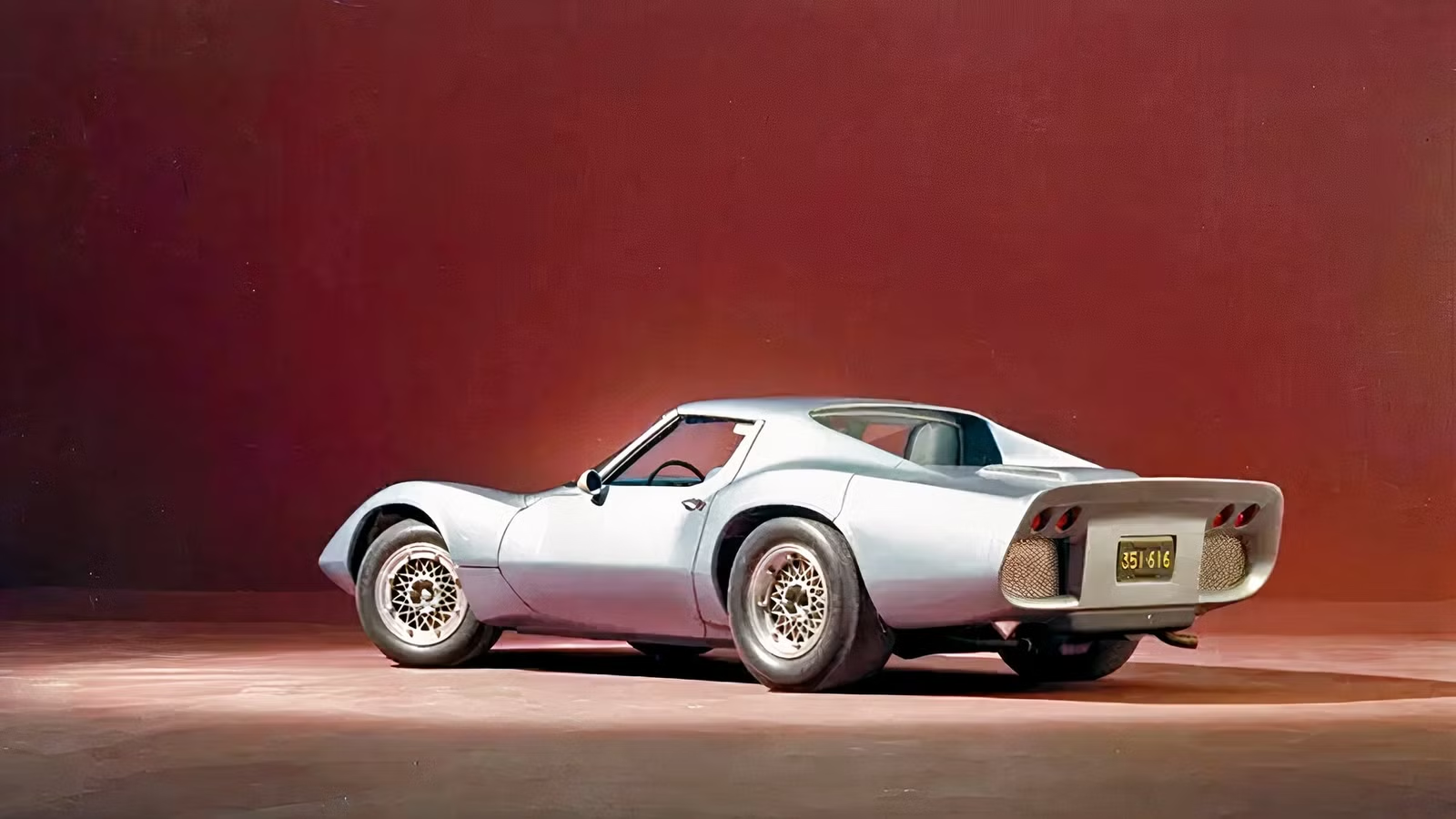
In 1965, a secret engineering war at General Motors ended in a spectacular, high-speed crash on a wet lane-change track. And the aftermath wasn’t just an ordinary corporate cancellation of the project. GM executives ordered the experimental vehicle to be completely cut into pieces and shipped away, attempting to bury a radical concept forever. This experiment was not a routine mechanical failure. It was the result of an internal ideological civil war over the future of America’s sports car, pitting two legendary engineering minds against each other to answer a single dangerous question.
How Two Legendary Engineers Clashed Over The Corvette Formula

In the early 1960s, the Corvette enjoyed massive commercial success, but behind closed doors, its engineering foundation was in an identity crisis. The traditional front-engine, rear-wheel-drive layout was reaching its physical limits. If Chevrolet wanted to compete with the finest European racing machinery from Ferrari and Porsche on the global stage, the layout had to be reinvented. This technical roadblock split GM’s research and development divisions into two fiercely competitive factions.
On one side stood Zora Arkus-Duntov, the legendary Corvette chief engineer who advocated for a balanced, mid-engined configuration, believing that placing the engine directly ahead of the rear axle would provide excellent high-speed stability and predictable dynamics. On the other side was Frank Winchell, head of GM’s central R&D team. Heavily influenced by his work on the compact Corvair, he envisioned a radical alternative to Duntov’s mid-engine formula.
Engineers Gambled On A Volatile Rear-Engine V8 Design


Winchell’s strategy was to hang a powerful American V8 well behind the rear axle line, similar to Porsche’s performance-car layout philosophy. The engineering challenge was massive, as traditional small-block engines weighed too much for a rear-slung configuration, creating a severe pendulum effect that would make the car incredibly unstable and almost impossible to control at high speeds. Winchell believed a rear-engine layout would maximize cabin space and rear-wheel traction, while Duntov viewed it as an inherent safety hazard.
To overcome this layout geometry, the engineering team had to solve a fundamental directional problem: flipping the standard engine backward behind the axle reverses the output rotation. Mounting the standard Chevy small-block would have resulted in a transaxle that delivered one forward gear and four reverse gears. The team didn’t want to build an expensive custom transmission, so Winchell sourced a reverse-rotation camshaft, starter, and distributor from marine catalogs. While the technique worked, this rear-heavy engineering gamble created immense friction within GM’s two competing factions.
The XP-819: GM’s Rear-Engine Maverick

The result of Winchell’s vision was the 1964-1965 Chevrolet Corvette XP-819. Built on a completely custom steel chassis, the engineering team settled on a 90-inch wheelbase, a full eight inches shorter than the production Corvette. Winchell installed an aluminum-block, reverse-rotation marine Chevy 327 V8. This specialized marine engine spun backward relative to a standard V8, allowing it to be mated seamlessly to a two-speed Pontiac Tempest transaxle mounted directly at the rear without requiring a massive, heavy custom gearbox assembly.
Legendary designer Larry Shinoda was tasked with wrapping this unorthodox mechanical packaging in fiberglass. Shinoda designed a sleek, low-slung body that hid the massive rear end, implementing a dramatic “Coke bottle” side profile with hidden pop-up headlights. The bodywork was so striking that even Duntov admitted it looked rather spectacular, despite not liking anything beneath the car’s skin.
Dynamically, the car was a total paradox: weighing just 2,700 pounds, it carried a shocking 71% of its total mass directly over the rear axle. On the dry and flat “Black Lake” skidpad at GM’s Milford Proving Grounds, the XP-819 shocked the engineers by pulling an extraordinary 1.0g of steady grip, a remarkable achievement for 1960s technology.
But it was extremely fragile. During a high-speed lane-change maneuver by test driver Paul van Valkenberg, the vehicle’s handling characteristics proved to be a disaster. While primary testing logs point to the inherent, violent snap-oversteer of the 71% rear bias, some documentation suggests standard-width Corvette wheels had been mistakenly fitted to the rear instead of the required wide-tread tires, causing the heavy tail to become an uncontrollable pendulum that sent the prototype into a series of violent impacts against the track barriers.
A 6,500-Hour Restoration That Resurrected A Shredded Legend

Following the catastrophic wreck, GM management swiftly erased the project’s existence, fearing liability and corporate embarrassment. Mechanics were ordered to cut the fiberglass body and custom backbone frame into literal pieces. Rather than melting the scrap, the fragments were packed away and quietly shipped off to the legendary skunkworks garage of racing innovator Smokey Yunick in Daytona Beach, Florida. The car was effectively written off in the official history, to remain a buried secret.
The destruction of the XP-819 was symbolic of the corporate dynamic changes at General Motors, signaling a firm rejection of the rear-engine platform for mainstream sports cars. For decades, the shattered pieces sat in the dark at Yunick’s garage. The automotive world moved on, and Duntov’s mid-engined prototypes went on to become popular, while Winchell’s radical rear-engine rebel was assumed lost to history forever.
The shattered remains sat undiscovered for years until a performance Chevrolet dealer, Steve Tate, found the pieces hidden away in Yunick’s garage. The remains of the car were then handed over to Kevin Mackay’s shop for a full restoration. The restoration required an astonishing 6,500 man-hours, as the team literally reassembled the severed frame rails and mangled fiberglass body panels, completing the work in 2002. The restored functional chassis went to the RM Sotheby’s auction block, commanding a final auction price of $148,500.
The Lasting Legacy Of A Forgotten Rebel

The XP-819 represents something grander than a forgotten concept car. While modern automotive history correctly identifies Zora Arkus-Duntov as the true father of the mid-engined C8 Corvette, Winchell’s radical experiment proved that GM’s engineering team had the audacity to try something completely radical. The architectural elements introduced by Larry Shinoda on the XP-819 did not die on the Milford skidpad; they directly shaped the aesthetics of the C3-generation Corvette. This showed that although the XP-819 failed mechanically, its design language defined the visual identity of the American sports car for a generation.
The XP-819’s handling limitations were exacerbated by 1960s-era tire technology. Bias-ply tires featured flexible, highly compliant sidewalls and narrow contact patches that struggled under abrupt side-to-side weight transfer. Ultimately, Winchell’s vision wasn’t undone by a lack of engineering imagination, but by the physical limitations of mid-1960s technology. The XP-819 remains an enduring chapter in GM’s mid-century golden era: a beautiful yet volatile fiberglass ghost born of a corporate civil war that ultimately culminated in a literal attempt to destroy it and bury it from history.
Source: Chevrolet, RM Sotheby’s, Remarkable Corvettes

Related posts


Latest Post


No Comments