
The Petersen’s ‘World’s Fastest’ Exhibit Is Already Starting Arguments—And That’s Exactly The Point
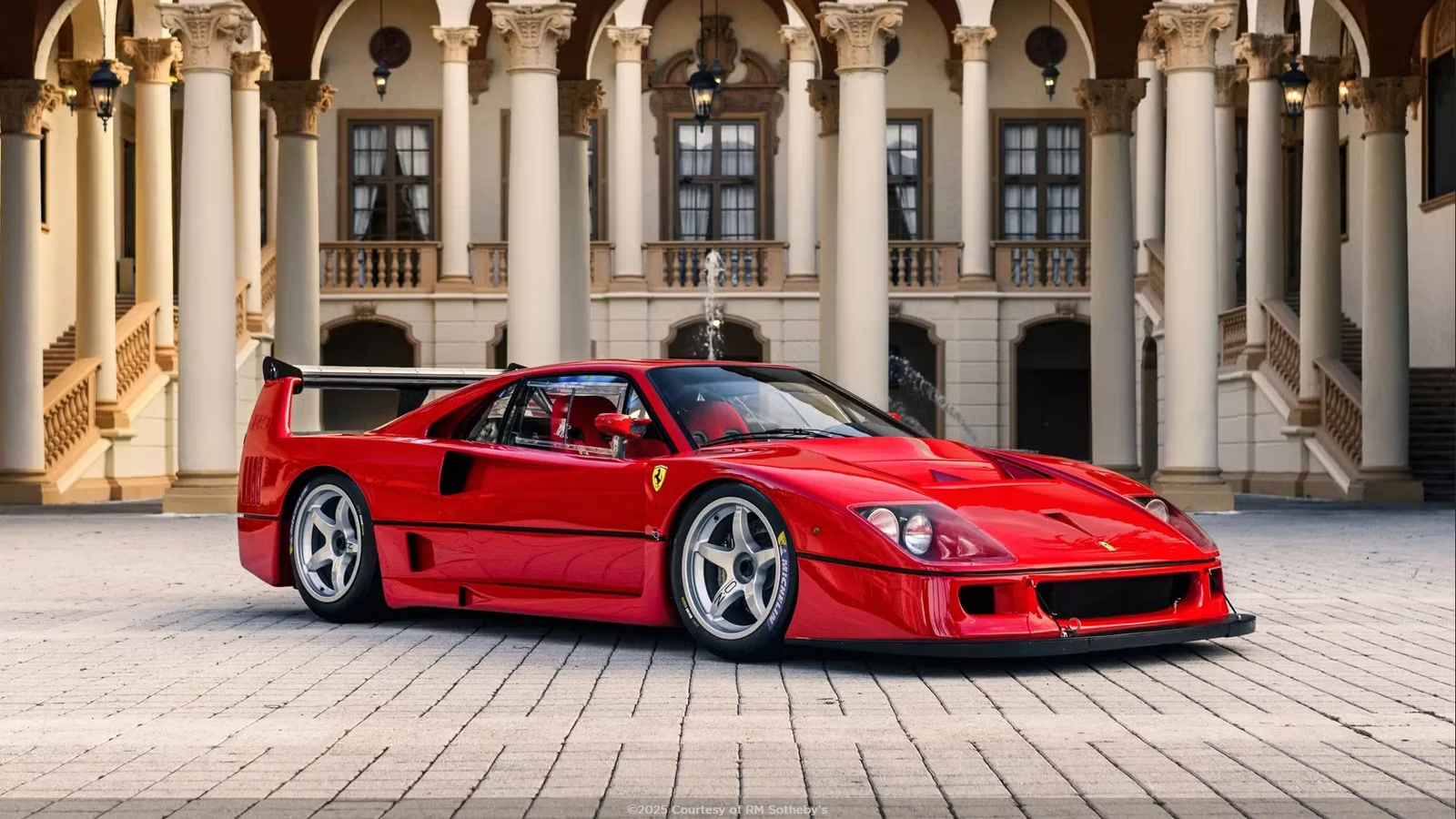
The Petersen Automotive Museum in Los Angeles opened its new “World’s Fastest” exhibit this week, and the debate started almost immediately. Eight cars fill the gallery, each staking a claim to a different version of the same title—and that deliberate ambiguity is the whole idea.

The exhibit, which opened July 16, doesn’t pretend there’s one definitive fastest car. Instead, it leans into the argument: fastest at what, exactly? Top speed? Zero to 60? A quarter-mile? A closed circuit? The answers change depending on which metric you choose, and the Petersen’s curators made that tension the centerpiece rather than trying to paper over it.
Eight Cars, Eight Different Definitions Of Speed
The exhibit’s core insight is that “fastest” fractures into distinct categories the moment you look closely. A car that holds the top-speed record—the kind set on a closed runway or salt flat—is almost never the same car that wins a 0-60 drag race or posts the quickest quarter-mile. And neither of those is likely to hold the outright lap record at a demanding road circuit.

The Petersen leaned into that split rather than forcing a single winner. Each of the eight cars on display represents a category where it genuinely leads, which means the exhibit is less a ranking and more a taxonomy of speed. That framing is smart: it sidesteps the impossible task of declaring one car the fastest full stop, while still giving each entry a legitimate claim to its corner of the title.
One of the more pointed curatorial choices was grappling with what counts as a production car. The Autoweek feature tied to the exhibit’s opening notes that the museum had to draw a line between production cars, limited-run homologation specials, and outright prototypes—a distinction that immediately excludes or includes very different machines depending on where you draw it.
The Curatorial Tension: Who Didn’t Make The Cut

Any exhibit with a hard cap of eight cars is going to leave notable contenders outside the ropes, and that’s where the real argument lives. The McLaren F1 is a useful illustration of the problem. More than three decades after its debut, the BMW-powered coupe still holds the record as the world’s fastest naturally aspirated production car—a category the exhibit may or may not have carved out space for. Whether it appears in the gallery or not, its absence from any “fastest” conversation is hard to justify without a careful definition of terms.
The broader issue is that speed records are a moving target, and some of the most credible claimants exist in awkward categories. Hypercars like the Bugatti Chiron Super Sport 300+ and the Koenigsegg Jesko Absolut have posted or targeted top speeds above 300 mph, but those runs involve specific conditions—closed roads, particular fuel, sometimes a single direction average—that complicate direct comparisons. Meanwhile, purpose-built electric machines have rewritten the 0-60 benchmark in ways that would have seemed implausible a decade ago.
The exhibit doesn’t try to resolve those disputes. It acknowledges them, which is arguably more honest than a clean top-eight list would be.
Why A Museum Is The Right Place For This Argument

Speed record debates usually live on forums and in comment sections, where they generate heat but rarely light. Putting the argument inside a museum changes the dynamic. The Petersen is giving physical form to a conversation that’s usually abstract—here are the actual cars, in the same room, each with a documented claim.
That approach also reflects how the Petersen has operated in recent years. The museum has built a reputation for exhibits that use specific cars to open broader questions about automotive culture and history, rather than simply displaying hardware. “World’s Fastest” fits that pattern: the eight cars are the hook, but the real exhibit is the question underneath them.
For visitors who already know their way around speed records, the exhibit offers something to push back against—a curatorial position to argue with. For those newer to the subject, it’s a clean entry point into why “fastest” is more complicated than it sounds. Either way, the Petersen seems to have calculated that a little productive controversy is better than a safe, uncontested display.
The “World’s Fastest” exhibit is open now at the Petersen Automotive Museum in Los Angeles. Whether you agree with all eight selections or show up ready to argue about the ones that didn’t make it, that’s probably exactly the reaction the curators were hoping for.
Source: Petersen Automotive Museum

Related posts





Latest Post


No Comments