
The Suzuki Two-Stroke So Violent It Forced Motocross To Rewrite Its Rules
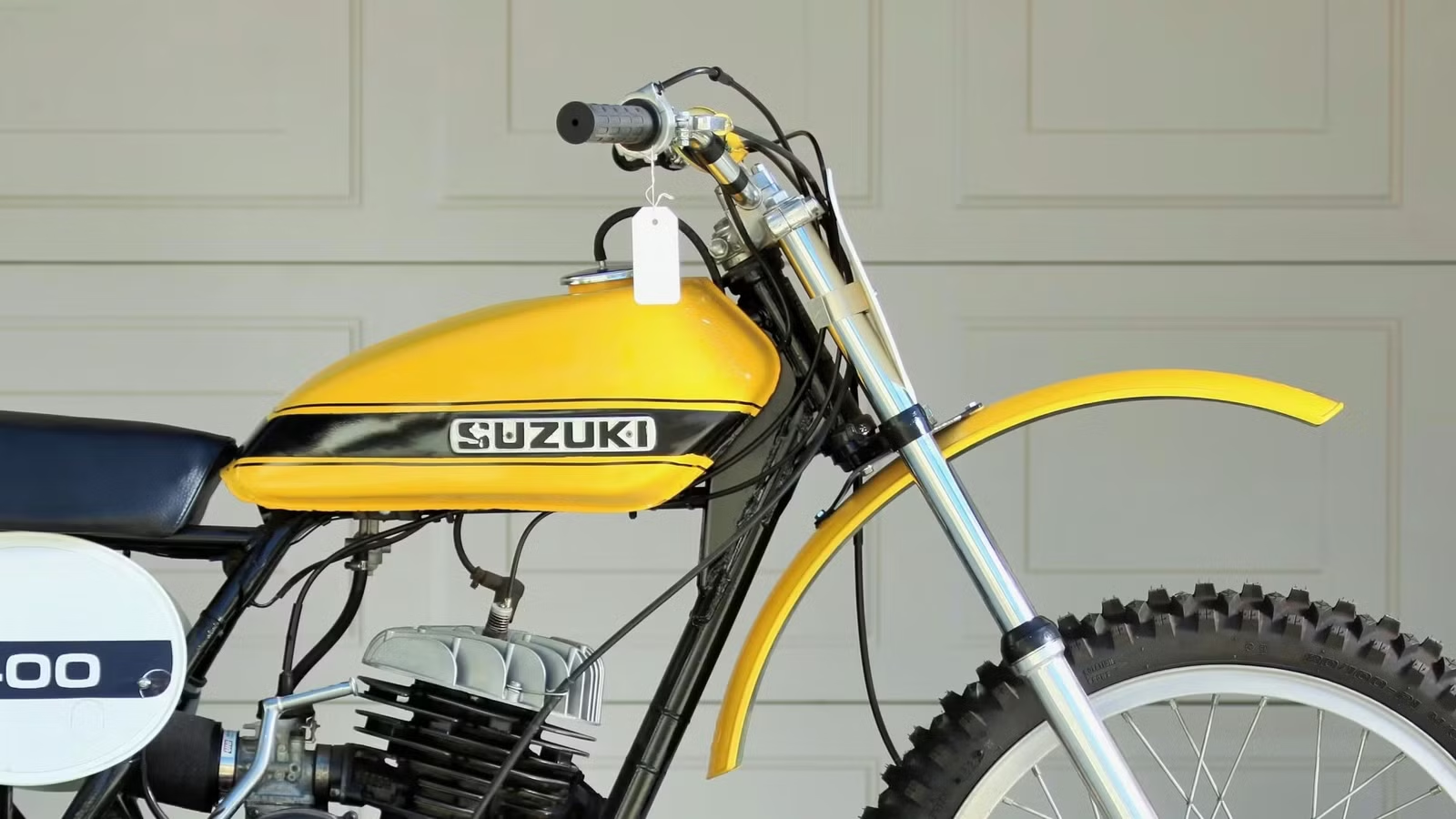
By the early 1970s, motocross had turned into an open arms race. Factories chased bigger horsepower numbers every season, but frame design, suspension theory, and ignition systems had not caught up to what the engines could suddenly produce. Suzuki entered that fight determined to make a statement. What almost nobody outside the factory understood yet was how badly the power on offer and the hardware meant to control it had been mismatched, and one rider was about to find out the hard way.
When Horsepower Outran the Chassis

Two-stroke engines were the reason motocross exploded in popularity through the late 1960s and early 1970s. They were light, cheap to build, and capable of producing far more power per pound than the four-stroke singles that had dominated off-road racing a decade earlier. Every major manufacturer wanted a slice of that momentum, and Japanese factories in particular saw an opening to challenge the European brands that had defined the sport for years.
The problem was that engine output was climbing faster than the rest of the motorcycle could keep pace. Ignition systems were still largely mechanical and imprecise, suspension technology had not yet embraced the progressive damping curves that would later become standard, and frame designers were still guessing at how much flex a chassis could tolerate under sudden, explosive power delivery. Somewhere in that gap between ambition and engineering, one factory built a machine that pushed every one of those weaknesses to its breaking point.
The Machine Riders Learned to Fear


Word about the new machine spread quickly once it reached dealerships and race tracks. Riders who expected a giant killer got exactly that in a straight line, where the engine pulled harder than almost anything else in its class. The trouble started the moment the throttle opened over rough terrain, where the power arrived with no warning and the chassis had nothing left in reserve to absorb it.
Testers who rode the bike back to back with rivals came away rattled rather than impressed. Riders described being thrown sideways out of corners, forearms cramping from fighting the machine for twenty minutes at a time, and a general sense that the bike was actively working against them rather than with them. A reputation like that does not build slowly. Within a single season, this machine had become the one nobody wanted to be handed at a demo day.
Meet the Suzuki TM400 Cyclone

The bike behind that reputation was the Suzuki TM400 Cyclone, introduced in 1971 as Suzuki’s flagship open class motocrosser. It ran a 396cc air-cooled two-stroke single producing roughly 39 horsepower at 6,500 rpm and about 33 lb-ft of torque, packaged into a machine that weighed close to 230 lbs. On paper, that combination should have made the TM400 a serious weapon against the best European open class bikes of the era. The irony is that Suzuki marketed its electronic ignition system, badged Pointless Electronic Ignition, as a rider-friendly upgrade that removed the hassle of manually adjusting ignition timing, a claim the company made outright in its own archived spec sheet. In practice, that same system became the single biggest reason the TM400 earned its fearsome reputation.
The Pointless Electronic Ignition was designed to hold a mild retard for easy starting, then advance smoothly as engine speed climbed. Instead, it jumped from retard straight to full advance at roughly 4,000 rpm with no graduation at all, and the exact rpm it fired at shifted depending on engine temperature, so riders could never predict the moment it would hit. A contemporary road test summed up the sensation bluntly, describing it as “hitting a light switch, rather than rolling on a throttle.” Making matters worse, the TM400 used half-circle flywheels rather than full-circle units, which lacked the rotating mass to smooth out those violent power pulses, so the hit landed instantly rather than building progressively. The rear shocks compounded the problem with a 50/50 compression-to-rebound damping curve, essentially the same setup found on a passenger car of the era, which meant the suspension could not absorb the sudden power delivery even when the ignition behaved itself.
How Privateers Fixed What Suzuki Would Not

Suzuki never substantially revised the TM400’s underlying problems during its production run, so the fix fell to privateers and tuners. The most effective cure was swapping the troublesome PEI system for an older points and magneto ignition, borrowed from the TS400 enduro model, which restored a predictable advance curve. Riders also bolted on heavier flywheels to smooth power delivery, replaced the stock shocks with Koni units offering a more progressive damping curve, and in extreme cases fitted entirely aftermarket frames to correct the chassis flex. None of it was official, and none of it was cheap, but it proved the TM400’s problems were fixable with the right engineering. Suzuki just had not done that engineering before shipping the bike.
How the RM370 Rewrote Suzuki’s Playbook

Suzuki’s answer arrived in 1976 with the RM370, a machine that shared almost nothing mechanically with the Cyclone it replaced. The transmission was entirely new and built specifically around the RM370’s power delivery rather than adapted from an older design. The rear suspension used a genuinely progressive spring rate, tested in period at 90 to 200 lb per inch, delivering a soft initial stroke that firmed up as it compressed, precisely the damping behavior the TM400’s shocks never offered. The RM370 also shed weight compared to its predecessor despite carrying more suspension hardware, further tightening a power-to-weight equation that had worked against the TM400 from the start.
None of this happened by accident. The RM370 addressed the TM400’s three specific failure points directly: a smoother, more predictable ignition curve in place of the erratic PEI system, a suspension setup built around progressive damping instead of a passenger car curve, and a chassis engineered from scratch rather than patched together. This was Suzuki correcting its own mistake, not the industry rewriting its rulebook wholesale. The RM370 quickly earned a reputation as one of the best handling open class machines of its era, a complete reversal from the bike it replaced.
A Cautionary Legend That Still Commands a Following

Despite its reputation, or perhaps because of it, the TM400 Cyclone has become a genuine collector oddity rather than a bike history forgot. Surviving examples trade in a fairly modest range today, with recent comparable sale data showing prices spanning roughly $2,475 for rougher examples up to $6,592 for the cleanest surviving originals. That range reflects a bike collectors want to own for its story and its styling far more than for its manners on a track.
Compare that to the Husqvarna 400 Cross, the Cyclone’s closest contemporary rival with a nearly identical 396cc engine, roughly 40 hp, and a comparable 231 lbs dry weight. The Husqvarna built its reputation on precise handling rather than raw intimidation, and the market rewarded that difference heavily. A recently tracked sale record for an earlier Husqvarna 400 Cross closed at $14,500, more than double the ceiling of even the best TM400. The gap is not really about rarity. It is about which bike riders trusted, and which one they were simply relieved to survive.
Sources: Off-Road.com, Classic.com, Mecum.

Related posts




Latest Post


No Comments