
The Only Two American Cars That Can Leave The 2025 Corvette ZR1 In The Dust
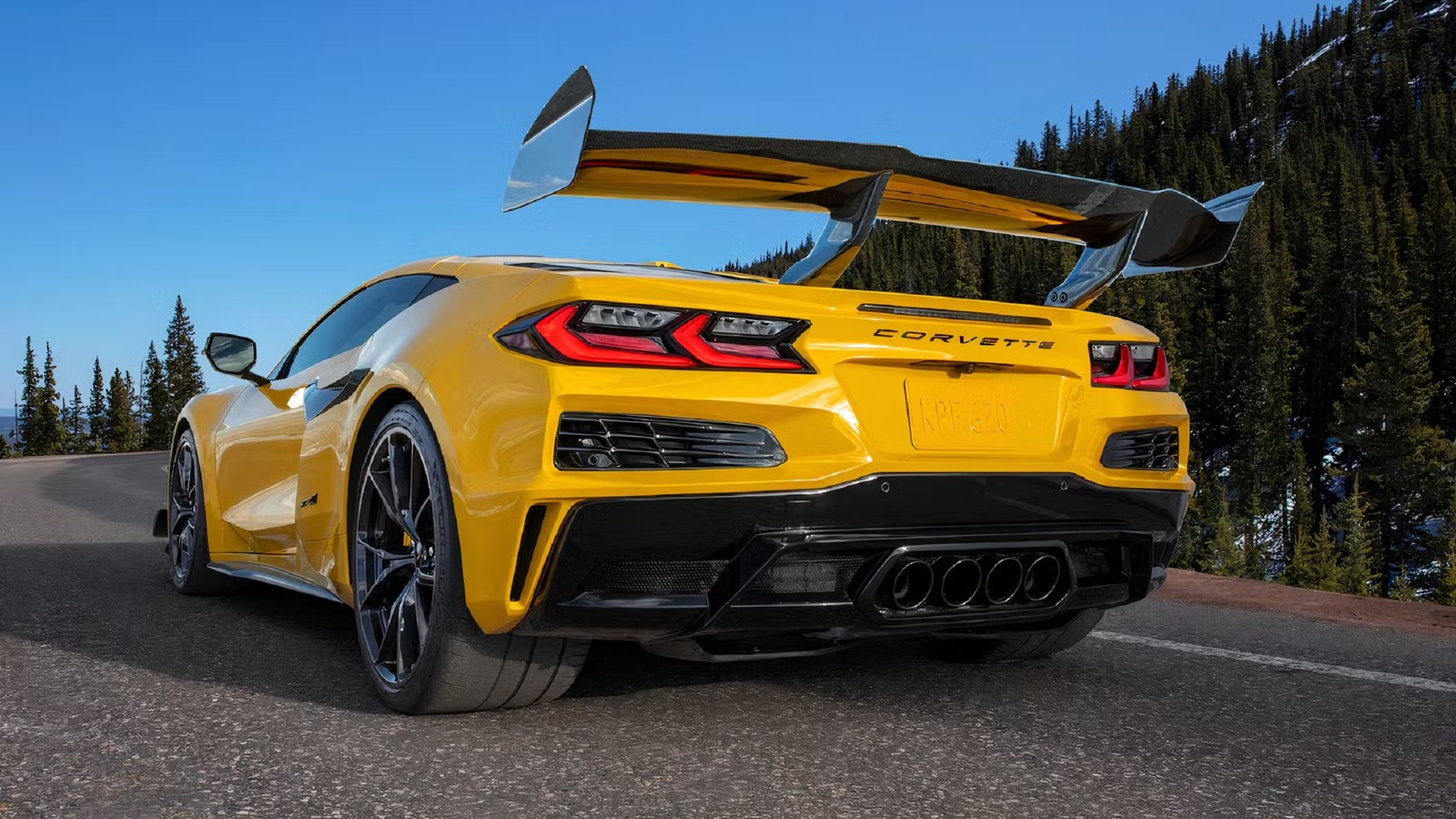
The 2025 Chevrolet C8 Corvette ZR1 is the first Corvette to use turbochargers from the factory. The C8 ZR1 is the fastest and most powerful Corvette ever built, and GM’s engineers didn’t start from scratch to get there. They took the Z06’s 5.5-liter flat-plane-crank V8 — already the most powerful naturally aspirated V8 in the world — strapped twin turbochargers to it, and unleashed something genuinely extraordinary.

Equipped with a more aggressive aero package than the C8 Corvette Stingray, E-Ray, and Z06, the ZR1 is the most track-focused model in the lineup. Chevrolet claims the ZR1 is the fastest car that costs less than $1 million, having set a top speed of 233 mph. The automaker also asserts that the ZR1’s twin-turbo V8 is the most powerful V8 ever produced by an American brand in series production.
Even with a staggering horsepower figure, there are two American hypercars that are faster and more powerful than the ZR1. They don’t come in under $1 million — not even close — but that’s the price of admission if you want to leave a C8 ZR1 behind.
The Hennessey Venom F5 Claims A 328-MPH Top Speed
Specs Comparison
 66 autotech Corvette ZR1 |
Hennessey Venom F5 |
|
|
Engine |
5.5-Liter Twin-Turbo V8 |
6.6-Liter, Twin-Turbo V8 |
|
Transmission |
8-Speed DCT |
7-Speed Automated Manual / 6-Speed Manual |
|
Horsepower |
1,064 HP at 7,000 RPM |
1,817 HP at 8,000 RPM |
|
Torque |
828 LB-FT at 6,000 RPM |
1,193 LB-FT at 5,000 RPM |
|
0-60 MPH |
2.5 Seconds (HC est.) |
2.5 Seconds |
|
Top Speed |
233 MPH |
328 MPH (Claimed) |
|
Dry Weight |
3,670-3,758 LBS |
2,998 LBS |
Chevrolet, Hennessey
The Hennessey Venom F5 is more powerful and faster than the C8 Corvette ZR1. The ZR1 uses the LT7 5.5-liter V8 fitted with two large turbochargers, producing 1,064 hp and 828 lb-ft of torque — enough to make it the most powerful Corvette in history. The ZR1 is available exclusively with an 8-speed dual-clutch automatic. Chevrolet estimates a sub-10-second quarter-mile time, though an official 0–60 mph figure has not been published. GM has confirmed a top speed of 233 mph.
The Hennessey Venom F5 relies on a larger 6.6-liter twin-turbo V8 that produces 1,817 hp and 1,193 Nm of torque. A 7-speed automated manual is standard, but buyers can also opt for a 6-speed manual for a more engaging experience. Unlike the ZR1, the Venom F5 claims a 0–60 mph time of just 2.5 seconds. The F5’s theoretical top speed exceeds 320 mph, and it set a verified record of 270 mph during development — already 37 mph quicker than the ZR1.
Extensive use of carbon fiber keeps the Venom F5’s curb weight to just 2,998 lbs, making it significantly lighter than the ZR1, which weighs between 3,670 and 3,758 lbs depending on configuration. That said, the ZR1 was never engineered as a low-drag top-speed machine. It is instead a track-focused apex predator built to carve corners and set fast lap times.
The SSC Tuatara Can Reach 295 MPH

Specs Comparison
|
Corvette ZR1 |
SSC Tuatara |
|
|
Engine |
5.5-Liter Twin-Turbo V8 |
5.9-Liter, Twin-Turbo V8 |
|
Transmission |
8-Speed DCT |
7-Speed Automated Manual |
|
Horsepower |
1,064 HP at 7,000 RPM |
1,350 HP / 1,750 HP (E-95 Flex Fuel) / 2,200 hp (Methanol) |
|
Torque |
828 LB-FT at 6,000 RPM |
984 LB-FT / 1,322 LB-FT (E-85 Flex Fuel) / 1,604 LB-FT (Methanol) |
|
0-60 MPH |
2.5 Seconds (HC est.) |
2.5 Seconds |
|
Top Speed |
233 MPH |
295 MPH |
|
Dry Weight |
3,670-3,758 LBS |
2,750 LBS |
Chevrolet, SSC
The second American car that outpaces the C8 Corvette ZR1 is the SSC Tuatara. The ZR1’s 1,064 hp and 828 lb-ft of torque are genuinely impressive numbers — but the Tuatara’s figures are in a different stratosphere entirely.
SSC fits the Tuatara with a 5.9-liter twin-turbo V8 — larger than the ZR1’s unit, though still smaller than the Venom F5’s. On 91-octane pump gas, the Tuatara produces 1,350 hp and 948 lb-ft of torque. Switch to E85 and output climbs to a staggering 1,750 hp and 1,322 lb-ft. On methanol, the engine is said to exceed 2,200 hp and 1,604 lb-ft — though in that configuration the car is no longer road-legal.
On the road, the Tuatara matches the Venom F5 with a claimed 0–60 mph time of 2.5 seconds. SSC’s first top-speed record attempt was mired in controversy, but a second, independently verified run settled the matter: the official top speed of the Tuatara stands at 295 mph — 62 mph beyond what the ZR1 can achieve.
The Tuatara is also considerably lighter than the ZR1, and its bodywork is shaped entirely around achieving maximum velocity. That means an extremely slippery aerodynamic profile, resulting in a drag coefficient of Cd=0.279. The Corvette ZR1 takes the opposite philosophy, prioritizing downforce over drag reduction. Chevrolet claims the ZR1’s carbon fiber aero package generates over 1,200 lbs of downforce at top speed.
The C8 Corvette ZR1 Is The Fastest Car Under $1 Million

Price Comparison
|
Model |
Price |
|
C8 Corvette ZR1 |
$180,000-$205,000* |
|
Hennessey Venom F5 |
$1,600,000-$2,100,000 |
|
SSC Tuatara |
$1,900,000+ |
Even as a corner-carving track weapon, the C8 Corvette ZR1 managed a remarkable 233 mph top speed. Chevrolet has not published an official MSRP, but the ZR1 is expected to start in the range of $180,000–$205,000 — a figure that cements its claim as the fastest production car under $1 million. The Venom F5 and SSC Tuatara are quicker and more powerful, but their price tags are in an entirely different league, both pushing well past the $1 million threshold.
The Hennessey Venom F5 debuted with a starting price of around $1.6 million and has since climbed to approximately $2.1 million before options. The SSC Tuatara starts at roughly $1.9 million, and a fully optioned build will likely push past $2 million.
Both the Venom F5 and the SSC Tuatara are engineered with an eye toward 310 mph — the rough equivalent of 500 km/h. Hennessey and SSC, alongside boutique hypercar makers like Koenigsegg with the Jesko Absolut, have designed cars with theoretical top speeds of over 300 mph. The barrier to actually achieving those numbers, however, remains tire technology, which has yet to catch up with the ambitions of the engineers.
Sources: Chevrolet, Hennessey, SSC.

Related posts



Latest Post


No Comments