
The Suzuki Sports Bike That Quietly Offers The Best Value In Its Segment
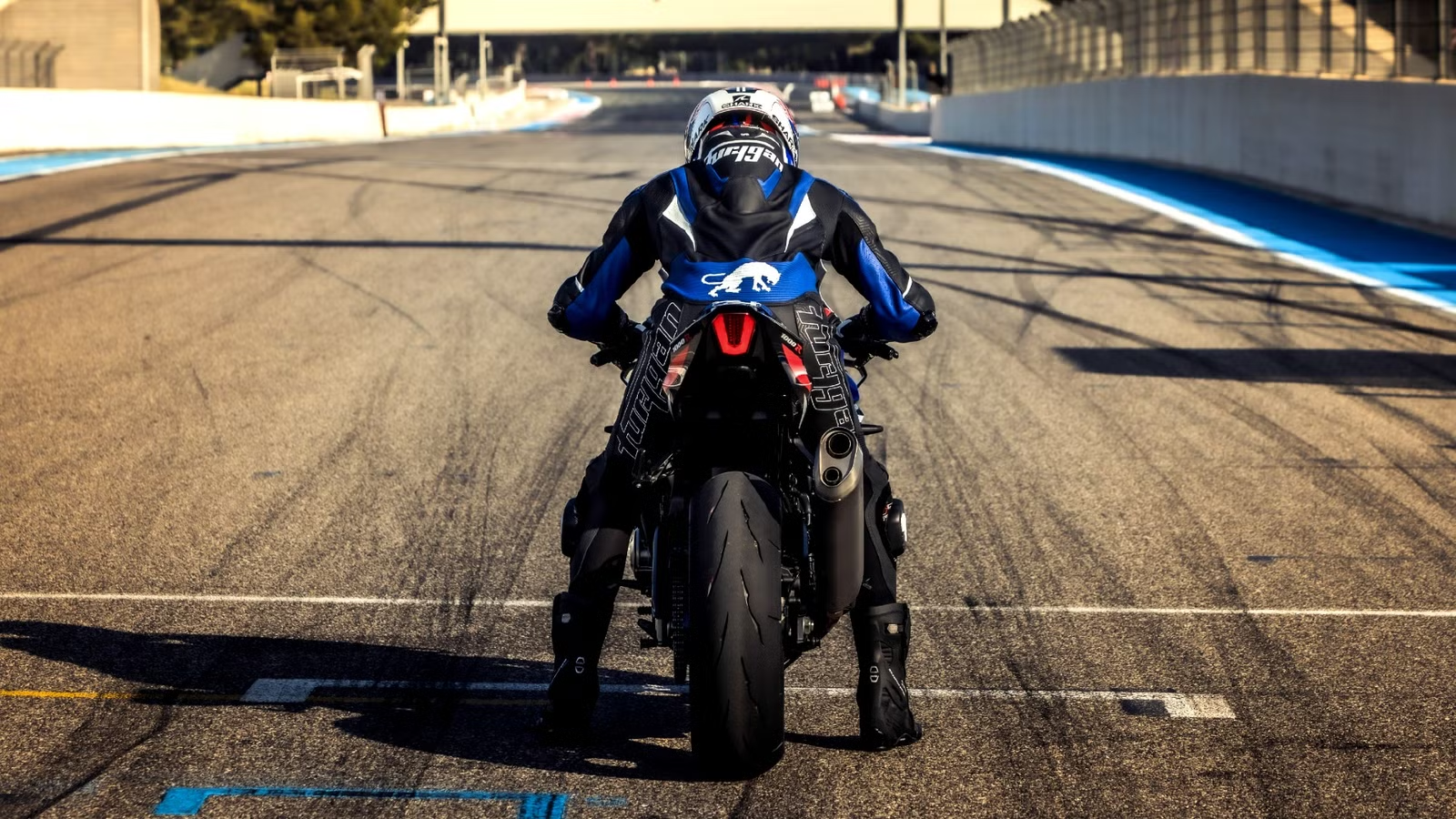
We all know Suzuki as a simple brand that focuses on selling large numbers of well-priced machines rather than whipping up unattainable exoticas. It applies that approach to nearly all of its machines, including the illustrious GSX-R lineup. Ever since their inception, Suzuki GSX-Rs have always tried to boast competitive MSRPs in their respective segments.

Sure, they might not be the cheapest, but they are certainly among the cheapest. The value prospect has always been high, too. Things aren’t all that different in 2026, either. All Suzuki sports bikes on sale offer brilliant value at attainable prices, whether it is the puny MY25 GSX-250R or the 1,340cc Hayabusa. One truly leads the way in terms of value, though, and it happens to be newest GSX-R worldwide.
The Suzuki Sports Bikes Lineup Is Competitively Priced In The US
If you look at Suzuki’s MY26 sports bike lineup, it starts with the GSX-8R. That’s a brand-new product from the company, launched just a couple of years ago in 2024. It’s priced at $9,699, which is right in the ballpark of rivals from Yamaha and Honda. Up next are the GSX-R600 and GSX-R750.


Both of these belong to the OG era of middleweight supersports and remain capable as ever if you’re into such bikes. But they haven’t had any updates in 15 long years. No new electronics, no facelifts, and no engine updates. That helps them bear competitive prices, again putting them in the ballpark of their rivals from other Japanese brands.

At the top of the lineup is the world-renowned Hayabusa. It is priced at $19,699, which is somewhat high by liter-class sports bike standards. But this isn’t a liter-class machine and rivals a niche segment, comprising the likes of the near-$18,000 Kawasaki Ninja ZX-14R. Considering the 14R hasn’t had updates since 2012, the much more modern Busa justifies the moolah well.
As good as all these are, neither of these offers segment-defining value today. For that, you need to look at Suzuki’s most powerful superbike right now. It beats all of its rivals by being the most affordable machine in its class and cheaper than its own previous model, while still bringing updates for the latest model year. Oh, and it comes in three variants, so there’s something for everyone.
Suzuki’s GSX-R1000 Quietly Offers The Best Value In Its Segment

Enter the GSX-R1000. Suzuki has priced the superbike at an astonishingly low $16,399 base MSRP–$100 less than the outgoing model. That makes the Gixxer cheaper than all of its rivals. The closest attack comes from the $16,999 Kawasaki Ninja ZX-10R and $17,099 Honda CBR1000RR, whereas more premium bikes like the Yamaha YZF-R1, BMW S 1000 RR, and Aprilia RSV4 are simply well over $19,000. Considering the Gixxer recently underwent notable updates, this quietly offers the best value in its segment.
There Are Three GSX-R1000 Variants On Offer

Coming to variants, the incredibly high-value GSX-R1000 serves as the base bike. Then comes the GSX-R1000R, priced at $17,939—$700 cheaper than the previous GSX-R1000R. The extra ‘R’ brings with it more premium suspension from Showa for better racetrack abilities. At the top of the lineup is the new-for-2027 GSX-R1000RS, selling for $18,639. This is essentially the GSX-R1000R, topped with carbon fiber winglets and a rear seat cowl.
As for colors, you get a total of three options, spread between the variants. They include:
- Candy Daring Red (GSX-R1000R and GSX-R1000RS)
- Pearl Vigor Blue (GSX-R1000, GSX-R1000R, and GSX-R1000RS)
- Pearl Ignite Yellow (GSX-R1000)
A Deep Dive Into The Updated Suzuki GSX-R1000

Nailing the price is half the battle won. The other half of the argument requires quality equipment, a powerful engine, and likable features to make a solid case in the superbike class. Lucky for you, the Gixxer 1000 promises all of that post its recent updates. Here’s a lowdown.
VVT-Equipped Inline-Four Engine With Revamped Internals

The GSX-R1000 has had a unique inline-four engine since 2017, thanks to its mechanical variable valve timing setup derived from MotoGP. This mill has not only proven to be highly reliable under stress, but it also promises a spread of power most of its rivals can’t match. In 2026, Suzuki has fine-tuned things for even better reliability and performance under stress. Some of the updates comprise:
- New crankshaft with thicker journals
- New crankcases
- Wider cam chain
- New head gasket
- New piston circlips
- Revised head gasket shape
- New single-stage funnels for first and fourth cylinder
- Higher compression ratio
As for numbers, the output is said to be 193 horsepower and 81 pound-feet at 13,200 RPM and 11,000 RPM, respectively. Yes, this is down from the previous 199 HP figure, but that’s because the new engine is tuned to meet stricter EU5 emission norms. We all know these strangle an engine’s performance (the same happened with the new ZX-10R not long ago).
Updated Engine Works In Tandem With Updated Electronics

Like the engine, the electronic have gone under the knife. A new six-axis IMU serves as the centerpiece here and helps the ECU make better judgements on the limit. At the same time, Suzuki claims the traction control (10 modes), wheelie control, cornering ABS, and roll-torque control have all been updated for 2026. A revamped launch control system and two-way quickshifter round things off. Small touches like a Low RPM Assist and Easy Start System round things off.
A bummer, however, is the cockpit experience. You still get the ancient-looking inverse LCD in a segment where all of its rivals have bright colored TFT displays. Even Suzuki’s own budget bikes–GSX-8S, SV-7GX, V-Strom 800–have TFTs. The LCD also means no smartphone connectivity, even as an optional extra.
The Underpinnings Are Carried Over From The Previous Model

We’re talking about the underpinnings last because you’ll find barely any changes here over the 2025 GSX-R1000. So the bike is still built around an aluminum perimeter frame, nestled on Showa 43 mm Big Piston forks and a Showa monoshock. Both are fully adjustable. The ‘R’ model ups the ante with Balance Free forks up front and a Balance Free Rear Cushion Light (BFRC-lite) monoshock.

Shared between the variants is a set of 17-inch wheels. These have dual 320 mm disc brakes up front and a 220 mm rear disc, where the front has Brembo monoblock calipers. They are the same calipers as before, and we feel Suzuki should’ve updated them to Stylemas (just like Yamaha did on the R1).
Since the underpinnings are largely the same, the dimensions aren’t too different either. This remains a little heavy but friendly machine. Some key numbers include:
- Weight: 447 pounds
- Seat height: 32.5 inches
- Wheelbase: 55.9 inches
- Ground clearance: 5.1 inches
Source: Suzuki Cycles

Related posts

Latest Post


No Comments