The Driver’s Car That Doesn’t Need Big Horsepower To Feel Special
8 minutes reading
Friday, 19 Jun 2026 13:00 0 107 autotech
The modern performance car is suffering from an identity crisis. In a desperate bid to win the spec-sheet wars, manufacturers have engineered vehicles that are faster, wider, and infinitely more complex than ever before. Yet, as zero-to-60 mph times tumble into territories once reserved for hypercars, the visceral joy of driving is evaporating.
True driving pleasure does not require multi-stage hybrid systems, heavy battery cells, or high triple-digit power outputs that can only be legally exploited on a closed circuit. Instead, the ultimate automotive fulfillment comes from a return to minimalist engineering, where the driver (not a collection of microprocessors) is the central component of the experience. In a world where modern sports cars have grown heavier, wider, and overly reliant on digital driver aids and high-output engines, enthusiasts will agree that true driving pleasure requires a return to minimalist engineering.
Modern performance cars use brute force to mask their weight, creating speeds that can only safely be used on a track rather than an engaging mountain pass. Modern electronic power steering, heavy battery packs, and intrusive advanced driver-assistance systems (ADAS) dull the sensory connection between the driver and the asphalt.
The Insulation Of Digital Assist Tech
Mercedes-AMG C 63 S E Performance drifting at the trackMercedes-Benz
Massive power requires aggressive traction control and complex electronic intervention, with torque-vectoring differentials and active anti-roll bars working constantly to keep the car on the road. These systems process the road surface first, altering the vehicle’s trajectory and creating a distinct digital barrier between the driver and the tarmac. As a result, the driver ends up managing the electronics rather than directly managing the chassis’ mechanical grip, ultimately taking away from the pure driving pleasure and engagement offered by a more analogue sports car, such as this driver’s car, which doesn’t rely on high outputs to feel special.
The Sports Car That Aged Better Than Its Rivals
This aging Japanese roadster still looks young and fresh.
The Power Of Less: The Mazda MX-5
The Magic Of A Balanced Power-To-Weight Ratio
Front 3/4 shot of 2026 Mazda MX-5 Miata RF in white parkedIan Wright | CarBuzz | Valnet
The MX-5 is the ultimate proof that you don’t need a massive engine when your total vehicle weight sits around 2,400 pounds, depending on which version you choose. Because of its featherweight, it bypasses the need for heavy braking systems, stiff suspension components, and massive wheels. The MX-5’s low mass creates a virtuous cycle: less weight requires less power, which allows for a smaller engine and fuel tank, keeping the overall package incredibly agile.
Base Trim Engine
2.0-liter I4
Base Trim Transmission
6-Speed Manual
Base Trim Drivetrain
Rear-Wheel Drive
Base Trim Horsepower
181 HP @7000 RPM
Base Trim Torque
151 lb.-ft. @ 4000 RPM
Make
Mazda
Model
MX-5 Miata
Segment
Sports Car
At the heart of Mazda’s MX-5 design is Jinba-ittai, meaning “horse and rider as one.” This idea of oneness of car and driver formed the guiding philosophy and internal mantra used by Mazda engineers to design the original Miata introduced in the late 1980s. The philosophy dictates that a car should not be merely used as a tool, but rather as a natural extension of the driver’s own body. To achieve this connection in the MX-5, Mazda focused on tactile feedback, a near 50:50 weight distribution, intuitive handling, and a manual transmission that feels like a direct mechanical extension of the arm.
The ND3 Evolutionary Step
2024 Mazda MX-5 EngineWilliam Clavey | TopSpeed
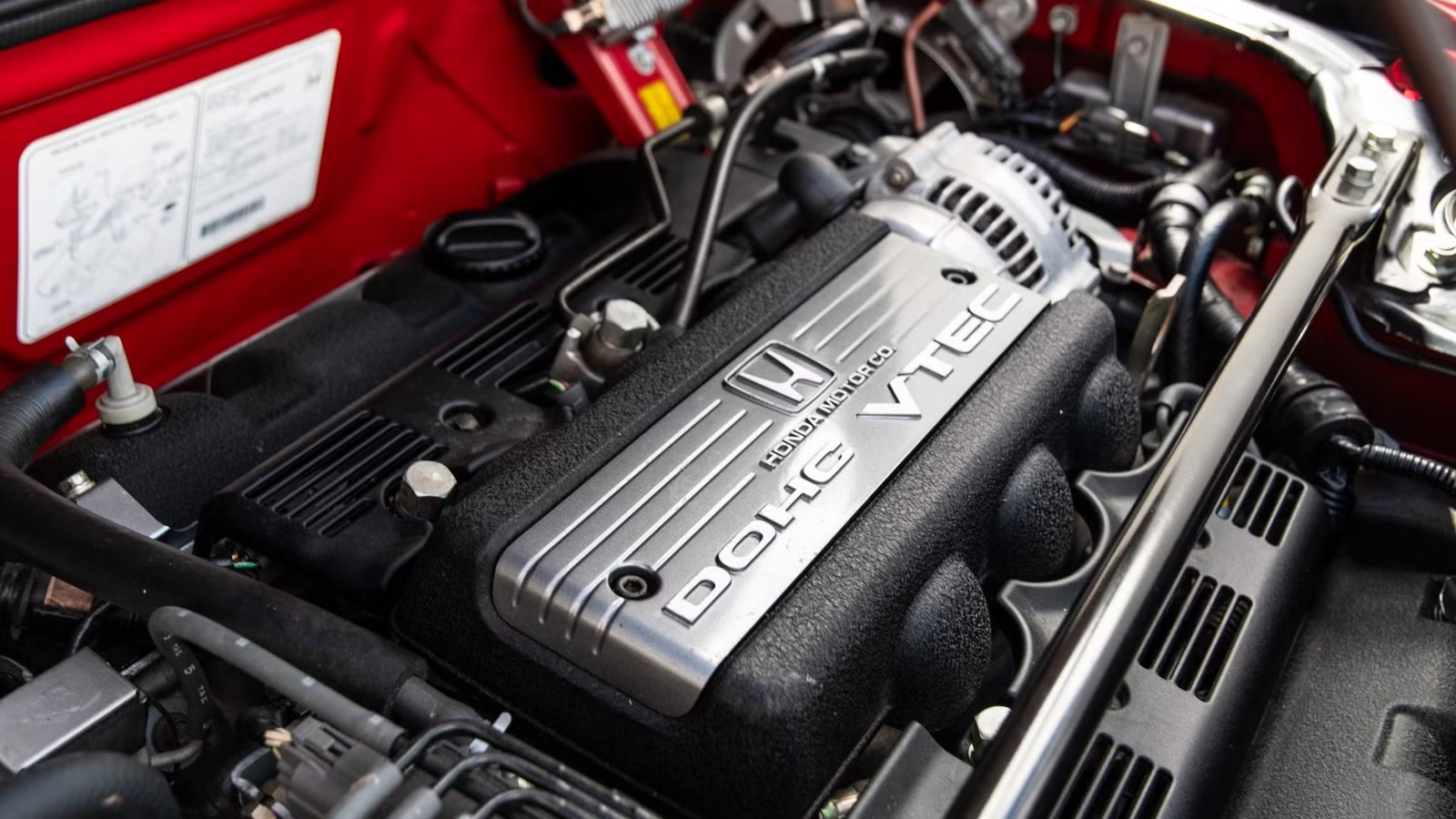
The latest iteration of the MX-5 is powered by a 2.0-liter Skyactiv-G engine, producing 181 horsepower at 7,000 rpm and 151 pound-feet of torque at 4,000 rpm. In a sports car like the MX-5, the joy comes from extracting every single horsepower near the redline rather than relying on low-end turbocharger surge. Some of the latest updates the ND3 introduced include the revised electric power steering rack for sharper feedback and the razor-sharp throttle response of the naturally aspirated 2.0-liter Skyactiv-G engine.
Which Miata Is Right for You? A Look at Every Generation
Most of us love the Mazda Miata, but which of the four generations is right for you? We look at each generation to help you decide.
What Makes The MX-5 Special
The Three-Pedal Romance
Red 2025 Mazda MX-5 Miata Driving ShotMazda
In an era dominated by hyper-fast dual-clutch gearboxes and single-speed electric vehicles, the MX-5 remains a rare, uncorrupted sanctuary for the purist. It stands as one of the very last internal combustion sports cars on the market to proudly offer a traditional manual transmission. This isn’t just about nostalgia; it’s about mechanical intimacy.
The Skyactiv-MT six-speed gearbox features a remarkably short, rifle-bolt throw that requires a deliberate, satisfying flick of the wrist to swap cogs. Paired with a finely balanced clutch pedal that communicates its bite-point directly to your left foot, the act of shifting becomes a rewarding loop of driver interaction. Mazda’s engineers intentionally spaced the pedal box to permit effortless heel-and-toe downshifts, ensuring that even a routine deceleration into a suburban intersection provides a small hit of motorsport-derived dopamine.
When a chassis only has to manage a sub-2,500-pound curb weight, the entire dynamic conversation shifts from managing mass to exploiting agility. The ND3 iteration emphasizes this through its new Asymmetric Limited-Slip Differential. By utilizing a lightweight conical clutch mechanism with distinct cam angles for acceleration and deceleration, the differential increases its lockup under engine braking. This technical addition stabilizes the rear axle during trail braking and turn-in, preventing nervous lift-off oversteer without compromising the car’s inherent agility.
Because you sit mere inches above the tarmac on progressive 205/45 R17 tires, speed is felt rather than just observed on a digital display. The MX-5 communicates chassis deflection, slip angles, and changing grip levels directly through your hips and palms, making a legal 40 mph drive down a twisty back road feel far more dramatic and immersive than doing 100 mph in an insulated, high-horsepower luxury cruiser.
The Bulletproof Sports Car You Can Actually Daily Drive
This German coupe is built to last with the if you properly maintain it.
A minimalist vehicle footprint requires uncompromising sacrifices that directly affect daily usability. To preserve the roadster’s featherweight status, Mazda omitted heavy insulation and thick acoustic barriers. The result is a cabin that suffers from pronounced tire roar, mechanical hums, and wind buffering at highway speeds, which can quickly induce fatigue on long cross-country hauls.
Furthermore, the space constraints are absolute. The boot offers a highly restrictive 4.59 cubic feet of volume, which is barely enough for two soft weekend bags, and the cabin leaves very little room for storage or taller occupants, who will find their knees pressed against the dashboard and their heads brushing the soft-top mechanism. The driver’s cluster also remains resolutely analog, completely lacking a modern digital speedometer readout.
Specification
Real-World Limitation
Curb Weight
~2,400 pounds
Total lack of heavy, noise-isolating sound deadening
Boot Capacity
4.59 cubic feet
Restrictive storage; limits touring to soft carry-on bags
Tire Width
205 mm
Low rotational mass, but limits absolute high-speed grip
Standing Alone In A Complex Market
The modern automotive landscape has become incredibly hostile toward the affordable, rear-wheel-drive sports car. Over the last decade, tightened emissions regulations and shifting consumer tastes toward high-riding crossovers have wiped out almost all the MX-5’s traditional peer group. Former rivals have either grown bloated and prohibitively expensive or have been axed from manufacturing lineups entirely.
This leaves the Japanese roadster standing virtually alone in its specific price bracket. While modern hot hatches offer a tempting alternative on paper by boasting double the horsepower, turbocharger shove, and five-door practicality, they ultimately carry massive weight penalties and complex electronic filters. The MX-5 remains a holdout, offering an unadulterated, low-depreciation driving experience that values pure physics over digital exaggeration.
The Mazda MX-5 remains a masterclass in automotive restraint, proving that when an engineering team fiercely protects a vehicle’s mass, massive horsepower figures become completely unnecessary. By allowing mechanical purity, linear throttle responses, and genuine chassis feedback to dictate the driving experience, it achieves a level of pure driver engagement that modern hyper-sedans and heavy performance EVs simply cannot replicate. In a world obsessed with paper specifications and digital dominance, the ultimate luxury for a driving enthusiast isn’t straight-line speed; it is the unfiltered, analog connection delivered by a lightweight roadster on a winding piece of tarmac.

















No Comments