
The Most Reliable Japanese Car From 2024
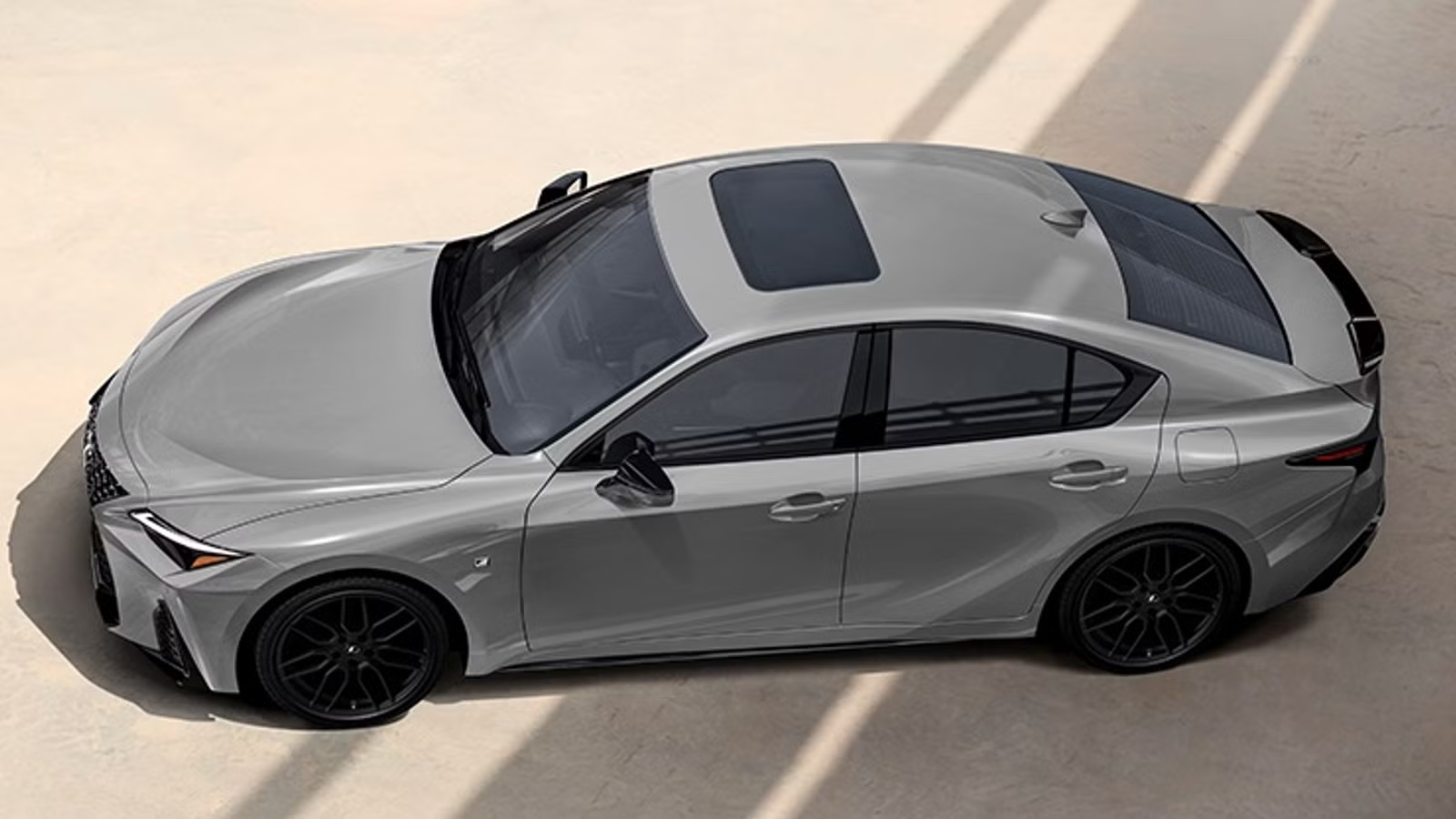
Reliability and Lexus have become nearly inseparable concepts in the automotive world — and for good reason. Decade after decade, the Japanese luxury brand has set the benchmark that rivals scramble to match. But in a segment increasingly crowded with turbocharged German sport sedans and tech-laden American entries, does Lexus still hold the crown? The answer is a resounding yes. Using J.D. Power’s 100-Point Score system, the highest-ranked compact premium car is the Lexus IS sport sedan, which earned an impressive 88/100 score — placing it at the top of its class.

That score makes the Lexus IS the highest-ranked compact luxury car on the market and the most reliable Japanese vehicle in its segment. If we are talking accolades, the Lexus IS has those in spades. Yet, is this fancy Toyota really that special? Well, the numbers don’t lie. When it comes to overall quality, driving experience, resale value, and dealership experience, few cars can go pound for pound with the Lexus IS.
Since its most recent refresh for the 2021 model year, the Lexus IS line has been dominant in its overall J.D. Power reliability rankings. We have researched countless vehicles using these rankings, and the 2022 Lexus IS is one of the few vehicles of any kind that has ever achieved a 90/100 score. This makes the 2021+ model year Lexus IS the highest-ranked Lexus car of its generation and among the most reliable Lexus models of all time.
The 2GR-FKS V-6 Engine Is As Reliable As It Gets
Lexus IS Engine Options
 28 autotech Turbocharged 2.0-L inline-four |
3.5-L V-6 |
Naturally aspirated 5.0-L V-8 |
|
|
Horsepower |
241 HP @ 5,200 RPM |
311 HP @ 6,600 RPM |
472 HP @ 7,100 RPM |
|
Torque |
258 LB-FT @ 1,650–4,400 RPM |
280 LB-FT @ 4,800 RPM |
395 LB-FT @ 4,800 RPM |
|
Transmission |
8-speed automatic w/ shift paddles |
6-speed automatic w/ shift paddles |
8-speed automatic w/ paddle shifters |
|
Fuel Economy (CMB) |
21 MPG |
22 MPG |
20 MPG |
|
0-60 MPH |
6.9 Seconds |
5.6 Seconds |
4.4 Seconds |
|
Top Speed |
143 MPH |
143 MPH |
149 MPH |
If there has ever been an appropriate use of the idiom “if it ain’t broke, don’t fix it”, it would be for describing the 2GR-FKS 3.5-liter V-6 engine found in the IS 300 AWD and IS 350 RWD/AWD models. The 2GR V-6 engine family has become the very foundation of Lexus’ famed reliability, and that fact hasn’t changed for nearly two decades. The 2GR was first used in Toyota models as early as 2005.
The 2GR-FKS V-6 Defines Reliability
The FKS variant found within the IS lineup has been used in Toyota products since 2015 and represents the most current iteration of this engine family. It may offer less peak power than some rivals in this segment, but it is the most robust. Toyota will likely continue using the 2GR-FKS at least until the end of this IS generation, which has now been in production for over a decade. Finding a suitable replacement for something so legendary in its bulletproof nature remains an open question.
Alternative Powertrain Options
The Lexus IS line is also impressive in its array of available engine configurations. You will find a 2.0-liter turbocharged inline-four in the entry-level IS 300 model and a 5.0-liter V-8 in the top-tier IS 500 models. The 2.0-liter turbocharged 8AR-FTS is a newer unit introduced in 2015, and given its more specialized application in higher-end Toyota products, its long-term robustness is still being established. The 5.0-liter 2UR-GSE V-8 found in IS 500 models, however, has long since cemented itself as the go-to high-performance V-8 engine for Lexus. You can be assured this V-8 is one of the most reliable engines on the market today.
The Lexus IS Line Is All About Balance

Although the Lexus IS line has garnered a reputation for its reliability, it is the overall package that the IS offers that is its true selling point. The Lexus IS line defines luxury without compromise. Never has the Lexus IS line been the sportiest or highest-performance option in its segment. Yet, when ranking the minimum standard across all ranking categories, it is clear that this Lexus sedan shines above its competition.
Why The Lexus IS Line Beats The BMW 3-Series
Within the compact luxury car segment, no other vehicle poses a larger threat to the Lexus IS line than the famed BMW 3-Series. Yet, year after year, the Lexus manages to beat out BMW at their own game in overall segment rankings. Lexus achieves this by delivering better overall quality, reliability, driving experience, resale value, and dealership experience. While the BMW 3-Series is unquestionably the more aptly named “sport sedan”, the Lexus IS shines precisely where the BMW falters.
The Lexus IS Line Is Flexible And Adaptable
The entry point into the Lexus IS lineup starts with the IS 300 RWD, which undercuts its direct competition — the BMW 330i Sedan — by a meaningful margin. At the upper end, the V-8-equipped IS 500 F Sport Performance commands a significant premium over the base model, yet still represents strong value compared to BMW’s M3, which delivers a similar power output at a considerably higher price. That gap is worth serious consideration if you are shopping for a daily-driven performance luxury sedan and aren’t looking to set track records.
No Lack Of Comfort or Convenience

If you are looking for the highest-performance luxury sedan on the market, it is likely to be a BMW 3-Series. Yet, if you are looking for the best overall package in that segment, it is going to be a Lexus IS. Yes, the IS 500 F Sport Performance is more than capable of lighting up the rear tires at a moment’s notice. Yet, that is probably not the reason you end up leaving the dealership with one in your possession.
The Smoothest Ride In Its Class
If we are at a racetrack, give us a BMW 3-Series. If we are anywhere else, the Lexus IS is the correct choice. The Lexus IS offers without question the most comfortable quality of ride in the segment. The seating position, the seats, and the overall road manners of the Lexus IS are second to none and remain a rare standout feature in this class.
No Lack Of Interior Quality And Features

Stepping into the interior of the Lexus IS 350 F Sport is as pleasant an experience as you could expect at this price point. All the key driver touchpoints — from the steering wheel to the shifter — are wrapped in quality perforated leather. The instrument cluster and infotainment system are as functional as they are elegant.
While we have a minor annoyance with the use of gloss black plastics for certain interior trims, the beauty of the central Lexus timepiece more than makes up for it. The Lexus IS does not lack any significant creature comforts or tech features, while maintaining high standards for convenience across the board.
The Future of The Lexus IS Line

The third-generation Lexus IS has now been available in the U.S. for over a decade. The 2021 model year brought the most significant refresh for this generation so far, and with the debut of the F Sport Performance line — headlined by the IS 500 F Sport Performance — Lexus continues to find compelling ways to keep the third-generation IS relevant and exciting.
What “F Sport Performance” Means For The Future

When Lexus introduced the F Sport Performance IS line featuring the same 5.0-liter 2UR-GSE V-8 engine found in the flagship “F” models, we were impressed. This was a bold move by the brand and remains so to this day. It is clear that Lexus recognized there was simply no other car on the market quite like the IS 500 F Sport Performance.
BMW, being Lexus’ primary competitor in this segment, hasn’t offered a naturally aspirated sport sedan with a V-8 engine in over a decade — not since the 2006–2012 E90/92 BMW M3. That makes the RWD V-8-powered Lexus IS the last of a dying breed of analog sport sedans, and it stands alone for it.
Why Compete When You Can Build Together?

Every day, somebody declares that the internal combustion engine has breathed its last. The doom-and-gloom narrative surrounding combustion engineering has never been louder in the automotive media. Yet the reality couldn’t be further from the truth. If anything, next-generation combustion engines will need to be genuinely revolutionary to earn mainstream adoption alongside electrification.
What we are witnessing right now is some of the most powerful, efficient, and reliable performance engineering ever produced. Just as BMW and Toyota’s engineering prowess came together for the GR Supra, these kinds of collaborations will define the future of automotive development. With the Lexus IS serving as one of the brand’s most flexible platforms, it is well positioned to be a front-runner for future engine and technology advancements within the Lexus lineup.
Sources: Lexus, Toyota, J.D. Power

Related posts




Latest Post



No Comments