
Hudson’s Inline-Six Made NASCAR Rewrite Its Rulebook
The early 1950s stock-car landscape was the playground for Detroit’s emerging V8 engines. The NASCAR template was simple: big, heavy American steel powered by overhead-valve V8 muscle. The dream was first sold on the track and then in showrooms. But as the post-war horsepower race became a reality, an engineering anomaly from an independent Detroit automaker took the NASCAR rulebook and turned it upside down.

The disruption wasn’t an exotic, foreign, imported prototype but rather stemmed from an engineering philosophy that prioritized the center of gravity and mechanical efficiency over brute displacement. By exploiting the loose boundaries of what was identified as a “factory production part,” this engineering anomaly forced NASCAR to transition from a casual Southern-style racing event into a tightly regulated sanctioning body.
The Fatal Flaw Of Post-War Muscle
In the early era of post-war American motorsport, stock-car racing was bound by a simple mandate: you race what you sell. And to enter a car in NASCAR’s premier division, manufacturers had to make sure the cars were built with parts that were available to the public. The cars had a minimum homologation requirement of 500 units. This gave rise to the classic phrase “Win on Sunday, Sell on Monday.”

The stakes were high for the Big Three. Oldsmobile had its overhead-valve Rocket V8 dominating the scene in 1949 and 1950. The general perception was that the era belonged to the pushrod V8 engine. The assumption was that the sheer capacity and the cylinder count would dictate absolute performance on the dirt and asphalt tracks of America.
Now the problem with the overreliance on the V8 horsepower race was that it narrowed the focus. Detroit became obsessed with peak power figures, ignoring the physics of translating power to the surface. Cars became heavier, engine blocks grew massive; naturally, the steering struggled under the massive forward bias of the cast-iron V8s. Manufacturers achieved the horsepower numbers, but the cars had deeply flawed handling characteristics at the circuits.
Hunting For A Loophole In The Rulebook

Most post-war cars were tall, top-heavy machines built on conventional body-on-frame architectures. On dirt ovals, these cars had heavy body roll in the corners, fighting to stay straight with the heavy mass and high center of gravity. Drivers wrestled the cars, relying on straight-line acceleration. The stress of such moments regularly snapped standard axles, caused steel control arms to collapse, and overheated the drum brakes.
Engine development was hitting its ceiling, as NASCAR strictly prohibited pure racing equipment to keep competition affordable. That being said, the definition of a “stock part” remained very vague. Engineers realized that if they could race-spec highly durable parts and add them to the consumer parts catalog, they could legally use them.
This set off a quiet Cold War. While corporate executives thought they had everything under control, the factory engineering departments quietly collaborated with mechanics to develop new specialized components. The aim was to build parts rugged enough to withstand 500 miles of continuous beating, and to cleverly mask them as heavy-duty options meant for rural police fleets and commercial towing vehicles.
The 1951 Hudson Hornet: The Car That Got It Right

The car that cracked this code to a T was the 1951 Hudson Hornet. Instead of a V8, Hudson used a massive 308-cubic-inch flathead straight-six, the largest-displacement six-cylinder engine in mass production at the time. In its base configuration, the H-145 engine produced a modest 145 horsepower and 275 lb-ft of torque. This advantage was paired with Hudson’s revolutionary “Step-Down” unibody chassis layout. By dropping the floorpan between the frame rails rather than on top of them, Hudson lowered the Hornet’s center of gravity, allowing it to carry far more cornering speed than its rivals.
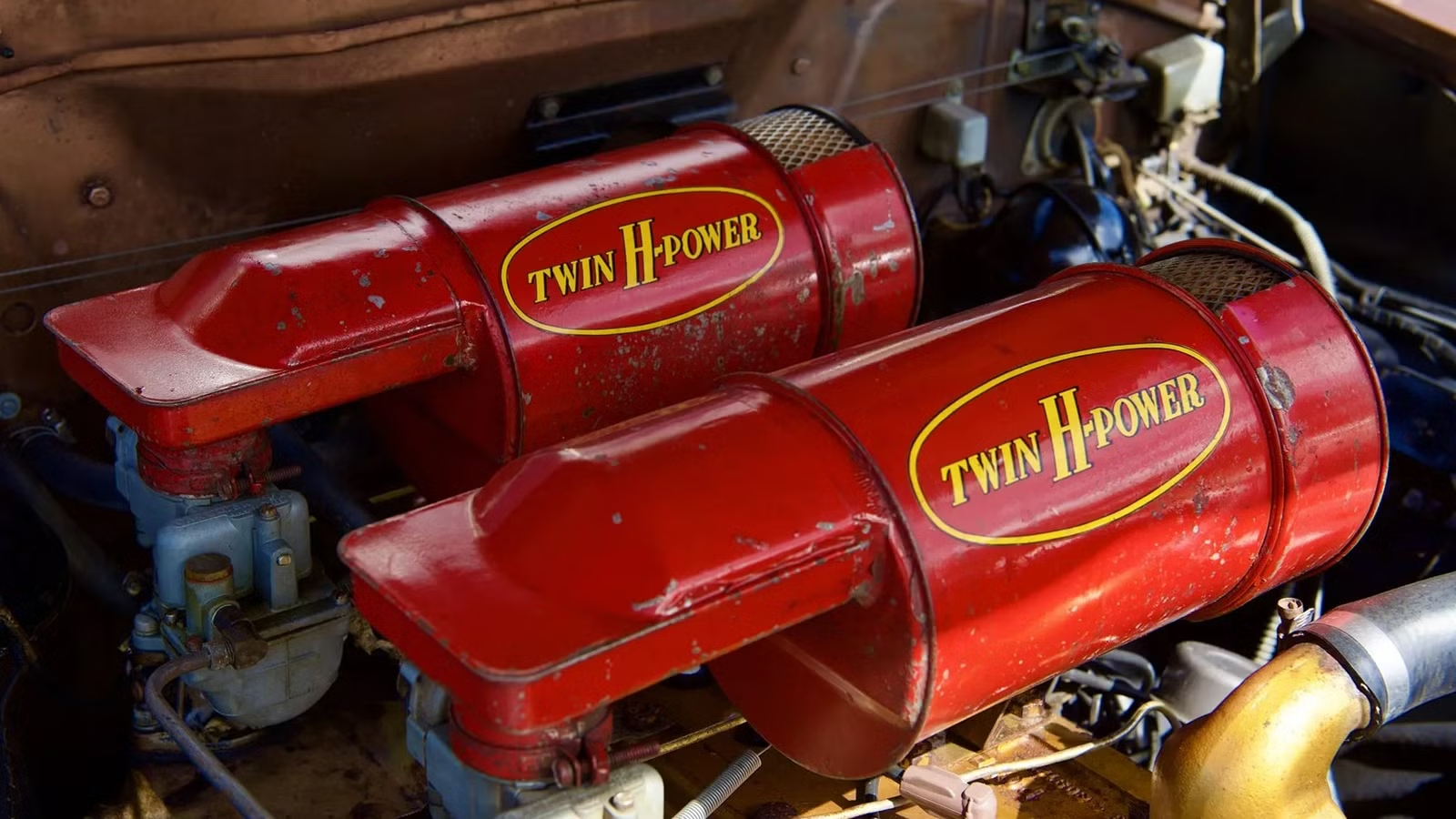
Driven by Marshall Teague and backed by engine builders like Smokey Yunick, the “Fabulous Hudson Hornet” was born. Hudson exploited the catalog loophole perfectly by introducing the “Twin H-Power” dual-carburetor, boosting the top end and increasing output to 170 horsepower. Hudson didn’t stop there; the company developed new parts, such as high-compression aluminum cylinder heads and heavy-duty suspension linkages, and stamped them with official factory part numbers to ensure they were fully street-legal under NASCAR regulations.
The 308 engine was built like an industrial power plant. It featured a high-chromium alloy engine block casting that resisted thermal warping far better than the V8 engines did. And its long 4.5-inch stroke produced massive low-end torque. This allowed drivers Herb Thomas and Marshall Teague to dominate the dirt tracks while their V8 rivals were struggling to get out of the corners. Between 1951 and 1954, Hudson captured over 80 overall NASCAR Grand National victories, while completely crushing the Big Three’s V8 efforts.
The Engineering Legacy That Transformed Motorsport Rules

NASCAR officials realized that Hudson’s catalog parts were purpose-built racing parts hidden in plain sight. Each time a technical inspector questioned a high-performance manifold or any other part, Hudson mechanics would simply pull out the catalogs and show that any average consumer could order the components. To stop this technical arms race, Bill France Sr. systematically rewrote the technical regulations.
In 1952, strict re-verification of “dealer-installed” performance parts meant that the H-Power kit options had to be factory-assembled, and not added at dealerships. The 1953 implementation of strict physical inspection of cylinder head casting numbers halted the use of unapproved, high-compression alloy racing heads developed under severe usage label. Finally, in 1954, formal tightening of homologation rules on body and engine components was put in effect to prevent small-volume independent manufacturers from using specialized low-production components.
The rewrites marked NASCAR’s transition from an era in which drivers drove their cars onto the track to a highly technical, stringently inspected sport. Track inspectors had to become technical experts, moving beyond just visual checks to measuring every inch and section, be it the cylinder heads, engine blocks, or chassis components. Hudson’s ability to engineer around the rulebook forced the inspecting body to develop precision tools. This established a new modern template for technical inspection.
Six-Cylinder Reminder That Smart Design Outlives Brute Force

The original Hudson Hornet commands an immense premium in today’s collector’s market. Vintage collectors recognize the historical gravity of the Step-Down design. They understand that the Hornet represents the exact turning point in history when racing shifted from a test of driver bravery to the battle of engineering prowess.
Hudson Hornet coupes and sedans equipped with authentic factory Twin H-Power systems can command anywhere between $40,000 and $80,000 for a clean example. Original models with documented “7-X” race-spec engine components command significant six-figure premiums. These 7-X variants feature larger valves, polished ports, and a relieved block; they were delivered directly from the factory and are considered the holy grail among collectors.
The Hudson Hornet stands as concrete proof that a race car did not need a V8 badge or aggressive body lines to be a foundational pillar of American performance history. A small engine with clever engineering can outrun a massive-displacement brute.
Source: Hudson, Bring a Trailer, Classic.com

Related posts




Latest Post


No Comments