
This New Harley-Davidson Softail Is The Post-War Classic No One Saw Coming
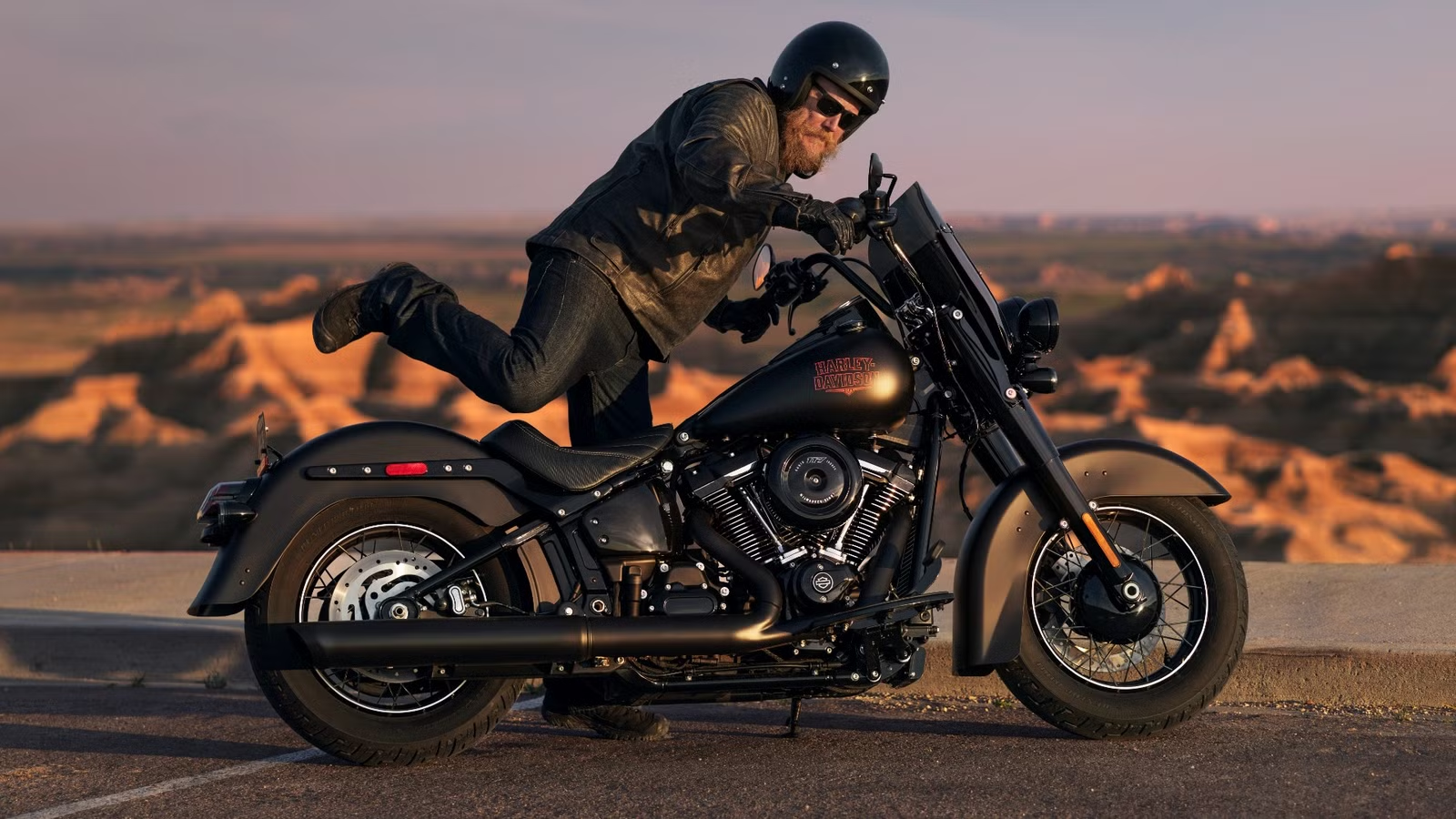
Being a Harley-Davidson fan in 2026 feels like a gift that keeps on giving. The brand kicked off the year by announcing several new full-dresser bikes and a price cut for some of its popular Softails. Then, it surprised us all with a mid-year addition in the form of the Super Glide, offering exceptional value compared to the bike it’s based on. That felt like the final MY26 announcement by the brand, but there’s been another surprise now. It’s a stripped-back cruiser that takes us back to the post-WWII era, while being based on the modern Softail lineup with the 117 V-twin powerhouse.
Harley-Davidson Played An Integral Role In World War II

We’ve seen Harley-Davidson produce several bikes that take us back to the post-World War era, and this isn’t random. It stems from the brand’s integral role in helping win the war by supplying thousands of bikes to the army during World War II. Around 90,000 units were supplied, all of which were the iconic WLA and WLC models. This helped the brand bag two Army Navy-E awards as well (for excellence in production).
During the time, Harley-Davidson also innovated new bikes to fit the army’s purpose better. This model was called the XA, and it took direct inspiration from the BMW R71. As such, the XA featured a shaft-driven, flat-twin powerhouse rather than a V-twin. It never entered production, however, as the WLA continued to dominate duties in varied conditions.

Post the Second World War, there was an uptrend in stripped-down machines to match army bikes. That’s because thousands of WLAs were sold to the public as government surplus. These were usually bought by returning soldiers and stripped down and modified for personal expression. That stripped-down aesthetic is exactly what H-D’s newest Softail aims to mimic now.

The 2026 Harley-Davidson Deadwood Boasts A Blacked-Out And Stripped-Down Persona

The newest Softail goes by the name Deadwood–a new moniker we’ve never seen Harley use. This takes inspiration from the post-WWII bikes, evident from its stripped-back aesthetic. Accordingly, there is no pillion saddle or skirtings, and the entire bike has a deep black finish (including the smoked windscreen). The orange tank graphics bring a subtle contrast to the mix.
Bjorn Shuster, Harley-Davidson Head of Design, explains:
The Deadwood motorcycle embodies that spirit of rebellion and individualism that was so prevalent following World War II, when many returning GIs rode a Harley-Davidson motorcycle to experience excitement and freedom. At that time, very few vehicles could match the thrilling performance of a stripped-down war-surplus Harley-Davidson. As designers, we find this era of customization and personalization, the early origins of the bobber-style custom, to be very inspirational. Our second key source of inspiration lies directly in the name Deadwood, a place linked to both the Sturgis Rally and to its own rebellious history. The graphic design for the tank art evokes a Western visual language that personifies that location.
The Deadwood Is Well-Priced In The Softail Lineup

The Deadwood is priced at $17,999, with only one color and trim option. Considering the mechanical package is based on the Heritage Classic, this is brilliant pricing. After all, you’re paying $2,000 less than the base Heritage Classic, while still getting bits like a special appearance, a tinted windscreen, and laced wheels. The latter is an optional extra for $850, as the Classic comes with cast wheels as standard. At the same time, there are no corners cut elsewhere. Here’s a lowdown on the nitty-gritty.
Powered By A Proven Milwaukee-Eight V-Twin Engine

The mechanical package is straight from the Heritage Classic. So you get the Milwaukee-Eight 117 engine here. This is its ‘Classic’ state of tune, comprising pushrod-actuated valves with hydraulic, self-adjusting lifters and a two-into-one exhaust. These help produce 98 horsepower and 120 pound-feet, all of which is down in the RPM range for tractability. 47 miles per gallon is the claimed mileage, and a six-speed transmission sends the power to the rear wheel. The Deadwood should be faster than the Heritage Classic, though, since the former weighs a sizable 33 pounds less fully fueled.
Double-Cradle Softail Chassis Joins Showa Suspension

In typical Softail fashion, the Deadwood has Harley’s double-cradle steel chassis to house the engine. This works in tandem with Showa 49 mm dual-bending forks and a Showa monoshock, where the rear has preload adjustability. 16-inch laced wheels, housing single disc brakes (300 mm front/292 mm rear), round things off.
While these are similar to the Heritage Classic, there are some dimensional differences. The most notable is the 25.5-inch laden seat height—almost an inch lower than the Heritage Classic. This is due to the new gunfighter solo seat and a shortened monoshock. Elsewhere, the length is 0.2 inches less, and the trail is 0.3 inches more. The five-gallon fuel tank capacity and 36.6-inch width remains the same, meanwhile.
Cornering-Enabled Electronics Are A Standard Inclusion

Finally, there’s the technology. This might be a retro homage, but you get all the modern tidbits we see on current Softails. It’s headlined by a six-axis IMU and ride-by-wire that gives you access to cornering ABS, cornering traction control, cornering drag-torque slip control, and ride modes. This is topped with all-LED lights, cruise control, a tire pressure monitoring system, and USB ports. As we mentioned earlier, the windscreen and laced wheels are also standard here.
What remains a bummer is the semi-digital instrument cluster mounted on the tank. Not only does this simply look dated in 2026, but it is also the same unit as the cheapest Harley today. A bit disappointing for a bike costing nearly $18,000. A circular TFT would be a better fit in our books.
Source: Harley-Davidson

Related posts
Latest Post


No Comments