
Aston Martin Valkyrie: Inside The F1-Bred Road Hypercar
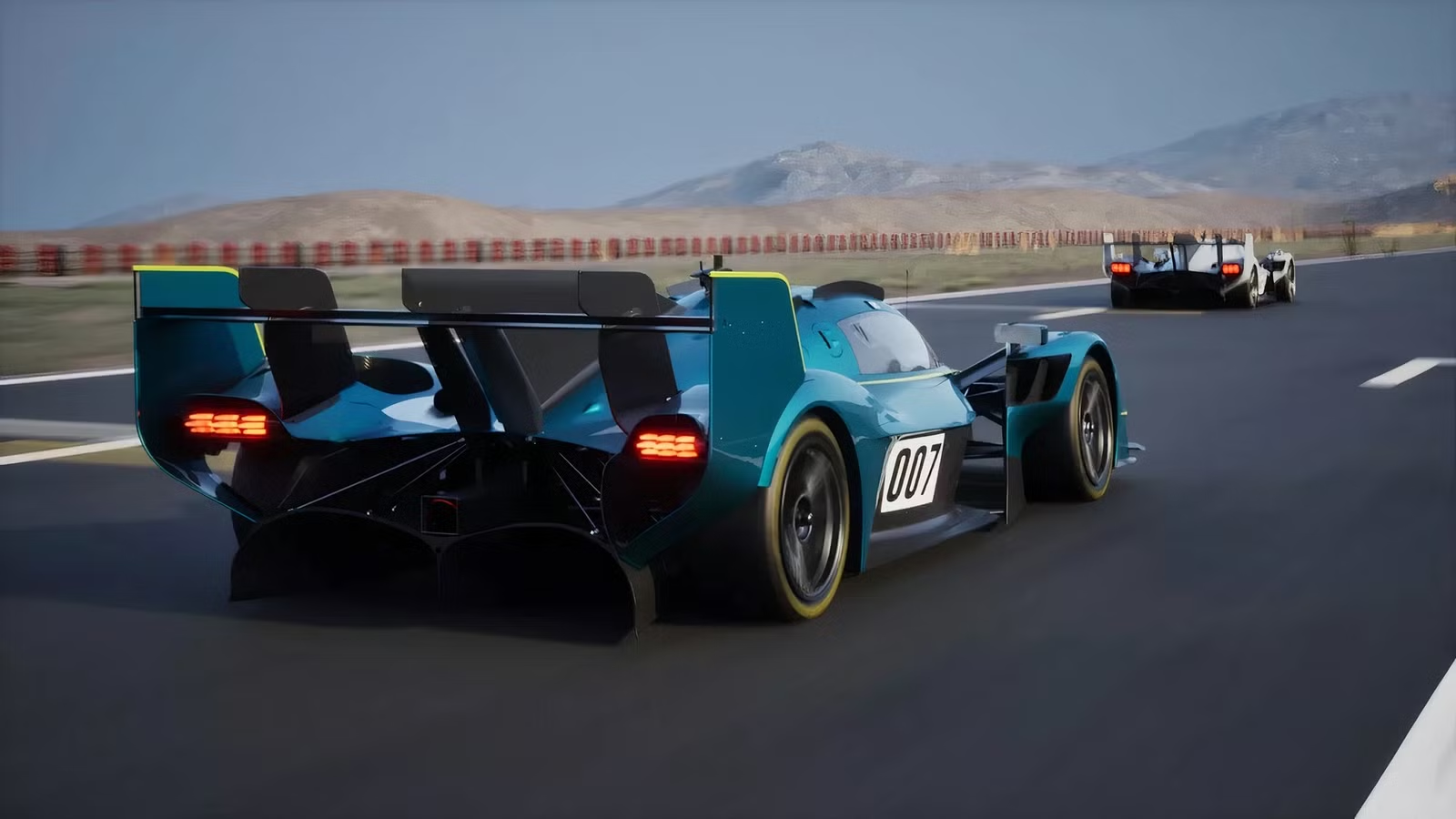
The Aston Martin Valkyrie may be the best British supercar/hypercar ever. It sounds brutal: a Cosworth V12 rockets it to 60 mph in less than 3 seconds, it sticks through the corners, and it sits at the crossroads of F1 culture and road-legal hypercars.

This meeting point can be seen as a natural progression of getting more speed and downforce into cars, as we have seen in everything from hatchbacks to SUVs, but is also largely thanks to the Adrian Newey effect.
Design Philosophy: F1 Aero Meets Road Reality
As Aston Martin’s recent Formula One designer, Newey has a lot to answer for: there are plenty of modern supercars that borrow ideas from motorsport, but few are made with the same aerodynamic priorities as a Grand Prix car.

The Aston Martin Valkyrie wasn’t built to resemble an F1 car, though, but engineered using the same aerodynamic philosophy. Rather than styling the body first and sorting airflow afterward, aerodynamics shapes the entire build.

According to Aston Martin, every intake, vent, tunnel, and body contour exists for a measurable engineering reason—whether that’s feeding cool air to the hybrid powertrain or increasing stability. Paired with the V12 and lightweight build, this hypercar is in a class of its own.
This design philosophy gives the Valkyrie a different feel from most hypercars, and instead of chasing the highest top speed, the Valkyrie engineering team has focused on creating extraordinary, usable performance through proper airflow.
Adrian Newey’s Approach

The Adrian Newey-Valkyrie partnership is about more than adding F1 looks and his F1 credibility. Newey has designed championship-winning cars by maximizing aerodynamic efficiency rather than simply increasing downforce, and the Valkyrie follows the same philosophy.
Ground-effect tunnels beneath the chassis generate enormous grip while producing far less drag than the conventional aero features you find on other supercars. Ground effect is also sensitive to ride height, so the Valkyrie’s suspension has to work with the whole aerodynamic package.

As you pin your foot in the Valkyrie, brake hard, and corner, the equally F1-inspired and intricate electro-hydraulic active suspension helps maintain the ideal aerodynamic platform, ensuring stable airflow beneath.
This all-around design thinking allows the Valkyrie to feel settled at speeds where most cars—even some of the most expensive hypercars—start to feel nervous, further proving that Newey’s design methodology is highly effective.
The Valkyrie’s Aero Language
Unlike many other hypercars that rely on massive rear wings, the road-going Valkyrie generates much of its downforce from underneath. Aerodynamic elements like active rear winglets adjust to help maintain stability; the open upper body helps generate downforce, and the F1-style cockpit is narrow, helping to reduce drag. However, it is the Venturi tunnels underneath that remain the showstopper, drawing in a huge amount of air to feed the rear diffuser.
There is fierce competition, but even up against the likes of the McLaren Senna and Ferrari LaFerrari, the Valkyrie produces more downforce. The Senna generates up to 800 kg at 155 mph, and the LaFerrari generates around 360 kg at 124 mph, which translates to an estimated 810 kg at 186 mph.

While that is some feat from both, the road-going Aston Martin Valkyrie can generate an extraordinary 1,100 kg of downforce, with peak downforce available from 137 mph to 220 mph. Aston Martin says it is also good for 3.3 g in corners.
Engine & Powertrain: The Cosworth 6.5L V12 and KERS-Like Hybrid

Instead of using downsized, turbo engines and artificial noise, Aston Martin went in the opposite direction, pairing one of the most advanced aerodynamic packages ever with a naturally aspirated V12 that feels like it belongs in an old-school racer and a hybrid system sitting between the engine and the Ricardo transmission.
Cosworth V12 Specifications

At the center of things is the Aston Martin Valkyrie Cosworth V12. This 6.5-liter naturally aspirated engine was developed by Cosworth with a lot of F1 wizardry. Aston Martin and Cosworth have focused on response, weight reduction, and a huge redline here.
The Cosworth RA V12 produces 1,000 horsepower and has an 11,100 rpm redline, making it one of the highest-revving production engines ever fitted to a road car. That screaming top end is a huge part of why the Valkyrie is such an animal. Power builds in a way that turbo engines cannot emulate, with the V12 getting even more aggressive as the revs climb.

It produces more than 150 horsepower per liter, which is exceptional any way you look at it. These kinds of figures are normally associated with racing engines rather than something designed for the road. Lightweight titanium connecting rods help to keep the engine’s overall weight down to just 454 pounds, and dry-sump lubrication means the V12 is lubricated during aggressive driving.
The Valkyrie’s exhaust note is one of its defining features, sending out a raw mechanical scream that rises through the rev range like that of an old-school F1 car. In an era dominated by electrified powertrains and turbo engines, this V12 provides the kind of drama fitting for such a machine.
Hybrid Boost System (KERS Inspiration)

The Valkyrie’s hybrid system is not designed to make it efficient or add a bigger horsepower figure, but it is there to make the Cosworth V12 even more responsive. With a design inspired by Formula 1’s Kinetic Energy Recovery System (KERS), the Integral Powertrain Ltd. setup uses electric assistance to bring forward the instant acceleration of a motor while keeping the high-revving character of an NA engine.
The system uses a rear-mounted MGU-K (Motor Generator Unit-Kinetic) paired with a lightweight battery pack provided by Rimac; together, they provide instant torque. Rather than replacing the V12, the electric motor fills in the lower rev range where a naturally aspirated engine generally produces less torque.

This means strong bite from a standstill, more aggressive acceleration out of corners, and sharper throttle response. The hybrid system provides the initial surge, and then the V12 takes over as the revs climb. The hybrid system also uses regenerative braking to recover energy during deceleration, storing it in the battery before using it for acceleration.
Performance Figures

If the Valkyrie Cosworth V12 horsepower wasn’t enough alone, the combined system output of 1,160 horsepower and around 664 pound-feet of torque should suffice. The Aston Martin Valkyrie 0–60 time is estimated at around 2.5 seconds, while it can reach 0–100 mph in 5.5 seconds.
The Aston Martin Valkyrie top speed is around 250 mph, which places it among the fastest road cars ever built. However, straight-line speed is not its main appeal; it is the fact that, thanks to its huge power output and F1-inspired aerodynamics, it can carry a huge amount of speed through corners.

Looking at the Aston Martin Valkyrie specs, it’s obvious that it was never just about getting the most horsepower out of the system; hypercars like the Venom F5 Evolution far trump it (2,031 horsepower), while the Mercedes-AMG One and Ferrari SF90 Stradale both take a very different approach to hybrid performance.
The Valkyrie delivers a connection between the driver behind the wheel, the engine, and the whole machine. The Cosworth V12, the Integral Powertrain Ltd.-designed hybrid rig, the Rimac battery pack, and the F1-inspired Newey-designed aerodynamics together make for an extraordinary combination.
Variants: Street Valkyrie vs. AMR Pro vs. LM

The Valkyrie may be a standout name, but there are a few variants of it. The standard version delivers road-legal Formula 1-inspired performance, the AMR Pro is for outright circuit performance, and the Le Mans-derived Valkyrie represents Aston Martin’s return to the pinnacle of endurance racing.
Standard Road Valkyrie

For something that looks like it just rolled out of the Silverstone pit lane, the standard Valkyrie is surprisingly usable. It gets LED lighting, reversing cameras, climate control, a front axle lift system, and a ride height mode to clear speed bumps without scraping the carbon fiber underneath.
The carbon fiber monocoque forms the interior structure, with lightweight seats fixed straight to the chassis in an F1-style seating position. Instead of moving the seats, you move the pedal box and steering column for adjustments.

A removable steering wheel houses the major controls, while digital displays replace mirrors with camera feeds. There is not much in the way of luxury, and every component has been designed to reduce weight and keep the experience driver-centric.
Aston Martin Valkyrie AMR Pro

The Aston Martin Valkyrie AMR Pro is what happens when Aston Martin removes the constraints of road-car homologation. It rides on a chassis with a 380 mm longer wheelbase and gets wider front and rear tracks, widened by 96 mm and 115mm, respectively.
It is also equipped with a more aggressive aero package, which includes a larger front splitter, larger Venturi tunnels, and an extended rear diffuser. The body is also extended by 266 mm and, thanks to the revised underbody tunnels and over-wing airflow, the AMR Pro generates twice the downforce of the road-going Valkyrie.

The hybrid system is removed to reduce weight and complexity, and the V12 runs without the road-use restrictions. With bespoke Michelin race slicks and track-focused chassis tuning, the AMR Pro’s advantage comes through cornering speed rather than just acceleration. It has been designed for those who want a genuine prototype-style driving experience without entering professional racing.
Le Mans Hypercar Program Connection

The Aston Martin Valkyrie LM is the next step in the Valkyrie’s racing philosophy. While the road Valkyrie was not created as an LMH homologation special, its focus on lightweight construction, aerodynamic efficiency, and race-inspired engineering provided a foundation for Aston Martin’s return to top-tier endurance.
This model is track-only and is configured to comply with FIA regulations, featuring redesigned front bodywork, full-length Venturi tunnels, and a large rear wing. Unlike the road car’s full-power V12/hybrid rig, the LM is limited to 697 horsepower, as FIA regulations dictate.

Lessons learned from endurance racing and developments in thermal management and aerodynamics fed straight into building the original Valkyrie; now, the road-going Valkyrie has become the foundation, and the LM has become Aston Martin’s bridge between road and race programs.
Pricing, Allocation, And Ownership Reality

The Valkyrie was never built to be obtainable nor designed to be a typical supercar purchase. It is Aston Martin’s ultimate engineering showcase, and the price reflects its performance, complexity, how long it took to create, engineering prowess, and exclusivity.
MSRP and Cost Structure
The original Aston Martin Valkyrie price, before the end of production in 2024, was $3 million before any personalization. Extras originally included specialized lightweight paint, custom harnesses and trims, exposed carbon fiber, the Gold Pack (which includes 24-carat gold leaf livery), and titanium badging.
The original Valkyrie MSRP structure is as follows:
- Valkyrie Coupe: $3 million.
- Valkyrie Spider: $3.5 million.
- Valkyrie AMR Pro: $4 million.
Final prices often stretched above $4 million because of high demand, reliability gremlins, and bespoke additions. The newer Aston Martin Valkyrie LM is even more expensive, with a starting price of between $6.5 and $7 million.
Production And Allocation

A total of 285 Valkyrie hypercars were made. There are 150 coupes, 85 open-top Spiders, 40 AMR Pro models, and 10 Valkyrie LM models.
Unlike some supercar purchases, buyers could not simply walk into a dealer, configure one, pay, and wait. Valkyrie ownership was more exclusive, with Aston Martin originally managing allocations through its global dealer network, with many models going to existing customers and collectors who already had a relationship with them.

Low production numbers also mean that, even among other hypercars, they are rare. Each model required specialist assembly, with deliveries slowly rolled out predominantly across the UK, U.S., and Europe. In short, it was never about having the budget for one, but more about securing one of the few build slots.
Ownership Considerations

A recent report by Bloomberg suggests that it will cost you up to $450,000 to service and maintain over three years. There was originally a service plan available, which brought that figure down to $340,000 over three years, but either way, that is a lot of money.
Spare parts are also restricted, with availability mainly through Aston Martin’s “Q by Aston Martin” division. Prices have not been released, but it is safe to presume that, given the nature of the Valkyrie, no parts will be cheap. Plus, with a computer with 15,817 individual adjustable electronic parameters, there have been some electrical issues reported.

While insurance premiums vary depending on location and driving record, annual insurance for the Valkyrie is exceptionally high regardless of location and ranges between $15,000 and $40,000. Fuel consumption is also very high. No official figures have been released, but on a good day, it is estimated that the Valkyrie can achieve 11 combined mpg.
Whether buying a Valkyrie is a practical investment or not is a question of how much you are using it. Used examples are low-mileage, and according to Classic.com, just three have been sold in the last year, with an average auction price of $3 million. However, that reasonable used price doesn’t account for how much it would cost to own one. The Valkyrie should be seen as a passion purchase in 2026 for its rarity and performance, but as examples get older, values could climb even further.
Performance On Road And Track
Real-World Acceleration And Speed

Aston Martin’s 2.5-second 0–60 mph claim is fast, but that figure has been proven to be understated. MotorTrend tested a Valkyrie and recorded a 0–60 mph time of 2.2 seconds, also calling it the most extreme car the tester had ever driven.
Steering is described as exceptionally responsive in the corners, while the traction generated by the Newey-esque aerodynamics is impressive, but only above a certain speed threshold.
Track Capability

The MotorTrend test drive reported that the aerodynamics only really come alive at over 62 mph; under that speed, they don’t do a lot. On a track with tight corners that keep speeds below 62 mph, there is some chance of inducing oversteer.
The test also found that such oversteer is easy to correct, courtesy of the quick steering ratio and traction control system. However, above 62 mph, the Valkyrie is truly stuck to the tarmac.

At these higher speeds, the Valkyrie’s cooling system comes into its own as well. The large side intakes, roof scoops, and managed airflow do not just generate enormous downforce, but also channel air to the V12, hybrid rig, and brakes. It is, in truth, a thinly veiled race car.
Road Manners

Despite the F1 seating position in the cockpit, the stripped-back interior, and the extraordinary amount of power on tap, the Valkyrie has been described as surprisingly pleasant to drive away from race circuits, albeit somewhat alien.
The V12 provides a linear throttle feel and does not get peaky at low speeds; the sequential transmission is smooth and will downshift automatically if needed; the ergonomics are well-considered, and the active suspension combined with hydraulic torsion bars and pushrod dampers offers a fluid feel.

The main complaints include cabin noise at speed, a large turning circle, tires that require warming up before spirited driving, and a tightly packaged powertrain that occasionally blows hot air into the cabin in traffic. The attention from onlookers is also considerable.
The Valkyrie’s Legacy And Position

The Aston Martin Valkyrie matters to the market because it changed the perception of what a hypercar could be. Plenty of marques borrow cues from motorsport, but Aston Martin started with F1 engineering and worked backwards. Adrian Newey’s obsession with airflow, lightweight construction, and aerodynamic efficiency shaped every part of the car, proving that performance doesn’t have to come from power alone.
This philosophy has now made its way into the non-road-car variants. The Valkyrie is the foundation for Aston Martin’s return to endurance racing, while its development continues to influence the brand’s high-performance models. So, is the F1-bred label justified? Not in the literal sense: the Valkyrie is not an F1 car with license plates. However, the way it prioritizes aerodynamics, packaging, and engineering over everything else makes it closer to an F1 car than almost any road car ever built.
Sources: Aston Martin, Bloomberg, and Classic.com.

Related posts




Latest Post


No Comments