
The Luxury Coupe That Outsprinted Most Sports Cars In Its Day
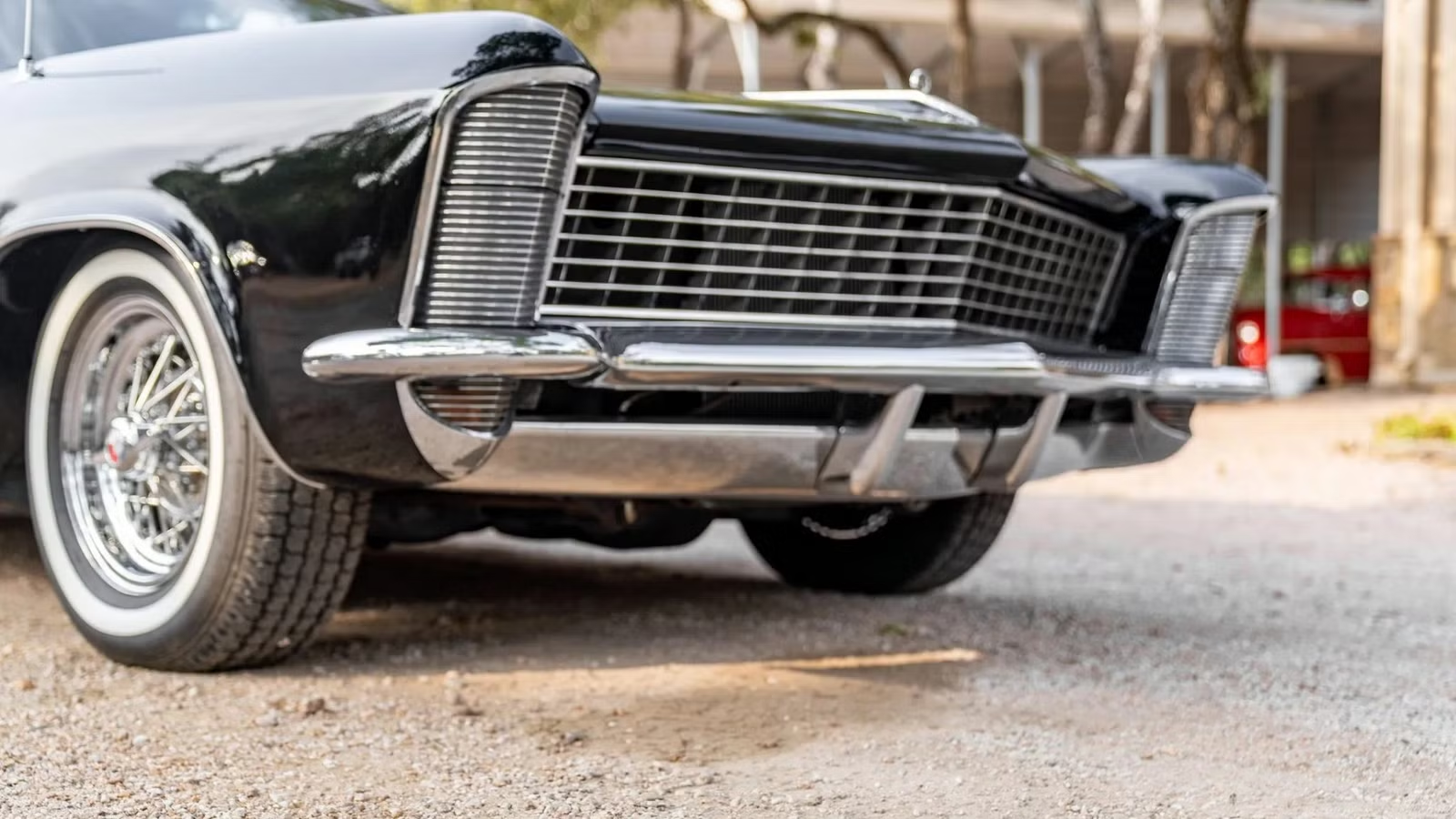
A long, low luxury coupe rolls to a stop with the calm of a car headed for a hotel entrance. It has no racing stripes, no hood scoop, and no loud exhaust warning everyone nearby to prepare for trouble. Then the light changes. More than two tons of polished steel leap forward, reaching 60 mph in about seven seconds. In 1965, many true sports cars could not match that pace. But a single model could do it while carrying four people, an automatic transmission, air conditioning, and enough cabin trim to furnish a small cocktail lounge.
In The 1960s, Speed Usually Came With Sacrifices

Sports cars of the early 1960s followed a clear recipe. They sat low, kept their wheelbases short, and carried as little weight as possible. Most offered two useful seats, a small trunk, firm springs, and a manual gearbox. Their cabins often placed function ahead of comfort. Thin doors, basic ventilation, heavy controls, and steady engine noise counted as part of the experience. Buyers accepted those flaws because sharp steering and light weight made the cars fun.
Personal-luxury coupes lived at the other end of the showroom. Cars such as the Ford Thunderbird, Pontiac Grand Prix, and Oldsmobile Starfire sold an image of relaxed success. Their long hoods, rich cabins, power accessories, and large engines promised easy highway miles. Drivers expected an automatic transmission, light steering, soft seats, and enough sound insulation to keep the outside world outside. Performance mattered, but it usually meant smooth passing power rather than a hard launch.
Size also set limits. A large coupe carried far more steel, glass, insulation, and interior hardware than a small roadster. Soft suspension tuning allowed weight to shift during hard acceleration, while narrow period tires struggled for grip. Tall axle ratios helped quiet the engine on the highway but dulled the launch. Four-wheel drum brakes also encouraged a sensible amount of restraint. Some luxury cars had huge V8s and impressive horsepower claims, yet few could challenge a serious sports car from a standing start. That gap made one quiet American coupe especially strange. It followed nearly every luxury-car rule, then broke the most important one.

The Fastest Car At The Stoplight Did Not Always Look The Part

The mystery coupe had the shape of a concept car that had somehow escaped into regular traffic. A long hood led into a low roof, a short rear deck, and crisp body sides with little visual clutter. The roof seemed to float over the doors because the body lacked a fixed center pillar. Its nose looked clean and formal, while carefully hidden lamps kept normal hardware from spoiling the lines. The car stretched more than 17 feet from bumper to bumper, yet its proportions stopped it from looking clumsy. It had presence without wearing a chrome costume.
Nothing on the body shouted about racing. There were no stripes over the roof, no giant hood bulge, and no exhaust tips large enough to swallow a grapefruit. Small emblems offered the only clear warning. Inside, the driver faced proper round instruments, bucket seats, a center console, and wood-style trim. The cabin looked more suited to a late dinner reservation than a starting line. Even the transmission selector controlled an automatic.
Its mass made the performance even harder to believe. Depending on equipment and the test scale, the coupe carried roughly 4,100 pounds before passengers and luggage joined the trip. It also measured 209 inches long and rode on a 117-inch wheelbase. Physics had not taken the day off here. Engineers simply gave physics a much larger engine to argue with.
The 1965 Buick Riviera Gran Sport Was Fast And Beautiful

|
Engine |
Power |
Torque |
0-60 MPH |
Top Speed |
|
425-cu-in V8 |
360 hp |
465 lb-ft |
About 7.0 seconds |
125 mph |
The car was the 1965 Buick Riviera Gran Sport, the hottest form of Buick’s first-generation personal-luxury coupe. The Riviera already ranked among Detroit’s boldest designs. General Motors design chief Bill Mitchell wanted a car that mixed European grace with American presence, and the production model arrived for 1963 with sharp edges, frameless side glass, and almost no needless decoration. For 1965, Buick finally added the concealed headlights Mitchell had wanted from the start. One electric motor opened the ribbed clamshell doors at the front corners. Since Buick redesigned the Riviera for 1966, those dramatic headlight covers lasted for only one model year. They also tended to protest when owners forgot to lubricate their linkages. Beauty has always required maintenance.
The Gran Sport option changed far more than the badges. For $306.38, Buick added the dual-carburetor Super Wildcat engine, a modified transmission, freer-flowing exhaust pipes, a limited-slip differential, and a 3.42:1 rear axle. The package also brought special wheel covers and restrained Gran Sport emblems. Buick built 3,354 examples, or fewer than one in ten Rivieras that year. Another 454 regular Rivieras received the same dual-carburetor engine without the full Gran Sport option, which means a pair of carburetors alone does not prove that a surviving car left the factory as a Gran Sport.

The main attraction carried an official name almost as large as the engine itself: the 425-cubic-inch Super Wildcat V8. Enthusiasts call the engine a Nailhead because its small vertical valves resembled nails, though Buick never used that nickname in its sales material. The design favored strong torque at everyday engine speeds rather than wild high-rpm breathing. Two Carter AFB four-barrel carburetors sat under a wide, twin-snorkel air cleaner. Buick rated the engine at 360 SAE gross horsepower and 465 lb-ft of torque, with peak torque arriving at only 2,800 rpm. Gross horsepower figures do not compare directly with today’s stricter net ratings, but the stopwatch removed any doubt about the engine’s strength.
Period testers recorded 0–60 mph runs of roughly 7.0 to 7.2 seconds. The quarter-mile took about 15.4 to 15.5 seconds at 92 to 95 mph. Those numbers placed the Riviera beside some of the finest sports cars of the year. Car and Driver recorded 7.0 seconds to 60 and a 15.6-second quarter-mile for a 1965 Porsche 911. Motor Sport measured a 4.2-liter Jaguar E-Type at 7.2 seconds to 60 and 15.0 seconds through the quarter. An Austin-Healey 3000 Mark II needed 10 seconds to reach 60. The Buick could not beat every exotic, but it could run with the elite and outrun much of the sports-car field.

Straight-line pace alone, however, does not explain the car’s appeal. Plenty of Detroit machines could run hard after someone stuffed a large engine into a lighter body. The Riviera Gran Sport took a harder path – it kept the style, quiet ride, solid structure, and rich cabin that made the standard Riviera special. Its speed felt almost out of character, which gave every full-throttle run more drama. A loud muscle car beating a roadster made sense, but a formal Buick doing it while its clock ticked calmly in the dashboard felt like the bank manager winning a bar fight without wrinkling his suit.
Delivering Speed Without Giving Up The Luxury Experience

The cabin played a major role in that split personality. Front bucket seats placed the driver low enough to feel part of the car without forcing the knees toward the chest. A full center console divided the seats and carried the automatic shifter. Buick used a textured black instrument panel, clear round gauges, thick carpet, chrome details, and wood veneer across the console and door panels. The materials looked rich but avoided the glitter overload found in some other American cars. Interestingly, Buick did not offer leather upholstery on the 1965 Riviera – buyers chose vinyl or an optional Beaumonde cloth-and-vinyl trim.
Comfort equipment could turn the Riviera into a rolling lounge. Buick made a tilt steering column and front seat belts standard for 1965. Buyers could add air conditioning, power windows, power vent windows, a power-adjustable driver’s seat, cruise control, an AM/FM radio, tinted glass, and automatic headlight dimming. Air conditioning appeared on 69 percent of the cars, while nearly three-quarters received power windows. The rear seat offered less legroom than the car’s outer size suggested, but the Riviera still carried people and luggage with far less fuss than a two-seat roadster.

The Riviera still carried limits that no badge could erase. Car and Driver weighed its test car at 4,166 pounds. Buick used large aluminum-finned drum brakes at all four corners, and although period testers praised their power, repeated hard stops could never match the fade resistance of four-wheel discs. The car felt stable in fast bends, but tight corners exposed strong understeer and the burden of all that steel. Crosswinds could also push it around.
Of course, a lighter Porsche or Jaguar offered more direct steering, stronger braking, and greater balance on a twisting road. But Buick never needed the Riviera to defeat every sports car in every setting – its achievement came from offering similar acceleration without the cramped cabin, hard ride, heavy clutch, noisy cruise, or tiny luggage bay. That made it an early version of the modern grand tourer – fast enough to thrill, comfortable enough to cross a state, and stylish enough to make the trip feel important.
The Riviera Gran Sport Made Luxury And Performance Equals

The 1965 Riviera Gran Sport could glide toward a formal entrance, idle with barely a shake, and then leave a stoplight with enough force to rearrange the luggage. Its clean shape made that contrast stronger – a scoop-covered muscle car announced its plans from half a block away, but the Riviera kept its plans private until the driver pressed the accelerator. Even its dual carburetors hid beneath one polished air cleaner, like two troublemakers sharing a respectable hat.
That surprise appearance explains a lot. A seven-second run to 60 placed a two-ton automatic Buick beside the Porsche 911 and Jaguar E-Type in period tests, while cars such as the Austin-Healey 3000 and many smaller British roadsters fell well behind. The quickest Corvettes and high-end exotics could beat it, especially once the road started to turn. Most sports cars of that era, however, could not combine comparable stoplight speed with the Riviera’s quiet ride, power accessories, usable cabin, and commanding shape.
Later manufacturers turned that same idea into a major part of the performance market. American luxury coupes gained stronger engines and firmer chassis tuning. European brands added larger grand tourers that mixed speed with leather-lined comfort and automatic transmissions. Modern performance coupes now treat effortless acceleration and luxury as natural partners. The Riviera Gran Sport reached that answer in 1965, using hidden headlights, two carburetors, and a V8 large enough to have its own ZIP code.
Source: Buick, Car and Driver

Related posts

Latest Post


No Comments